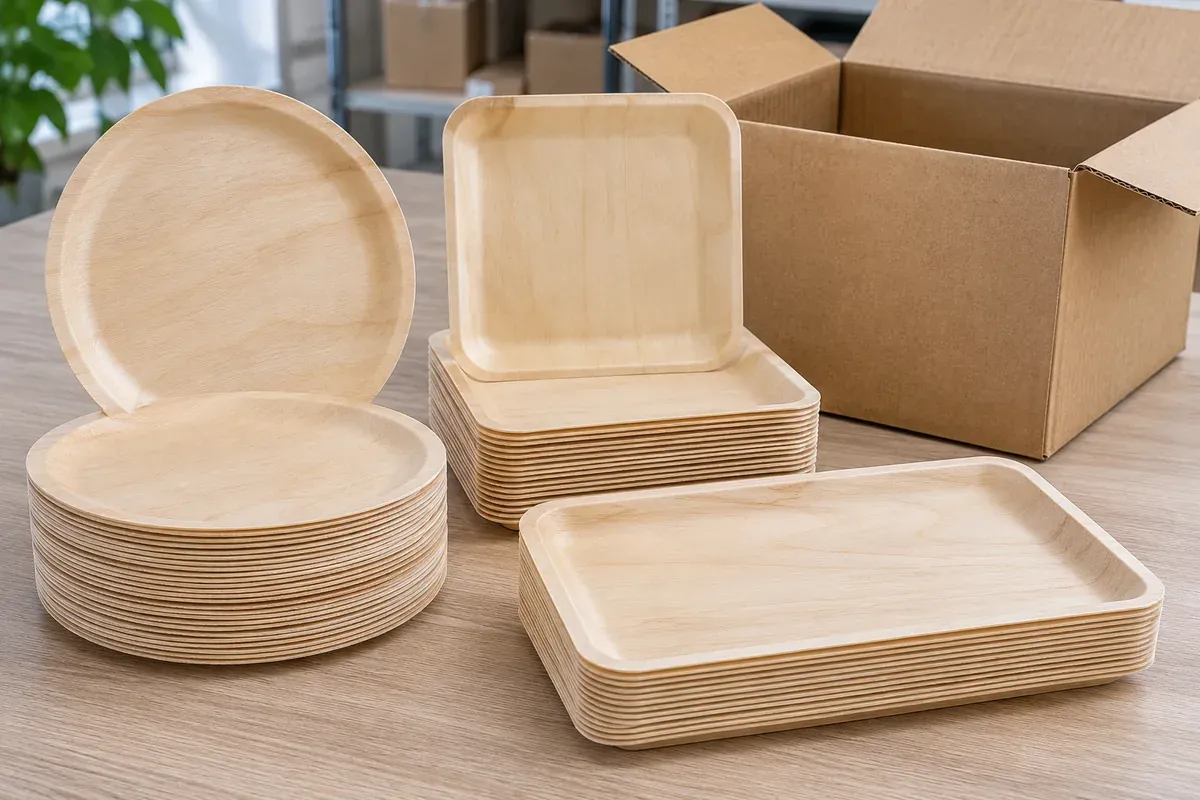
Bulk Disposable Wooden Plates: Sizes, Pack Counts and Quote Checklist
Two quotes for “8-inch wooden plates” can describe different products. One supplier may mean the outside diameter, another the usable flat area. One may quote loose pieces in a master carton; another may include sealed inner packs and a retail sleeve. Before comparing prices, get the plate drawing and the packing equation onto the same page.
This guide is for importers, caterers, foodservice distributors, event suppliers and private-label retailers buying bulk disposable wooden plates. It focuses on the decisions that make a quotation usable: shape and size, the food the plate will actually hold, pieces per inner pack, inner packs per carton, and what is included in the price. EcoWoodPlate lists a disposable wooden plates and cutlery set as a product family; final configurations, MOQ and lead time are confirmed by quotation rather than one public number.
Begin with the food and serving route
A small tasting plate, a plated dessert and a full event meal do different jobs. Send the supplier the menu or a representative serving, not just a diameter copied from another listing. Ask whether the customer will carry the plate through a buffet, eat with a knife and fork, or set it on a table. Moist or oily food, serving time and temperature matter when choosing a plate and any surface treatment. A product that works for a dry pastry sample should not be assumed to suit a sauced main course.
Keep reusable wooden dinnerware out of this comparison. Disposable formed-wood plates are thinner, stack and pack differently, and are normally specified for single-use service. If a supplier shows a heavy turned serving tray as the sample, stop and clarify the product category before asking for a bulk price.
Measure the plate the way a buyer will use it
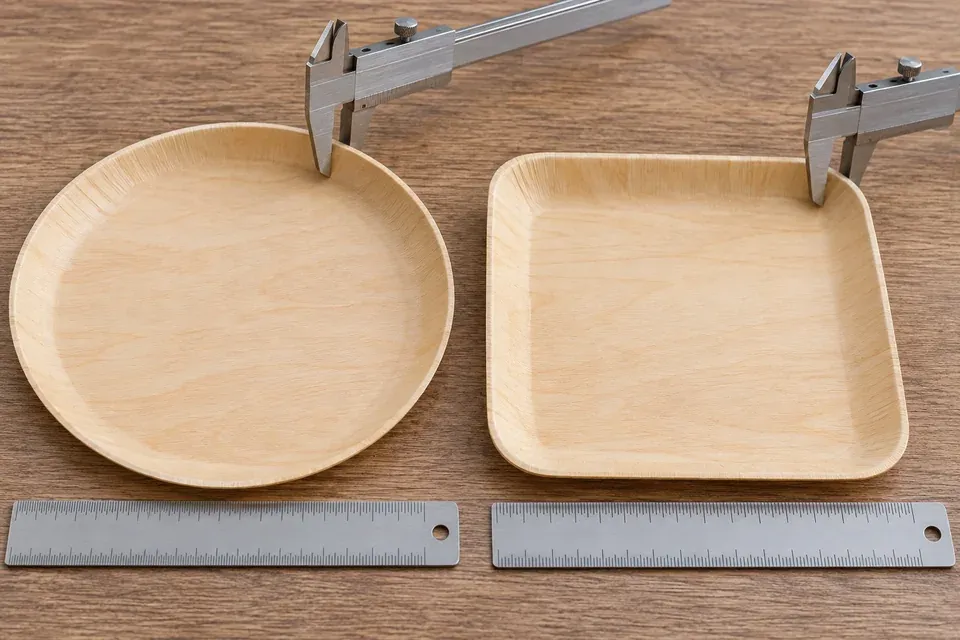
For a round plate, specify outer diameter, usable flat area inside the rim, rim height and material thickness or construction. For square and rectangular formats, give outside length and width, inside serving area, corner shape and depth. The outside dimension determines shelf and carton fit; the flat area determines whether the intended food or cake board actually sits safely. Request a drawing with tolerances where the fit matters, then verify those points on a physical sample.
As an illustrative RFQ example only, a buyer could request a round plate with an 8-inch outside diameter and ask the factory to report the usable flat diameter separately. “8 inches” alone is not an approved SKU specification. The same principle applies when a buyer wants to combine plates with cutlery: define the plate and each utensil as separate line items, even if they will ship as a set.
Choose the material and finish with the use in mind
Thin wooden plates are commonly made from formed wood veneer; the available species and construction depend on the supplier and design. If you want birch, poplar or another material, name it in the brief and ask how the selected material is sourced and processed. Do not assume that a photograph identifies the wood. Confirm any coating, oil, barrier layer or absence of added finish for the exact item.
For food-contact purchasing, ask for the documentation relevant to the intended market, food type and use conditions. EcoWoodPlate's product information invites buyers to request applicable food-contact test documentation for the selected product; that is a request to verify a specific SKU, not a blanket certification claim. Sample inspection still matters: look at the food-facing surface, rim, trimmed edges, odor, visible defects and how neatly a stack separates. Set the acceptance criteria before the bulk run.
Write the pack count as an equation
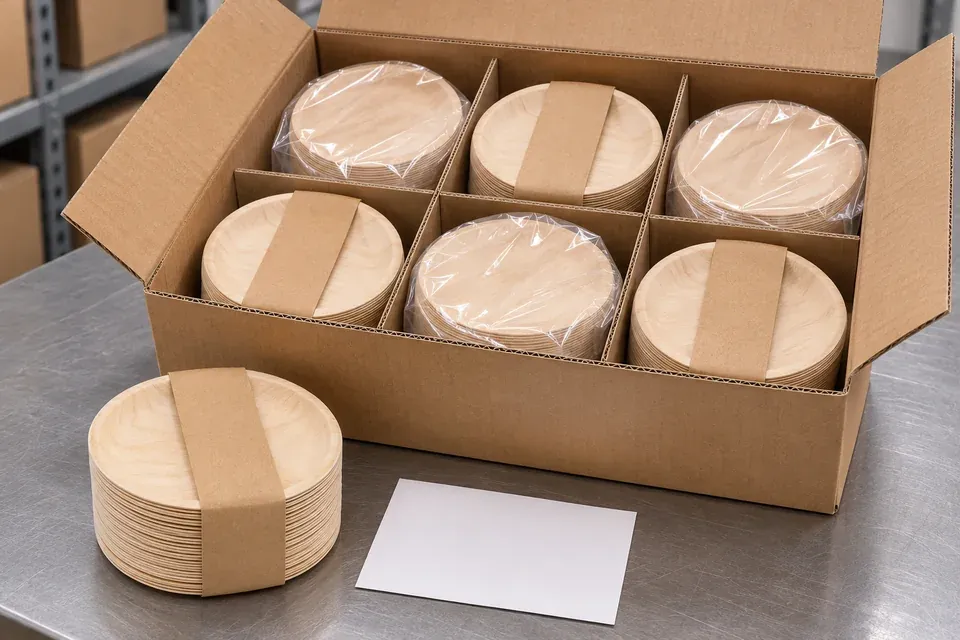
“200 per carton” is not enough if the distributor expects 25-piece packs that can be pulled from a shelf. Specify the whole hierarchy: plates per inner pack × inner packs per master carton = plates per master carton. State whether an inner pack is a clear wrap, kraft band, paper sleeve or printed retail pack. Ask whether mixed sizes can share an export carton; if yes, require a clear SKU map and outer-carton mark.
Here is a planning example, not an EcoWoodPlate standard pack: 25 plates per inner pack × 8 inner packs per master carton = 200 plates per carton. A planned order of 6,000 plates would therefore require 30 cartons before any overage, sample allowance or order-multiple adjustment. If the buyer actually needs 50-piece shelf packs, the carton plan and packaging cost must be recalculated. This simple equation catches more quoting errors than a long email about “bulk packaging.”
Ask for the packed carton dimensions and gross weight after the sample pack-out. Those numbers matter to warehouse slots, parcel fulfillment, container planning and landed-cost calculations. Do not infer them from the bare plate diameter. A protective inner wrap can change both stack height and carton count.
What production and inspection should cover
For formed wooden plates, the manufacturing route may involve material selection, cutting blanks, forming or pressing, trimming edges, surface inspection, counting and packing. The exact machinery and process should be confirmed for the offered design. The purchasing team does not need a dramatic workshop story; it needs to know where size, rim integrity, surface condition and count are checked.
Ask for an agreed sample showing the acceptable wood appearance and edge finish. If the plate is nested tightly, check that one plate can be removed without tearing the next. If the plate has a shallow rim, check that the shape is consistent across the stack. When the order includes forks, knives or spoons, verify the count for each part of the set, not only the plate quantity. Incoming material inspection, forming checks and a pre-shipment carton sample are different control points; one final photo cannot replace them.
OEM packaging and artwork change the quote
Private-label buyers may need a logo on the outer sleeve or carton, a barcode, a language panel, a retail insert or a cutlery bundle. Some ask about logo printing on the plate itself. Treat these as separate requests until the supplier confirms which method is suitable for the material and intended food use. Approve print placement and sample appearance before mass production. A plate-size change may also force a new sleeve, stack height or master carton.
Ask for a plain bulk option and a branded retail-pack option in separate quote lines. That makes the added packaging cost visible and avoids comparing two unlike offers. The EcoWoodPlate OEM/ODM service page describes the customization inquiry route; a final proposal should still name the exact plate, pack and artwork revision.
A quote checklist buyers can paste into an RFQ
| Field | What to provide or request |
|---|---|
| Use and market | Menu/food type, serving duration, destination country, applicable documentation request. |
| Plate specification | Shape, outside size, usable area, rim depth, material, finish, sample reference. |
| Quantity | Pieces per SKU, trial or repeat-order expectation, permitted assortment mix. |
| Inner pack | Plates per pack, wrap/sleeve style, label, barcode and language. |
| Master carton | Packs per carton, total plates per carton, carton dimensions, gross weight, marks. |
| Commercial basis | Price basis and currency, MOQ by SKU/pack, sample charge, lead time, trade term, shipment point. |
| Approval | Drawing, physical plate sample, fully packed sample, artwork revision and QC acceptance points. |
When comparing quotes, normalize to the same unit: price per plate for the same specification and packing, plus the cost of the chosen retail pack and freight basis. A lower piece price may be offset by a bigger carton, extra repacking or an unsuitable pack multiple. The general disposable wooden plates wholesale guide covers the wider sourcing decision; this checklist is for making the actual quote comparable.
Sample and MOQ questions worth asking early
Ask whether a stock sample matches the quoted material, size and finish. A stock sample can show basic plate feel, but it cannot approve a custom inner pack or printed sleeve. Request one fully packed sample once the configuration is settled. Confirm whether the quoted MOQ applies per plate shape, per size, per printed pack or across a mixed order. Do not assume that an MOQ from another supplier or product page carries over to this project.
For export, agree how cartons are sealed, marked and protected from crushing or moisture during the planned route. Check the first packed cartons against the signed pack-count equation and retain the SKU label and packing-list version. Seasonal buyers may also need a delivery-backward schedule; our holiday-events plate guide treats that separate planning problem.
FAQ
What sizes should I ask for in a bulk plate quote?
Give the intended food and ask for outside dimensions, usable serving area and rim depth for each candidate. Do not select by an inch label alone.
What is the difference between pack count and case count?
Pack count is the number of plates in one inner or retail pack. Case count is the total in the master carton. Request both, plus the number of inner packs per carton.
Can plates and cutlery be quoted as one set?
Yes, if the factory confirms the configuration. Define the count of plates, forks, knives and spoons in each set and the number of sets per carton so nobody interprets “200 pieces” differently.
Can a custom logo or retail sleeve be added?
Packaging and branding can be discussed, subject to the selected material, method and order quantity. Approve artwork and a physical packed sample before treating the branded version as the same SKU as a plain bulk pack.
How do I confirm food-contact suitability?
Describe the destination market and intended contact conditions, then request the applicable documentation for the exact selected plate and finish. Do not rely on a general website badge or a different material's test report.
EcoWoodPlate, operated by Cao County Puchuang Wood Industry Co., Ltd., can review a defined disposable-plate project with importers and private-label buyers. If you are comparing a Chinese wooden products manufacturer or an OEM wooden products supplier, send the plate shape, serving use, required quantity, inner-pack count, carton plan and destination through ecowoodplate.com/contact. A custom wooden products factory can give a more useful answer when the quote checklist is complete; for bulk disposable wooden plates, the pack equation is part of the product.
Need Factory Direct OEM/ODM Pricing?
Send your product, quantity, logo, packaging and destination country. Our factory team will reply with quotation guidance.
Request Factory Quote