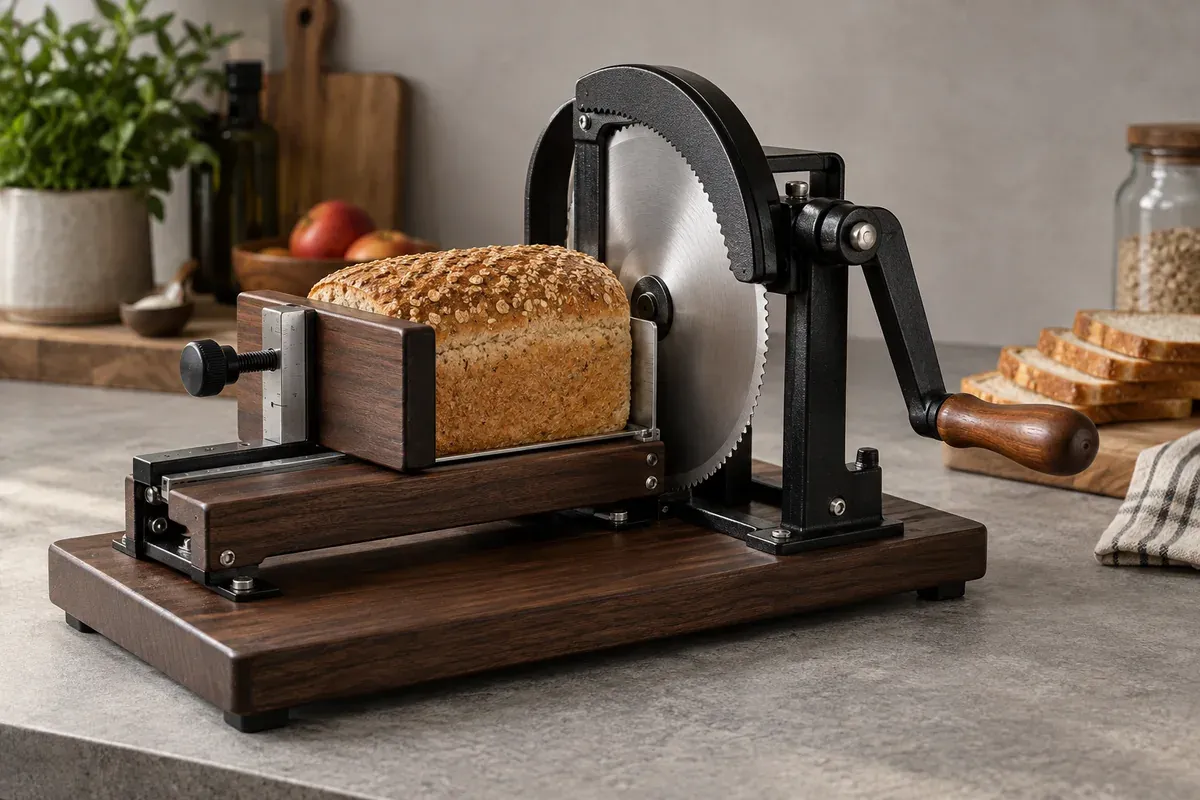
A wooden bread slicer with hand crank turns hand power into a controlled cutting path. How does it work in practice? The crank rotates a circular blade through a shaft. A loaf sits on a carriage or feed surface, a thickness guide sets the distance to the blade, and a guard helps keep the operating area defined. The wood is the structure around the mechanism: it supports the carriage, holds the upright frame and gives the product its countertop character.
That is the short answer. For an importer or private-label buyer, the more useful answer is that the crank, blade, carriage, thickness stop, slice guide and crumb path have to work as one system. If one part is poorly placed, the product can still look good in a photo and disappoint when a customer tries to slice a real loaf.
The parts that do the work
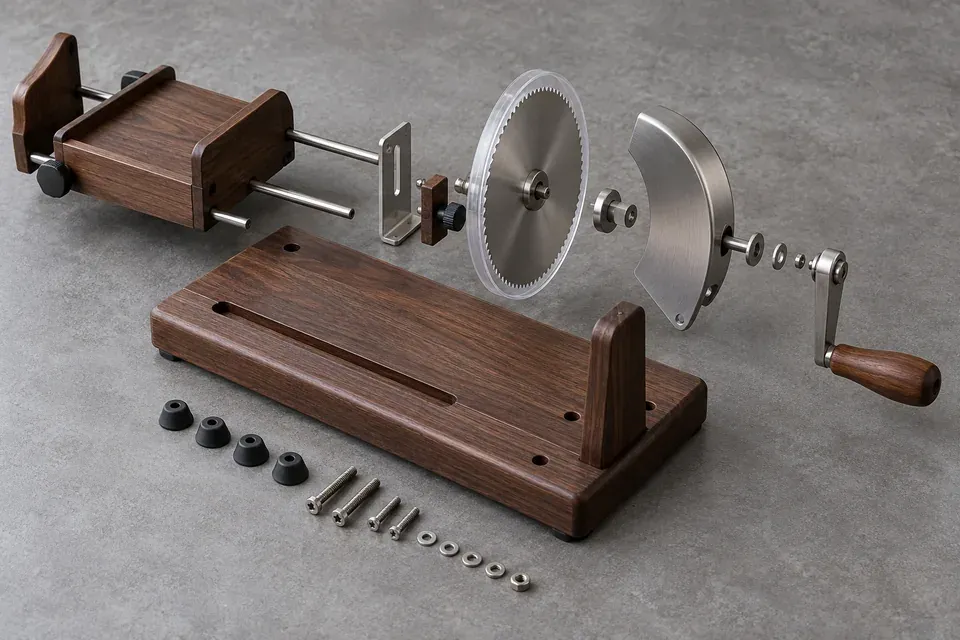
Manual bread slicers vary in shape, but a rotary hand-crank model usually contains the same functional groups. The current EcoWoodPlate product page for SKU k005 describes a wooden base, stainless-steel blade, metal guard and hand crank. Buyers should confirm the final bill of materials for their own project, because small changes to the shaft, guide or packaging can change how the product feels and ships.
| Part | What it does | What a buyer should notice |
|---|---|---|
| Wooden base and upright | Carries the carriage, blade frame and feet | Flatness, stable fastener points, sanding and wood movement around hardware |
| Crank and shaft | Transfers hand rotation to the blade | Smooth rotation, handle retention, shaft play and clearance around the handle |
| Circular blade and guard | Creates the cut while the guard defines the exposed area | Approved part specification, alignment, guard fastening and protected packing |
| Carriage and thickness stop | Places the loaf and sets the blade-to-guide gap | Travel, stop repeatability, loaf support and adjustment method |
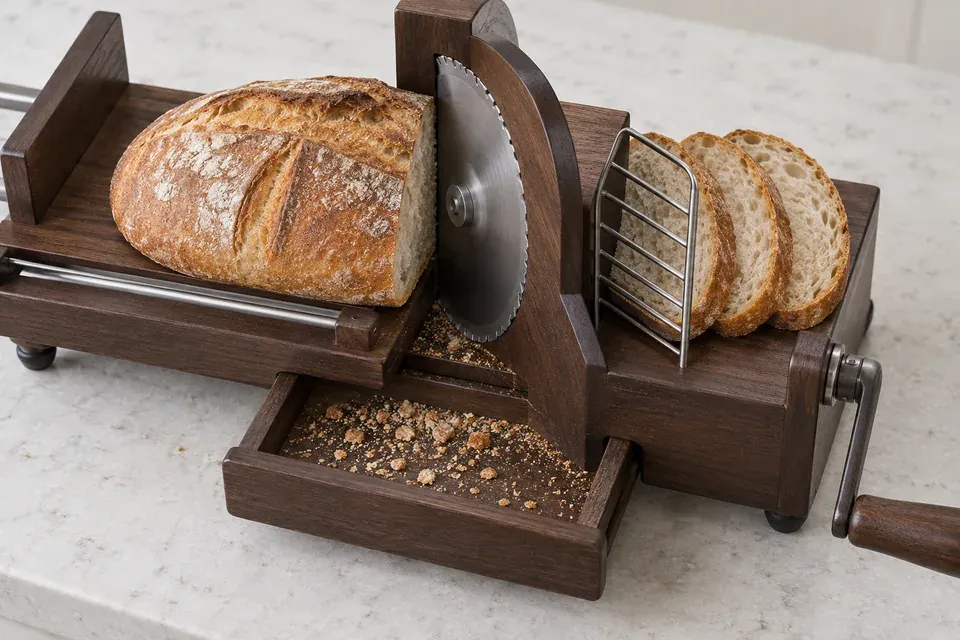
| Slice guide and crumb area | Directs a cut slice away and gives crumbs somewhere to go | Crank clearance, cleaning access and whether the guide traps slices |
How a wooden bread slicer with hand crank works
The crank is attached to a shaft. As the handle turns, the shaft rotates the circular blade. The blade does not need a motor because the operator supplies the rotational energy directly. Depending on the design, the loaf stays against a fixed guide while the carriage advances it toward the blade, or the operator moves the loaf steadily along the carriage while turning the crank.
The key word is steadily. A manual rotary slicer is not meant to force a loaf through one fixed opening. The carriage, guide and blade work together to give the bread a predictable path. A hard crust, a very soft crumb and an irregular sourdough loaf do not behave in the same way, so the product instructions and sample test should name the loaf types the brand expects to support.
How the thickness setting affects the slice
On a hand-crank slicer, thickness normally comes from the gap between the blade and a guide or stop. Moving the guide farther from the blade creates room for a thicker slice; moving it closer creates a thinner one. The product may use a knob, sliding stop or marked scale, but the mark is only a starting reference.
A marked 12 mm setting does not guarantee a finished 12 mm slice. Bread compresses. Crusts resist the blade differently. A tall, uneven loaf may lean on the carriage. That is why a B2B sample report should say how the setting was measured, which loaf was used and whether the buyer is approving the mechanism position or a finished-slice result.
Why a slice guide can matter more than it looks
After a slice passes the blade, it needs space to leave the machine. On some hand-crank designs, a loose slice can fall into the handle's path. A 2026 public user discussion described exactly that annoyance and a home-made guide intended to prevent it. This is not an EcoWoodPlate customer case and it is not a substitute for testing. It is a practical design lesson: the outgoing-slice route belongs on the drawing.
A well-positioned slice guide should help the slice clear the crank without creating a new trap for crumbs or making the product difficult to wipe down. Buyers should test it at the proposed thin and thick settings, then check it again with the longest loaf their instructions claim to support.
Crumbs, cleaning and realistic use
Crumbs are part of the product's daily reality. They fall from the blade area, ride on the carriage rails and collect near guards. A decent design gives users access to those places without asking them to reach through a sharp cutting area. Whether the product has a removable tray, an open crumb channel or a simple wipe-clean base, the instruction sheet should match the actual sample.
For a buyer, cleaning is also an assembly question. If a guide bracket is held by a fastener, the team needs to decide whether it is removable, which tool is needed, and how it is put back in the right position. A generic instruction card copied from another slicer is not enough.
What the factory needs before making a sample
A complete brief should include the overall footprint, wood appearance, loaf-size envelope, blade and guard requirement, target stop positions, guide-bracket requirement, logo artwork, instruction language and packaging route. The factory then turns that brief into a drawing, component list and sample plan.
Wooden parts are cut, drilled, sanded and finished before hardware is assembled. During assembly, the meaningful checks are not only visual: crank rotation, shaft play, blade alignment, carriage travel, stop movement, guard attachment and base stability all need attention. The wooden base should not rock, and the hardware should not pull loose from its mounting points under the agreed functional check.
A real-world style sample conversation
The Maya–Chen conversation below is an illustrative example, not a customer testimonial.
Maya, a kitchenware buyer: “We want the slicer to handle sandwich loaves and smaller sourdough loaves. How do we show that in the sample?”
Chen, a project coordinator: “Send the width and height range, then approve a test plan. We can record the carriage position, stop setting, guide position and the type of loaf used. Please also tell us whether your carton needs the crank packed separately.”
Maya: “Our pilot is 400 units. We need a wood logo, a plain insert card and a spare-hardware bag.”
That is a sensible conversation because it begins with use, not decoration. Four hundred finished units with six separate hardware pieces each create 2,400 pieces to count and contain. The sample should show the hardware bag, the correct assembly sequence and the exact carton protection—not a generic illustration.
OEM choices that do not change the basic working principle
Many private-label changes leave the core mechanism untouched: wood color, base profile, logo engraving, handle material, feet, box, barcode and insert card. These can still affect the finished product. A darker stain may change the visual tolerance for wood grain. A different handle can alter crank clearance. A retail color box can change how the blade needs to be protected.
A full mechanism redesign is different. Altering the carriage travel, blade size, shaft, guard or stop system normally means another engineering and sample cycle. EcoWoodPlate's OEM/ODM process is the right place to organize that distinction before production materials are ordered.
What buyers should inspect before a bulk order
- Does the sample match the approved drawing and component list?
- Does the crank turn smoothly through the full operating path?
- Is the blade aligned to the carriage and the thickness guide?
- Does the guide keep finished slices clear of the handle?
- Are guard, shaft, crank and feet firmly attached?
- Are sanding, finish, wood color range and fastener points acceptable?
- Can the intended crumb area be cleaned according to the final instruction?
- Does the retail box protect the full blade edge, wooden base and loose parts?
This is also where a buyer distinguishes a real Chinese wooden products manufacturer from a trading description. Ask who controls wooden fabrication, metal-part sourcing, assembly and final pack-out. EcoWoodPlate, operated by Cao County Puchuang Wood Industry Co., Ltd. through ecowoodplate.com, works with importers as a wooden kitchenware supplier, custom wooden products factory and OEM wooden products supplier.
FAQ
Does a wooden bread slicer with hand crank need electricity?
No. The operator turns the crank, which rotates the blade through a shaft. There is no motor in a manual hand-crank model.
What controls slice thickness?
The distance between the blade and the guide or stop creates the setting. Finished slice thickness can still vary with bread shape, crust and compression.
Why does bread sometimes interfere with the crank?
The outgoing slice may fall into the crank path if the design lacks enough clearance or a suitable slice guide. That route should be tested on the approved sample.
Can a wooden base carry a private-label logo?
Laser engraving can be evaluated on the base. Approve the artwork, position, orientation and appearance on a physical sample before bulk production.
What MOQ is listed for EcoWoodPlate's current hand-crank model?
The current k005 product page lists 200 pieces. The final MOQ depends on the material, mechanism, finish, branding and packaging selected for the project.
How should the unit be packed for export?
Separate moving metal parts from wood surfaces, cover the full blade edge, immobilize the carriage and count every loose part. The final pack needs to match the product weight and shipping route.
From “how it works” to an order-ready brief
For the current configuration, start with the manual wooden bread slicer product page. The companion complete buyer guide covers selection, supplier checks and bulk-order control in more depth. You can also compare the wider Kitchen & Dining range, then discuss dimensions, logo, packaging and market needs through OEM/ODM. Once you understand how a wooden bread slicer with hand crank works, contact EcoWoodPlate for a project-specific conversation.
Need Factory Direct OEM/ODM Pricing?
Send your product, quantity, logo, packaging and destination country. Our factory team will reply with quotation guidance.
Request Factory Quote