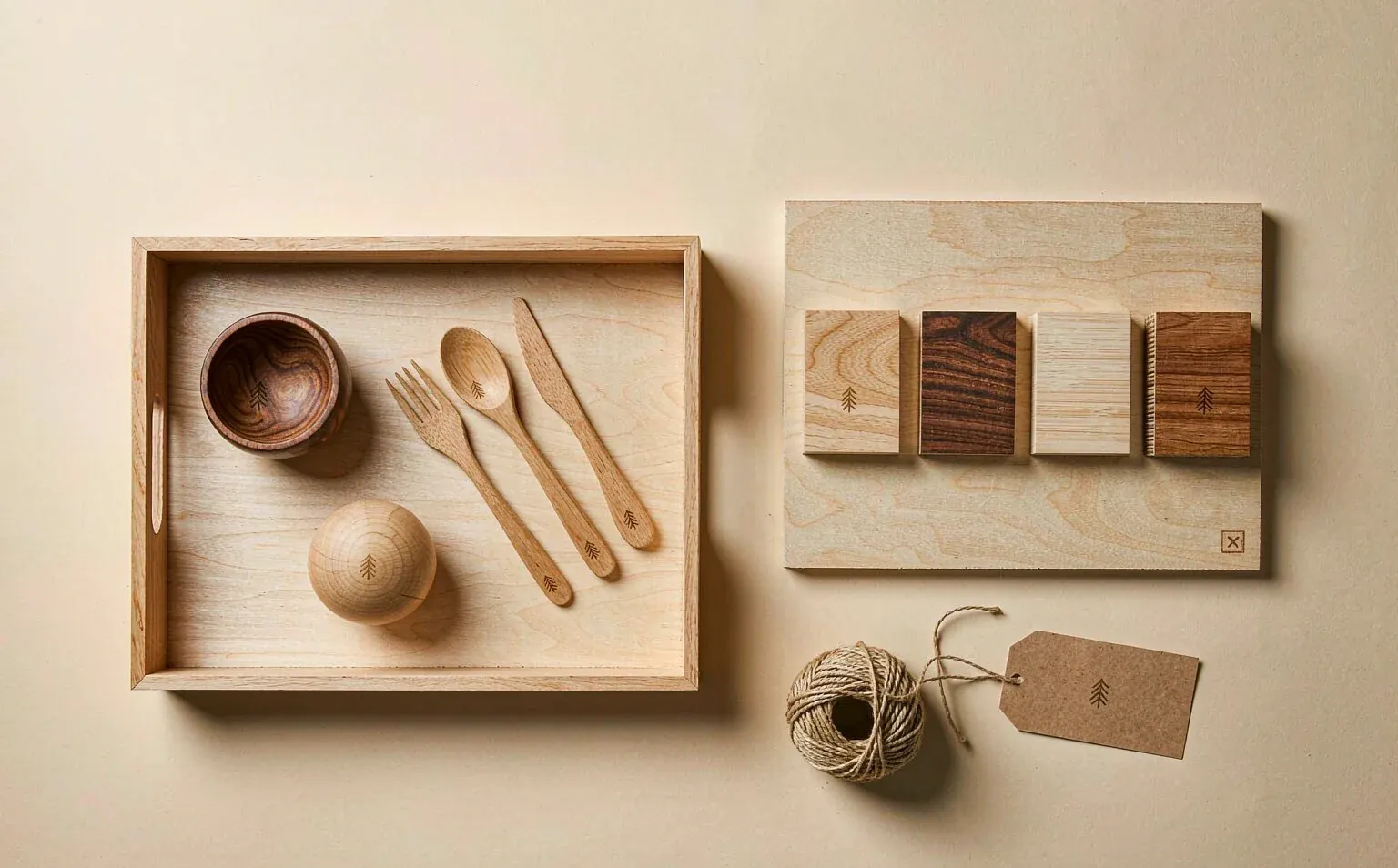
AI-generated concept illustration, not EcoWoodPlate product photography. One mark across four wood species reads differently on each; the swatch board shows why a single engraving setting cannot be assumed to work everywhere.
A private-label wooden holiday gift set is a multi-item bundle built around one or more wooden components and sold under the retailer's own brand. Three decisions determine whether it works, and they are usually made in the wrong order: what goes in the set, how the finished set is classified and marked on entry to the United States, and where the components are assembled. Buyers spend time on the first and meet the other two after artwork approval.
Choose the set's job before the product list
Gift sets come from a few recognizable templates, and each carries its own constraint.
- Host and entertain. Serving board, utensils, small bowl. High perceived value, heavy, and the board's edges are the most damage-prone part of the shipment.
- Tea and wellness. Tray, ceramic piece, loose tea. The ceramic sets the breakage rate, and the tray is sized around its tolerance rather than its drawing.
- Corporate appreciation. A desk or kitchen object plus a consumable. The requirement is surviving individual drop-shipment, not pallet delivery.
- Family or children's. The one template where age grading changes the paperwork, not just the packaging.
The structure is a hero item, a supporting item, a consumable, and the container. There should be exactly one hero. Two items of comparable value and visual weight give the customer no focal point and give you no price anchor.
Example Conversation: Two heroes, one price
Buyer: "We want a board, four utensils, a candle and a tin of preserves at $79.95 retail. Is that realistic?"
Supplier: "Start from the landed-cost ceiling, not the contents list. At that price the container and insert have a fixed budget before any component is costed. If the board is the hero, it carries the brand mark and the highest material cost; the candle and preserves complete the occasion rather than adding value."
Buyer: "What if we add a second board?"
Supplier: "Then you have two heroes and one price. Either the retail price moves or one board's specification comes down."
A set is often classified as one article, not several
Under the Harmonized Tariff Schedule of the United States, General Rule of Interpretation 3(b) provides that goods put up in sets for retail sale are classified as if they consisted of the component giving them their essential character, where that criterion applies.
The explanatory notes set three conditions that must all be met. According to CBP ruling N275838, a retail set consists of at least two different articles prima facie classifiable in different headings, is put up together to meet a particular need or carry out a specific activity, and is put up for sale directly to users without repacking. A carton of four identical boards fails the first condition; a bundle assembled for a promotion and repacked before sale fails the third.
The consequence is that duty on a gift set is not the sum of duty on its components. Change the mix and you can change which component carries the essential character, which changes the classification and landed cost of the whole set. A substitution that saves money per unit can cost more at entry, so the review belongs before the bill of materials is frozen.
Example Conversation: The substitution that raised landed cost
Buyer: "We swapped in a cheaper board and the landed cost went up, not down."
Supplier: "If the set is classified by essential character, the wooden component may be what sets the classification for the whole set. Changing its material or relative value can move the classification, not just the component price."
Buyer: "So the cheapest component isn't the cheapest set?"
Supplier: "Not automatically. Cost the set at entry."
Marking the box is a separate question
Under 19 CFR 134.11, a usual container must be marked so the ultimate purchaser knows the origin of the contents. But 19 CFR 134.22(d)(1) treats a container that imparts the essential character to the whole as generally not a usual container. A well-made wooden box holding low-cost consumables can be read as an article in its own right, and then the box itself needs marking — typically a "Container made in ___" statement. The design decision and the marking decision are the same decision, usually made by different people.
US kitting does not change that on its own: under 19 CFR 134.1(b), added work must effect a substantial transformation.
One brand, four wood surfaces
A private-label set carries the same mark on the tray, board, sleeve, and hangtag. The brief says to put the logo on everything and keep it consistent, and that instruction is where a set starts to look assembled from parts.
| Surface | How the mark behaves | What to fix in the artwork |
|---|---|---|
| Light pine or poplar | High contrast, holds fine detail; open grain can bleed a hairline | Check the smallest text at production size |
| Acacia or rubberwood | Dark and dense; engraving reads low-contrast | Plan a fill, foil, or a lighter mark |
| Bamboo | Strand grain interrupts continuous lines | Avoid hairlines and tight curves |
| Plywood face or edge | Edge shows laminations; a mark crossing it breaks at glue lines | Keep the mark on the face, or break it deliberately |
Consistency comes from fixed relationships, not an identical process: mark height relative to the face, clear space, minimum stroke weight, and one accent color used the same way everywhere. Approve a test board per substrate and keep it as the bulk reference. A brand color matched on coated stock will not match on raw pine.
Design the cavity around real contents
An insert drawn from a spec sheet almost always needs adjustment once real products sit in it. Mixed sets are hardest, because a board, a glass jar, and a folded textile push against three tolerances. Give the factory the filled weight and approximate center of gravity of each item, not only its dimensions, and say how the set will travel: hand-carried, shelf-stacked, or shipped individually.
Example Conversation: The insert passed, the carton failed
Buyer: "The insert was approved, but the jars rattle once the sets are in the master carton."
Supplier: "The insert holds the jar; the carton holds the insert. If the cavity has vertical play or the carton is oversized, the set moves as a unit inside the shipper. Add a top pad, and test the assembled set in its carton rather than the insert alone."
Two failures need their own test. Odor comes first: tea, chocolate, candles, and cosmetics pick up smell, and freshly finished wood is not odor-neutral, so seal real contents in the real container for several days. Food contact comes second. A sealed jar is packaging around packaging, which differs from loose confectionery on an oiled surface, where the finish and adhesive join the question. Under 21 CFR 170.3(e)(1), a packaging component that does not migrate into food does not become a component of the food — a call for your compliance partner, not for the word "natural."
Decide where the set gets assembled
| Location | Works when | What it costs | Main risk |
|---|---|---|---|
| Factory-assembled, one SKU | Demand is forecastable and the mix is fixed | Lowest unit labor; one carton, one barcode | You commit every component before demand is known; one shortage stops the set |
| Third-party kitting in market | Late differentiation, mixed configurations, or individual addressing | Per-unit kitting fee; two inventories to reconcile | Component mismatch between separate shipments |
| Store or showroom assembly | Display flexibility matters more than consistency | Highest labor, and it is your staff's time | The set varies by whoever is on shift |
Kitting in market is not only a large-company option. In an r/smallbusiness thread, a buyer needed US fulfillment to assemble and ship about a hundred gift boxes to multiple companies — too many to build by hand, too few for a factory program.
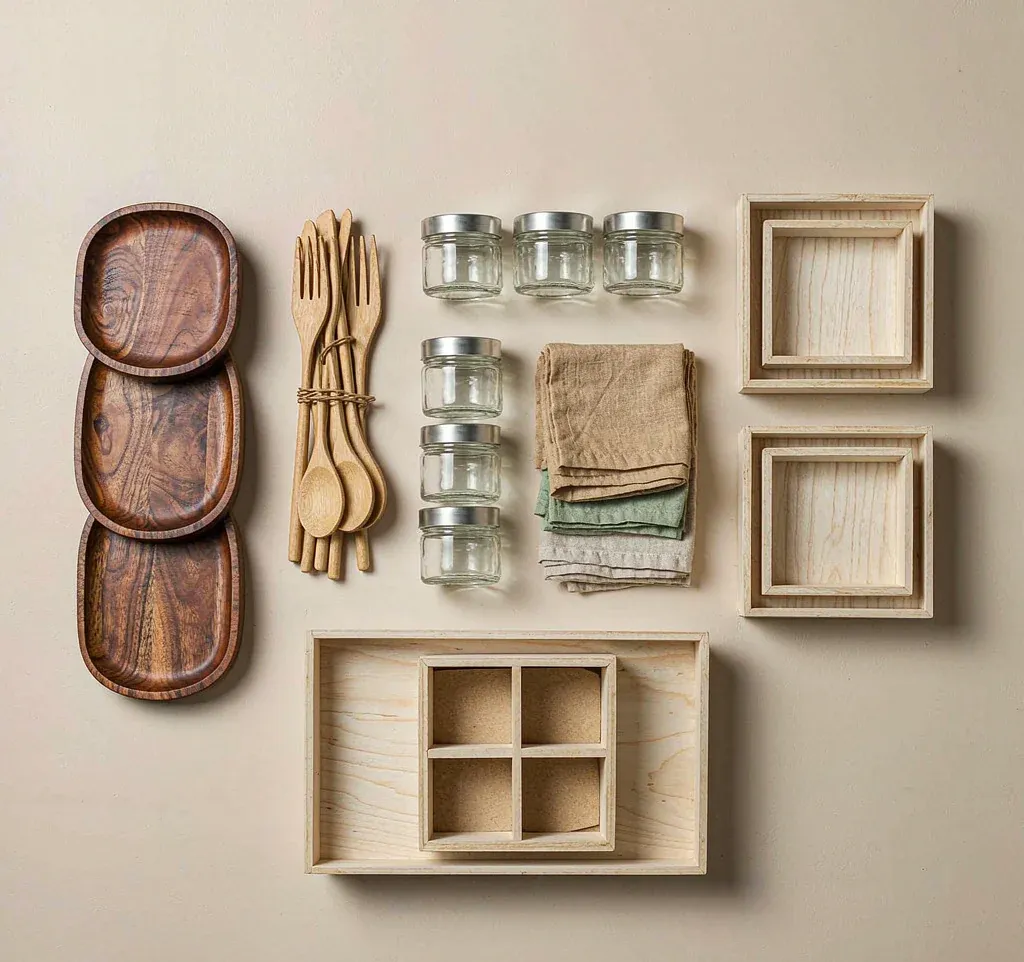
Whichever route you choose, one question decides the risk: who owns component inventory? If the factory assembles, it owns components until handover. If a warehouse kits, you own several separate inventories and the exposure of a shortage in any one of them.
A planning sequence that survives a single season
- Fix the date the set must be on a shelf or in a distribution center, and the channel it sells through.
- Choose one hero, one supporting item, and one consumable.
- Review the classification of the assembled set before artwork is approved.
- Test the brand mark on each substrate at production size.
- Prototype the insert with real contents, at filled weight, in the shipping configuration.
- Choose the assembly location and assign ownership of component inventory.
- Approve one assembled set, not a folder of component samples, and photograph it from fixed angles.
- Carton-test and drop-test the finished set, not the components.
- Write the reorder and substitution rule into the purchase order.
Frequently asked questions
What is the MOQ for a private-label wooden holiday gift set?
It depends on the wooden component, because a set's effective minimum is set by whichever component has the highest one. EcoWoodPlate's gift set presentation tray and stackable gift box set both list 200 pieces at a 15–20 day production lead time — a reference point, not a quote.
Is a gift set classified as one product or as separate products?
Often as one, under GRI 3(b), if it meets the three conditions for goods put up in sets for retail sale and is classified by the essential character of one component — not automatic, and not a reason to skip a review.
Should gift sets be assembled at the factory or in the US?
Factory assembly suits a fixed mix and forecastable demand; US kitting suits late differentiation and individual drop-shipping. The deciding question is usually who carries component inventory risk.
Does a holiday gift set need a children's product certificate?
Only if the set is a children's product, which depends on how it is marketed and who it is intended for, not on the season. 16 CFR 1200.2 lists candles among products the Commission has traditionally warned adults to keep away from children, and those are excluded from certain CPSIA provisions — but a candle in the box does not settle the classification of the whole set.
Planning a private-label set for next season?
EcoWoodPlate produces wooden gift components and presentation packaging for private-label programs. Send your set concept, target retail price, and packaging direction to discuss specifications, insert layout, and branding options. For the container side, see the holiday gift box execution guide; for a single-SKU program, the BBQ tool set guide.
Need Factory Direct OEM/ODM Pricing?
Send your product, quantity, logo, packaging and destination country. Our factory team will reply with quotation guidance.
Request Factory Quote