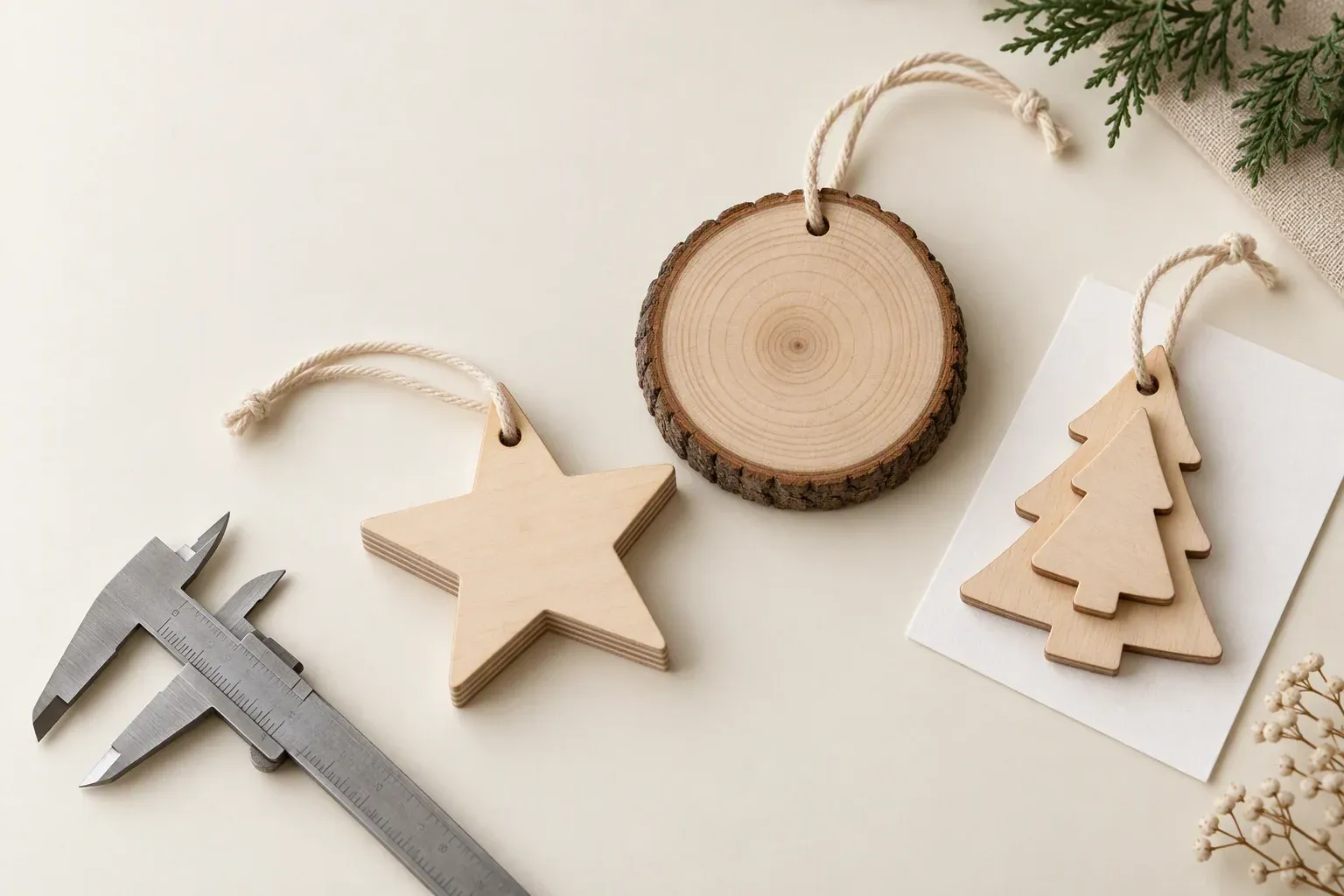
AI-generated sample-review concept, not EcoWoodPlate product photography. Actual materials, dimensions and available designs require sample confirmation.
For U.S. retailers, sourcing wooden Christmas ornaments wholesale starts with defining the sellable unit: an unfinished blank, a decorated hanging ornament, or a packaged set. Specify the material, hanging construction, artwork, acceptable variation, and packaging before comparing quotes. Then approve representative samples, verify product-specific import requirements, and plan backward from your warehouse receiving date—not Christmas Day.
A low unit price is not useful if the hanging holes split, personalized names become unreadable, or the shipment arrives after your selling window. These are the decisions to resolve before placing a bulk order.
Decide what the retailer will actually sell
Unfinished wooden ornament blanks leave painting or engraving to the retailer or customer. Finished ornaments arrive with the decoration and hanger already applied. A DIY kit adds components and instructions, creating a different product and compliance assessment—especially if marketed to children.
Specify whether a quoted “piece” means one blank, one ornament with cord, or one complete retail pack. For mixed designs, list the quantity of each shape and whether substitutions are permitted. Keep year-dated artwork separate from evergreen designs so unsold stock is not automatically tied to one season.
This guide focuses on hanging ornaments. For coordinating ornaments with boxes and other gift items, use the broader wooden Christmas gifts sourcing guide.
Specify the construction, not simply “natural wood”
A wood-look photograph does not identify a material. Ask for the species, whether the item is solid wood or panel-based, and the actual face, core and finish specifications.
| Construction | Useful application | What to verify |
|---|---|---|
| Solid-wood cut shape | Visible grain and an unlaminated edge | Species, grain direction, knots near narrow sections, thickness and acceptable shade range. |
| Natural branch slice | Rustic round ornaments with growth rings | Diameter range, drying method, cracks, bark retention, flatness and import requirements for the actual processing level. |
| Plywood shape | Flat cutouts or layered designs | Face and core materials, exposed layers, voids, splinters and glue-line integrity; confirm applicable panel documentation. |
| MDF shape | Painted designs where visible grain is unnecessary | Edge finish, coating coverage, moisture protection and documentation for regulated composite wood. |
No single thickness or moisture percentage suits every shape and material. A wide star and a delicate snowflake can fail differently even when cut from the same sheet. Specify the intended design, then evaluate the physical sample.
EcoWoodPlate lists unfinished natural wood slices for crafts and ornaments, with drilling, engraving and packaging options. That is a starting point for a project discussion, not confirmation that every Christmas design is stocked.
Approve the small features that cause large rejects
Measure overall size, thickness, hanging-hole position and the narrowest connections in the design. Check that the hole has enough surrounding material, that the cord passes cleanly through it, and that the ornament hangs in the intended orientation. Set handling or pull-check criteria appropriate to the design; a casual tug is not a certified safety test.
Inspect the front, back and cut edges. Agree on acceptable laser-edge darkness separately from loose soot, scorch marks or splinters. Check whether rubbing leaves residue on light packaging. Evaluate odor after the sample has been enclosed in its intended pack; odor alone neither proves nor disproves chemical compliance.
Wood exchanges moisture with surrounding air and changes dimension as moisture conditions change, as explained in The Wood Database’s technical overview. Ask how material is dried, conditioned and checked before packing. For natural slices, define acceptable cracking and bark loss rather than assuming “kiln-dried” means permanently crack-free.
This illustrative exchange is not an EcoWoodPlate customer record. A photograph captures appearance; a specification also controls the features that keep the ornament usable.
For personalization, test the longest name and smallest lettering on the intended material. Approve spelling, font, placement and artwork revision separately from the product sample. Require written approval before changing the substrate, finish or hanger.
Compare quotes by design and sellable unit
Ask whether the minimum order applies per shape, artwork, color, retail pack or entire order. A supplier may combine identical blanks across designs while treating different printed boxes separately. Do not assume a mixed assortment qualifies for the same MOQ as one repeated SKU.
This example explains why design count matters: cutting layouts, artwork changes, sorting and packaging can create work that a headline piece price does not show.
Request separate lines for samples, setup, decoration, cords, retail packaging, inspection and freight. Compare the same delivery terms and named destination. Budget duties, brokerage, inland delivery and a realistic allowance for unusable goods; do not divide total cost by ordered quantity if some units cannot be sold.
Protect the ornament and preserve the assortment
Thin tips need protection from bending and contact with neighboring pieces. Test tissue, sleeves, dividers or fitted inserts with the actual shape rather than prescribing the same pack for every design. Keep cords from tangling and avoid pressure on raised decorative layers.
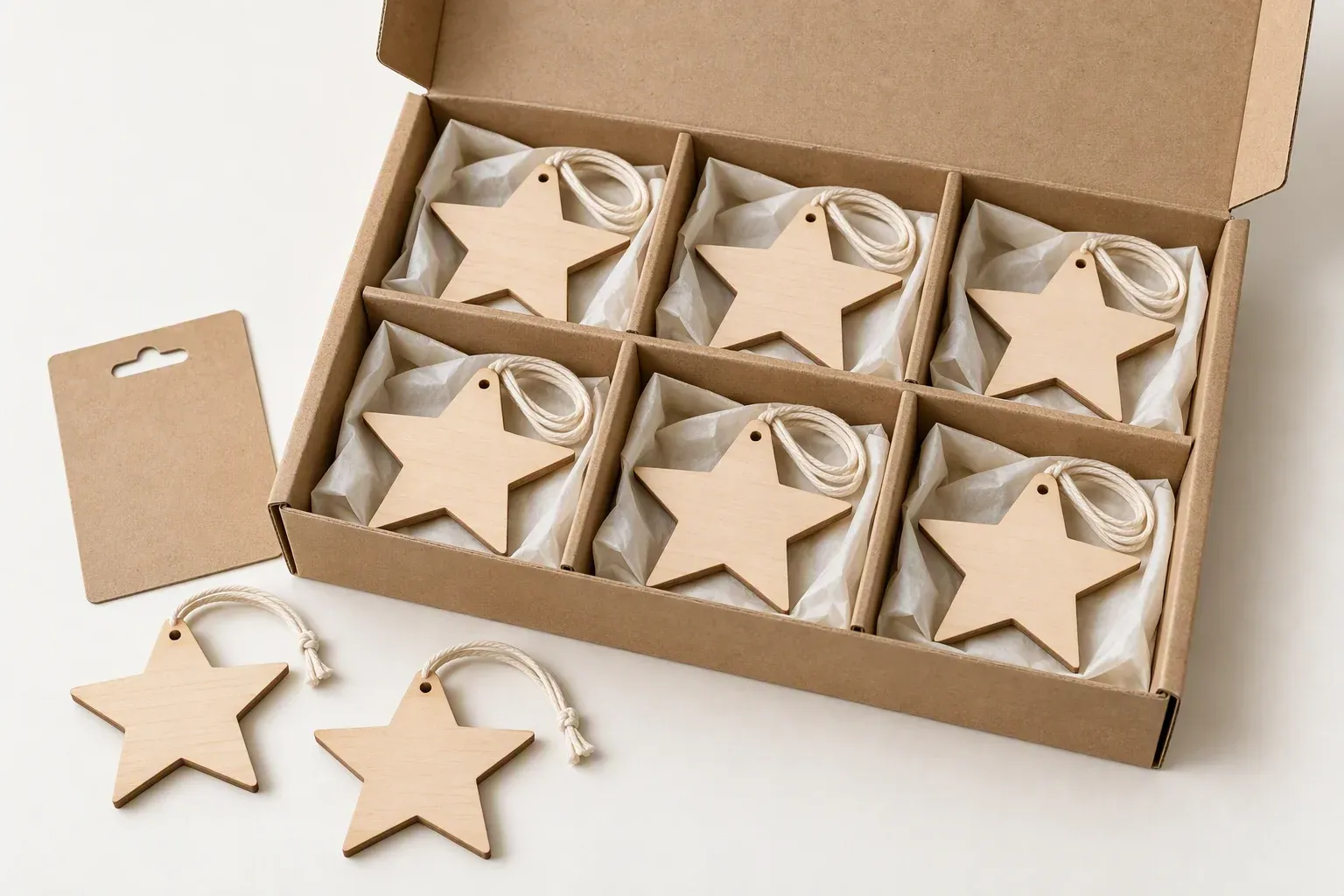
The distinction matters: shelf presentation is not transport validation. Agree on a packaging evaluation appropriate to the shipment route, carton weight and handling conditions; do not claim a passed test without a report.
Confirm barcodes, units per inner pack, assortment counts and carton marks. Work backward through domestic delivery, customs, freight, inspection, production and sample approval. Record what happens if artwork approval is delayed; a production estimate is not a guaranteed U.S. arrival date.
Check U.S. requirements against the exact SKU
These are screening questions for your importer, customs broker and testing adviser—not a universal compliance checklist:
- Classification and duties: Confirm the actual design’s HTS classification and applicable charges at entry. Do not apply an old “duty-free” claim to every wooden ornament.
- Wood sourcing declarations: APHIS Lacey Act requirements depend on the listed HTS code, entry status and other conditions. Obtain species and harvest-country information where required; manufacturing country is not necessarily harvest country.
- Plant health: Check commodity-specific APHIS import requirements, particularly for natural or bark-on pieces. ISPM 15 concerns regulated wood packaging such as raw-wood pallets and dunnage; it is not a blanket product certificate for ornaments.
- Intended users: CPSC guidance treats most seasonal decorations as general-use products. Child-directed designs or kits need a separate assessment. CPC or GCC requirements depend on classification and applicable rules; a “not a toy” label alone does not settle classification.
- Composite wood: EPA TSCA Title VI guidance covers defined hardwood plywood, MDF and particleboard, with applicable obligations extending to finished goods containing them. Confirm the substrate and documentation instead of assuming every plywood is covered—or every small ornament exempt.
Keep material specifications, relevant reports and approved label copy tied to the actual SKU. Neither “natural” nor “water-based” substantiates a blanket safety or environmental claim.
FAQ: wholesale wooden Christmas ornaments
What should an ornament RFQ include?
Send drawings, dimensions, construction, quantity per design, artwork, hanger details, pack count, intended users, destination and required receiving date. Request a quote that identifies exclusions and approval assumptions.
Are unfinished wooden ornaments cheaper than finished ones?
They can reduce factory decoration work, but the retailer then carries finishing, labor and inspection costs. Compare the cost of a complete sellable item, not just the blank.
Is plywood better than solid wood for ornaments?
Neither is automatically better. Compare the intended outline, edge appearance, grain, finish and substrate documentation on samples. Thin connections and hanging holes still need attention in either construction.
What is the MOQ for custom wooden Christmas ornaments?
There is no universal MOQ. Material, design count, decoration and packaging affect it. Obtain a project-specific minimum; a listed MOQ for a craft blank does not automatically apply to a finished ornament assortment.
Can wooden Christmas ornaments be sold as children’s craft kits?
Possibly, but child-directed kits require their own classification and applicable safety assessment. Adding paints, small parts or play activities can change the requirements. Do not reuse an adult-decoration compliance file without review.
Discuss a defined ornament project
EcoWoodPlate, the brand of Cao County Puchuang Wood Industry Co., Ltd., lists custom wooden-product services including engraving, finishing and packaging. To discuss an ornament project, send your specifications and packaging requirements. Ask the team to confirm design feasibility, material availability, samples and quotation terms before treating any concept as an approved product.
Need Factory Direct OEM/ODM Pricing?
Send your product, quantity, logo, packaging and destination country. Our factory team will reply with quotation guidance.
Request Factory Quote