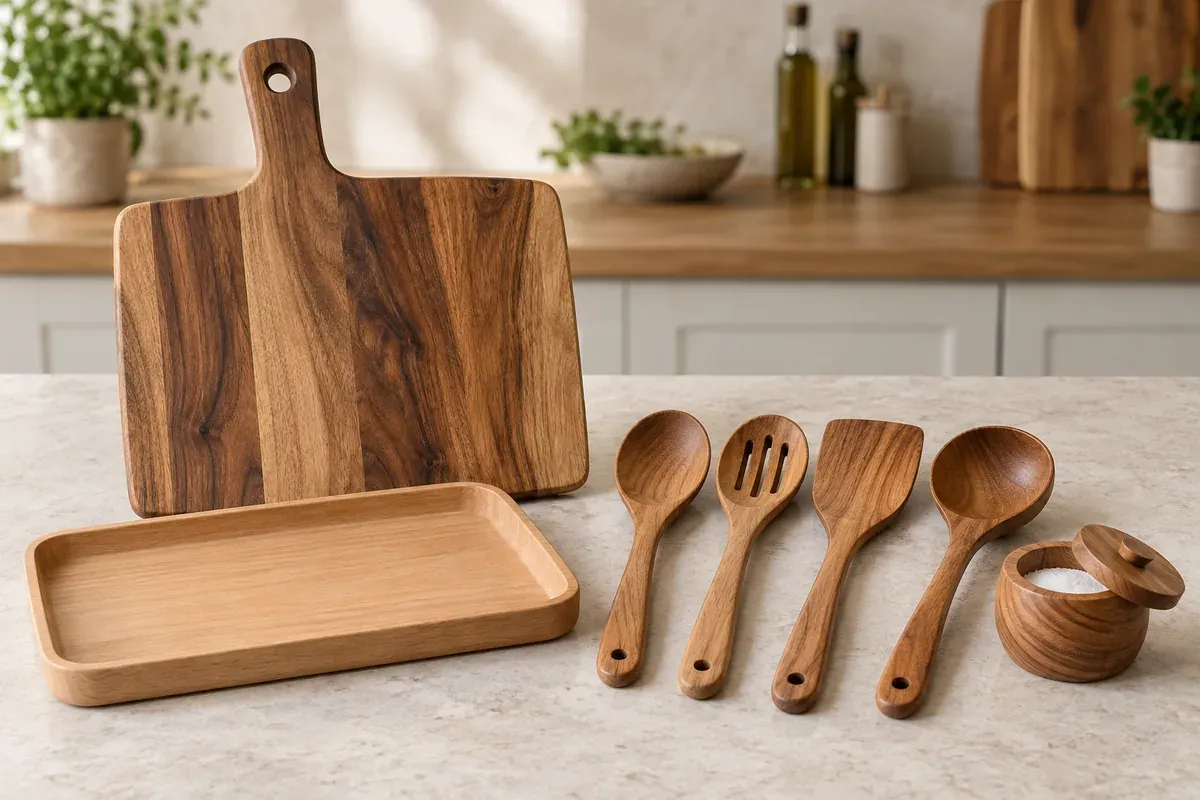
Wooden Kitchenware Supplier: A Complete B2B Buyer Guide
A wooden kitchenware supplier should do more than quote a spoon or cutting board. For a reliable bulk program, the supplier must translate the buyer’s intended use into a controlled material, finished dimensions, surface treatment, branding, inspection plan and export pack.
This is an informational sourcing guide. For current products and commercial enquiries, use EcoWoodPlate’s Kitchen & Dining wholesale category as the primary product page.
What does a wooden kitchenware supplier actually supply?
The deliverable is not only the wooden item. It is a repeatable specification covering the product, packaging and evidence needed for the destination market. A wooden kitchenware manufacturer may cut and shape components, sand them, apply oil or coating, add a logo, assemble sets and prepare retail or bulk cartons. Some operations or materials may be subcontracted, so buyers should ask which steps occur at the quoted facility.
EcoWoodPlate is the export brand of Cao County Puchuang Wood Industry Co., Ltd. As a Chinese wooden products manufacturer, the company presents kitchenware production, OEM/ODM development, inspection and packing support for B2B projects. Those general capabilities still need to be converted into written requirements for each order.
When comparing a wooden products manufacturer in China, ask whether the quoted legal entity is the custom wooden products factory, an exporter, or both. An OEM wooden products supplier should also identify who controls each production step.
Which buyers benefit from factory sourcing?
Factory sourcing works best when the buyer can define a repeatable product and order enough units to justify material purchasing, machining setup, finish preparation and packaging. Typical buyers include:
- Importers building a coordinated range across several wooden kitchenware SKUs.
- Wholesalers supplying independent shops, hotels, restaurants or gift channels.
- Retail and e-commerce brands needing private-label packaging and barcode control.
- Marketplace sellers that must confirm pack size, label position and kit completeness.
- OEM customers supplying a finished drawing and ODM customers developing from a concept.
Real buyer signal: a 100–300 unit validation order
In a public Amazon UK sourcing discussion, a funded kitchenware seller described an initial target of 100–300 units and asked for factory visits, quality control, and UK FBA packaging knowledge. The product combined metal with a birch handle, so it is not an EcoWoodPlate wooden-kitchenware case. It is useful because it shows that a modest launch order can still require a complete specification and inspection plan. The post is a buyer’s self-report, not proof about any supplier.
Common product groups and buying questions
| Product group | Typical buyers | Critical questions |
|---|---|---|
| Cutting and serving boards | Retail, gifting, hospitality | Species, glue lines, flatness, edge profile, juice groove, logo and finish |
| Spoons, spatulas and utensil sets | Kitchenware brands, e-commerce | Handle dimensions, bowl or blade geometry, sanding, set count and sleeve packing |
| Serving trays and cake stands | Hotels, catering and homeware | Joinery, handle strength, stability, food-contact area and carton protection |
| Bread slicers and storage items | Bakeries, specialty retailers | Moving parts, blade or hardware responsibility, ventilation, assembly and instructions |
| Salt cellars and lidded containers | Gift, gourmet and countertop ranges | Lid fit, internal finish, odor, grain matching and cleaning directions |
Buyers can compare these product types in the wooden kitchenware wholesale catalog. Use catalog images to shortlist shapes; use drawings and samples to approve production.
Choose wood by function, not by name alone
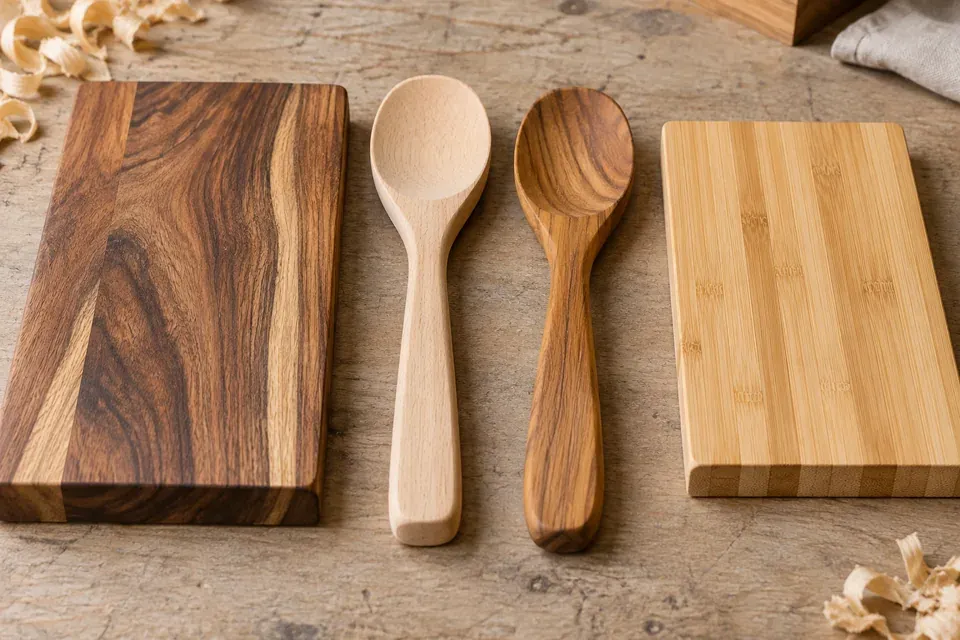
Species affects grain, weight, machining, finish absorption and cost, but species alone does not decide whether a product is suitable. Ask for the botanical or commercial species name used in the quotation, whether components are solid, laminated or finger-jointed, and which appearance variations are acceptable.
| Material | Useful characteristics | Buyer checks |
|---|---|---|
| Acacia | Visible grain variation and strong shelf presence | Color range, joints, checking and finish absorption |
| Beech | Pale, relatively even appearance and clean machining | Color sorting, small defects and handle geometry |
| Teak | Warm color and recognizable grain | Species identity, oiliness, sourcing documents and logo contrast |
| Bamboo | Strip-built appearance and panel efficiency | Adhesive system, lamination quality, edge splits and destination requirements |
Moisture targets should be agreed for the product, construction and destination rather than copied from another order. Record the method, measurement locations and conditioning state. Natural grain and color variation should be approved with a range sample, not a single ideal photograph.
How wholesale wooden kitchenware is manufactured
A practical manufacturing route has eight control points:
- Specification review: confirm use, material, dimensions, tolerance, finish, logo, quantity and pack.
- Incoming inspection: check material identity, moisture condition, grain, color and defects.
- Cutting and forming: saw, CNC-route, turn or shape parts using drawing datums.
- Assembly: control glue application, joint alignment, hardware and curing where applicable.
- Sanding: inspect faces, edges, recesses and handle transitions for rough fibers or splinters.
- Surface treatment: apply the approved oil, coating or other finish under recorded conditions.
- Branding: verify logo file, size, position, orientation, contrast and legibility.
- Final inspection and packing: compare finished goods and retail packs with the signed standard.
Do not accept “food safe” as the complete finish specification. Record product identity, supplier, application, curing and intended conditions of use. For the United States, the FDA explains that the regulatory status of a food-contact article depends on the status and intended use of its component substances. Buyers should confirm the correct requirements with qualified specialists for each market.
OEM and ODM: control the revision, not just the sample
OEM wooden kitchenware normally begins with a buyer drawing, artwork or reference sample. ODM begins earlier, with decisions about material, geometry, construction and packaging. Use revision numbers on every approved file.
The following people and quantities are illustrative, not an actual customer case.
Maya, brand buyer: “We need 2,400 five-piece utensil sets with our logo.”
Chen, product engineer: “That is 12,000 wooden components. Let’s approve one master drawing per shape, one finish range and one packed set before bulk production.”
That conversation prevents a common mistake: approving one spoon and assuming the other four shapes follow automatically. Customization may cover length, handle profile, color, oil or coating, laser engraving, printing, labels, sleeves, retail boxes, inserts and master-carton marks. EcoWoodPlate’s OEM/ODM wooden product service explains the project path from requirement review to sampling, production, QC and shipping.
Samples and MOQ without invented promises
MOQ depends on material purchasing, CNC or tooling setup, finish batch size, logo process, set composition and packaging. Ask for the minimum per design, material, color and logo—not only a single headline number. A sample fee, production price and packaging-development cost should be quoted separately when relevant.
Approve both an unpacked product sample and a packed sample. Your record should cover material, finished dimensions, weight where useful, color range, surface feel, odor after opening, logo, function, care instructions, labels and carton configuration. Changes made after approval need a new revision and a decision on whether another physical sample is required.
QC for a wooden kitchenware manufacturer
Quality control starts before cutting and continues after packing. Define defect categories and the sampling plan with the supplier or an independent inspector. Typical checkpoints include:
- material and construction against the bill of materials;
- moisture readings and visible cracks, knots or glue-line issues;
- critical dimensions, flatness, lid fit, assembly and set completeness;
- sanding at edges, slots, holes and handle transitions;
- finish identity, coverage, transfer, curing, color and odor;
- logo location, darkness, orientation and artwork version;
- retail labels, barcode readability, carton marks and accessory count.
For mixed-SKU orders, distribute inspection across products and production lots. Keep the approved sample and signed specification available when reviewing pre-shipment findings.
Packaging: protect the product and the landed margin
Wooden surfaces can be scratched by neighboring pieces, loose hardware or abrasive carton movement. Separate finished items, immobilize components and protect exposed corners. Avoid sealing products before the agreed finish process is complete.
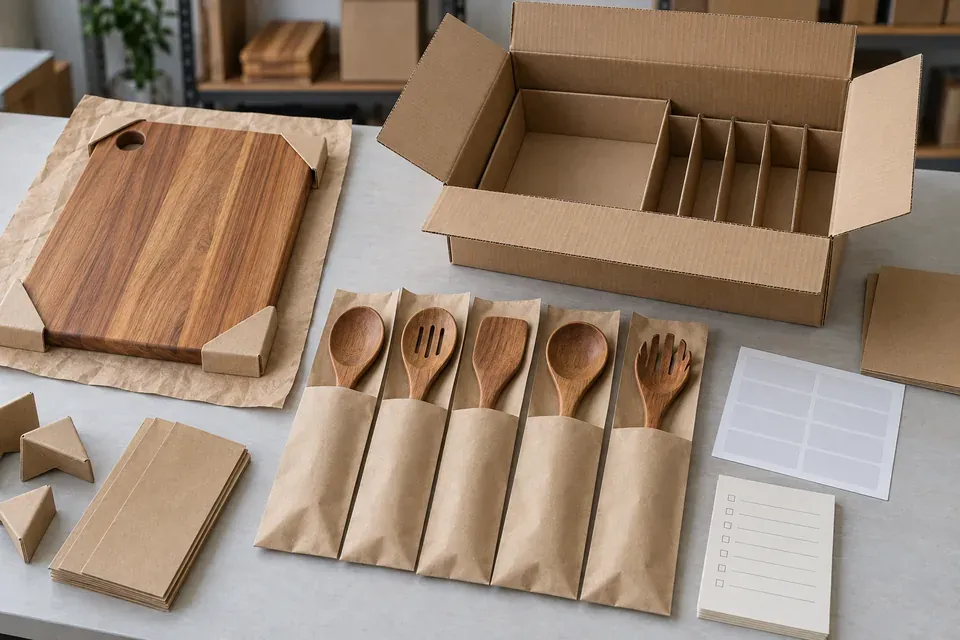
Use numbers to compare options. An illustrative carton measuring 420 × 300 × 240 mm occupies 0.03024 m³; reducing height to 200 mm changes that to 0.0252 m³, a 16.7% volume reduction. This calculation does not prove freight savings: packed weight, carrier rules, master-carton strength and product protection still control the decision.
Confirm unit pack, master-carton quantity, dimensions, gross and net weight, drop or transit-test method where needed, pallet plan, labels and loading arrangement. E-commerce parcel delivery may require different protection from palletized wholesale.
A nine-step sourcing process
- Define the customer, intended use, destination market and sales channel.
- Select product groups from the Kitchen & Dining category.
- Send drawings, quantities, material preferences and target packaging.
- Verify the legal company, facility, production scope and subcontracted steps.
- Compare quotations on the same specification and trade term.
- Develop and review product and packaging samples.
- Freeze drawings, finish range, logo, labels and acceptance criteria.
- Inspect production and the complete packed order before release.
- Retain reference samples and record changes for the repeat order.
Buyer RFQ checklist
- Product/SKU list, target quantity and reorder expectation.
- Destination country, channel and intended food-contact conditions.
- Material, construction, dimensions and critical tolerances.
- Finish identity, color range, logo artwork and care instructions.
- Required test scope and documents for the destination and use.
- Retail pack, barcodes, inserts, master carton and delivery term.
- Sample approval owner, inspection plan and target shipment date.
FAQ
How do I choose a wooden kitchenware supplier in China?
Compare factories using the same written brief. Verify company identity and production scope, then assess material control, sample accuracy, finished-product QC and packaging—not price alone.
Which wood is best for wholesale wooden kitchenware?
There is no universal best species. Choose around use, construction, appearance, weight, finish compatibility, documentation, availability and price position.
Can a supplier make custom sizes, colors and logos?
Often yes, subject to feasibility. Lock dimensions, tolerances, finish reference, artwork version, logo position and acceptable appearance in the approved specification.
How should buyers confirm food-contact finishes?
Identify every relevant substance and intended condition of use, then confirm suitable documentation or testing for the destination. A generic “food safe” statement is not enough.
What should be checked before a bulk order ships?
Check product identity, dimensions, construction, sanding, finish, odor, logo, function, set count, labels, carton marks and the agreed packed configuration.
How should importers ask about MOQ?
Ask for MOQ by design, material, color, logo and pack. Explain the expected trial and repeat volumes so the wooden kitchenware supplier can identify the real production constraint.
Build the brief before requesting the quote
For current product options, begin with the EcoWoodPlate Kitchen & Dining page. If you need custom dimensions, finishes, engraving or packaging, review the OEM/ODM process. When the product list and destination are ready, send them through the EcoWoodPlate contact form at ecowoodplate.com. A useful first enquiry gives Cao County Puchuang Wood Industry Co., Ltd. enough detail to review feasibility instead of guessing.
Need Factory Direct OEM/ODM Pricing?
Send your product, quantity, logo, packaging and destination country. Our factory team will reply with quotation guidance.
Request Factory Quote