Wooden Squirrel Feeder Manufacturer: An OEM Guide
A wooden squirrel feeder manufacturer should do more than copy a catalog photo. The factory must repeat the approved roof, openings, platform, finish, hardware, logo, and packaging across the bulk order. Outdoor use exposes mistakes quickly: rain reaches the feed, debris stays wet, or screw points enter the feeding area.
This guide is for importers, garden-center wholesalers, pet brands, wildlife-gift retailers, purchasing managers, and e-commerce sellers. EcoWoodPlate, operated by Cao County Puchuang Wood Industry Co., Ltd., supplies custom wooden products through ecowoodplate.com. Buyers can use the checks below when comparing EcoWoodPlate or another Chinese wooden products manufacturer.
What Is a Wooden Squirrel Feeder?
A wooden squirrel feeder is an outdoor feeding station designed to hold nuts, acorns, corn, or suitable feed while giving a squirrel a stable place to land and eat. Formats include platforms with circular feed holes, lidded feed boxes, picnic-table shapes, and tree-mounted trays.
The product fits garden and wildlife importers, pet-product wholesalers, hardware chains, nature-gift brands, educational retailers, and private-label sellers. It is not an indoor ornament. Drainage, edge sealing, corrosion resistance, mounting strength, cleaning access, and carton protection belong in the specification.
A Real EcoWoodPlate Catalog Case
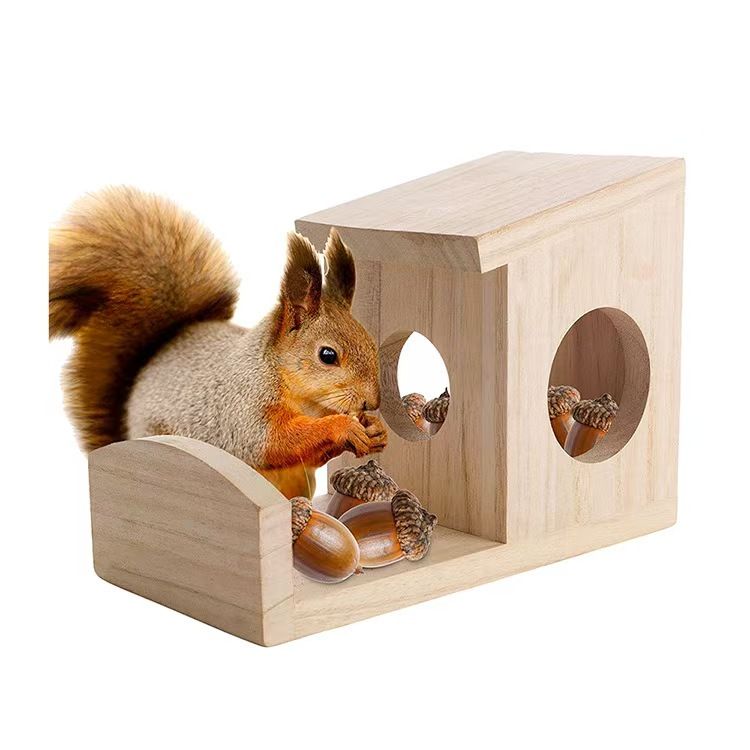
EcoWoodPlate?? public wooden squirrel feeder has two circular feed holes, an enclosed upper section, a landing platform, and a curved front guard. The catalog lists an MOQ of 200 pieces and a 10??5-day production lead time. A new size, coating, logo process, printed carton, or mixed-color order can change both.
The following is a representative project conversation, not a customer testimonial:
Maya, garden-retail buyer: ??he sample looks right in the front photo, but can you confirm both circular openings after sanding and coating???/p>
Leo, factory project manager: ??es. Please mark the finished diameter and tolerance on the drawing. We will measure the coated sample rather than only checking the CNC file.??/p>
Maya: ??se a 45 mm opening with a proposed tolerance of plus or minus 1 mm. Keep the engraved logo 18 mm below the roof edge.??/p>
Leo: ??e will label that drawing SF-240-V3 and repeat those two measurements on the first production pieces.??/p>
The useful part of the exchange is version control: one drawing code connects the sample, artwork, production check, and inspection report.
Define the Use Case Before Requesting a Quote
Tell the supplier where the feeder will be mounted, which feed it will hold, whether the consumer assembles it, and how it should be opened for cleaning. ??ame as the photo??is not a manufacturing specification.
A buyer-defined drawing example might state:
- overall size: 240 ? 180 ? 220 mm;
- roof overhang: 25 mm beyond the front opening;
- two circular feed openings: 45 mm finished diameter;
- landing platform depth: 90 mm;
- two drainage gaps: 3 mm wide;
- wall-mount holes: 6 mm diameter on 120 mm centers;
- no exposed screw point inside the feeding area.
These are illustrative RFQ numbers, not universal EcoWoodPlate tolerances. The custom wooden products factory should review them against the species, board thickness, tooling, and assembly method before the purchase order is signed.
Choose Wood for Structure and Exposure
| Material | Practical advantage | Buyer checkpoint |
|---|---|---|
| Pine | Easy to machine, visible grain, widely used for simple feeder bodies | Sort open knots, resin, dents, and splitting around screws |
| Fir | Light and practical for roofs and assembled panels | Confirm section thickness and pilot holes around fasteners |
| Exterior-grade plywood | Stable sheet structure and efficient CNC cutting | Confirm grade and seal exposed layers and drilled edges |
| Hardwood | Denser surface and heavier retail feel | Check weight, machining, cost, and finish; hardwood is not automatically weatherproof |
Ask the supplier to name the species and panel construction. ??olid wood??is incomplete. Incoming material inspection should identify splits, open knots, severe color variation, edge damage, and unsuitable moisture. A buyer may propose a moisture range, but the final value should suit the species, production season, and destination climate. Request recorded meter readings rather than a verbal promise that the wood is dry.
Production Steps a Buyer Can Audit
- Incoming inspection: check moisture, species, thickness, knots, cracks, and contamination.
- Cutting and drilling: establish the roof, back, openings, mounting holes, and platform with controlled tooling.
- Edge treatment: round exposed corners and remove fibers inside the circular holes.
- Trial assembly: check roof alignment, platform level, joint gaps, and fastener depth.
- Sanding: inspect broad faces, end grain, openings, and corners under consistent light.
- Logo test: test laser engraving, printing, or labels on the actual material and finish.
- Surface treatment: apply the approved finish and allow adequate curing and odor release.
- Final QC and packing: verify structure, appearance, hardware, accessories, marks, and carton protection.
An OEM wooden products supplier should explain which operations are in-house and which are subcontracted. Buyers do not need a staged factory performance; they need product-specific evidence that matches the quotation and sample.
Outdoor Finish, Drainage, and Cleaning
Forum discussions about wooden feeders repeatedly mention wet feed and mold after rain. That is a design issue as well as a care issue. On the physical sample, check whether the roof sheds water away from the feed area, water can leave the platform, the consumer can reach the inside for cleaning, and the finish covers edges and drilled holes evenly.
Do not accept ??aterproof??without support. Ask for the coating specification, application method, drying process, intended use, and any test evidence relevant to the destination market. An indoor gift-box finish should not be assumed suitable for a feeder exposed to rain, sunlight, animal contact, and repeated cleaning.
OEM and ODM Customization
A wooden pet products manufacturer can usually discuss size, opening diameter, roof shape, wood, color, finish, logo, mounting hardware, instruction sheet, barcode label, retail box, and master-carton marks. ODM work may change the feeding mechanism or build a coordinated birdhouse and wildlife-feeder range.
Freeze decisions on one specification sheet. Use a code such as SF-240-V3 on the drawing, approved sample record, artwork, packaging proof, and inspection checklist. For private label wooden products, approve the logo on the actual wood and coating because grain, density, stain, and laser settings change contrast.
Samples, MOQ, and Lower-Risk Ordering
MOQ depends on material preparation, cutting setup, custom color, logo method, printed packaging, and the number of SKUs. Ask for separate minimums for the product body, each color or artwork, printed packaging, and each barcode or language version. A catalog MOQ should not be copied into a new OEM purchase order without review.
For a changed structure, finish, logo, or package, approve a physical sample before production. Check dimensions, hole edges, roof fit, platform level, screw depth, odor, color, logo contrast, hardware, and packed condition.
A lower-risk first order may keep the stock product structure while adding an engraved logo, barcode label, and neutral box. A fully printed retail carton or new structure can follow after the buyer confirms demand. This reduces packaging minimums without pretending that every factory can produce an unlimited number of custom versions at the catalog MOQ.
Bulk Quality-Control Checklist
- Confirm product, drawing, artwork, and carton version codes.
- Measure overall dimensions and critical opening diameters.
- Check platform level and stability on a flat surface.
- Inspect cracks, open knots, glue marks, resin, splinters, and rough holes.
- Confirm screws are seated and no sharp point enters the feeding area.
- Check roof alignment, overhang, drainage, and cleaning access.
- Compare color and sheen with the approved sample.
- Verify logo size, position, orientation, spelling, and contrast.
- Confirm hardware count, instruction sheet, barcode, and carton marks.
- Open packed units and inspect rubbing, corner pressure, and movement.
Define the inspection quantity, defect classes, and acceptance criteria before production. For a 1,200-piece, three-logo example, the buyer could require first-article approval when each 400-piece logo version begins, followed by the agreed final random inspection. The exact sampling plan should reflect product and market risk rather than being improvised after cartons are sealed.
Export Packaging and Shipping
Wooden feeders combine broad faces, projecting roof edges, corners, and small hardware. If units move inside the master carton, surfaces rub and the roof takes impact. Approve a fully packed sample, not only a packaging dieline.
Check for an interleaf, sleeve, or bag that protects the surface without trapping residual coating odor; roof-edge protection where needed; a sealed and identified hardware bag; partitions if direct contact can scratch the finish; and a carton fit that limits movement without crushing the product. Confirm packing only starts after the finish has cured.
For e-commerce, clarify whether the consumer receives the export carton or a separate retail pack. A carton that survives pallet transport can still fail individual parcel handling. Record carton dimensions, gross and net weight, quantity, SKU, barcode, and shipping marks before release.
Buyer RFQ Checklist
- Send a drawing with overall and critical dimensions.
- State the use environment, feed type, mounting method, drainage, and cleaning needs.
- Name the wood species or acceptable alternatives.
- Define finish requirements and the destination market.
- Provide the logo file, size, position, and color reference.
- List target quantity and the number of SKUs or artwork versions.
- Specify retail packaging, barcode, manual, and carton marks.
- Write sample approval and bulk inspection criteria.
- Provide destination, shipping method, and delivery window.
- Mark which reference-sample features must be copied and which must change.
FAQ
How do I verify a wooden squirrel feeder manufacturer in China?
Check the legal company identity, factory address, product-specific process, sample quality, material records, hardware control, packing method, and ability to answer technical questions. Compare claims with the physical sample and independent checks where appropriate.
What wood is suitable for a squirrel feeder?
Pine and fir are practical for many feeder structures, exterior-grade plywood can provide stable flat panels, and hardwood may suit a heavier line. Detail design, moisture control, edge sealing, finish, and maintenance matter as much as species.
Can a factory add a private-label logo?
Yes. Options may include laser engraving, printing, labels, branded instructions, retail cartons, and carton marks. Approve the logo on the actual material and finish.
How should a squirrel feeder sample be approved?
Record dimensions, opening size, roof fit, platform stability, drainage, edges, hardware, finish, logo, accessories, and packed condition against a version-controlled drawing and checklist.
What packaging protects wooden feeders during export?
Protect roof edges and visible faces, isolate hardware, prevent unit-to-unit rubbing, control movement, and approve a packed sample. Do not seal uncured finished products in cartons.
Discuss a Wooden Squirrel Feeder Project
EcoWoodPlate and Cao County Puchuang Wood Industry Co., Ltd. can review projects for buyers seeking a wooden squirrel feeder manufacturer, OEM wooden products supplier, or broader wooden products manufacturer China partner. Send the intended use, drawing, quantity, logo, finish, packaging brief, destination, and required delivery window through the contact page. A detailed brief allows the team to identify technical questions before quoting the sample and bulk order.
Need Factory Direct OEM/ODM Pricing?
Send your product, quantity, logo, packaging and destination country. Our factory team will reply with quotation guidance.
Request Factory Quote