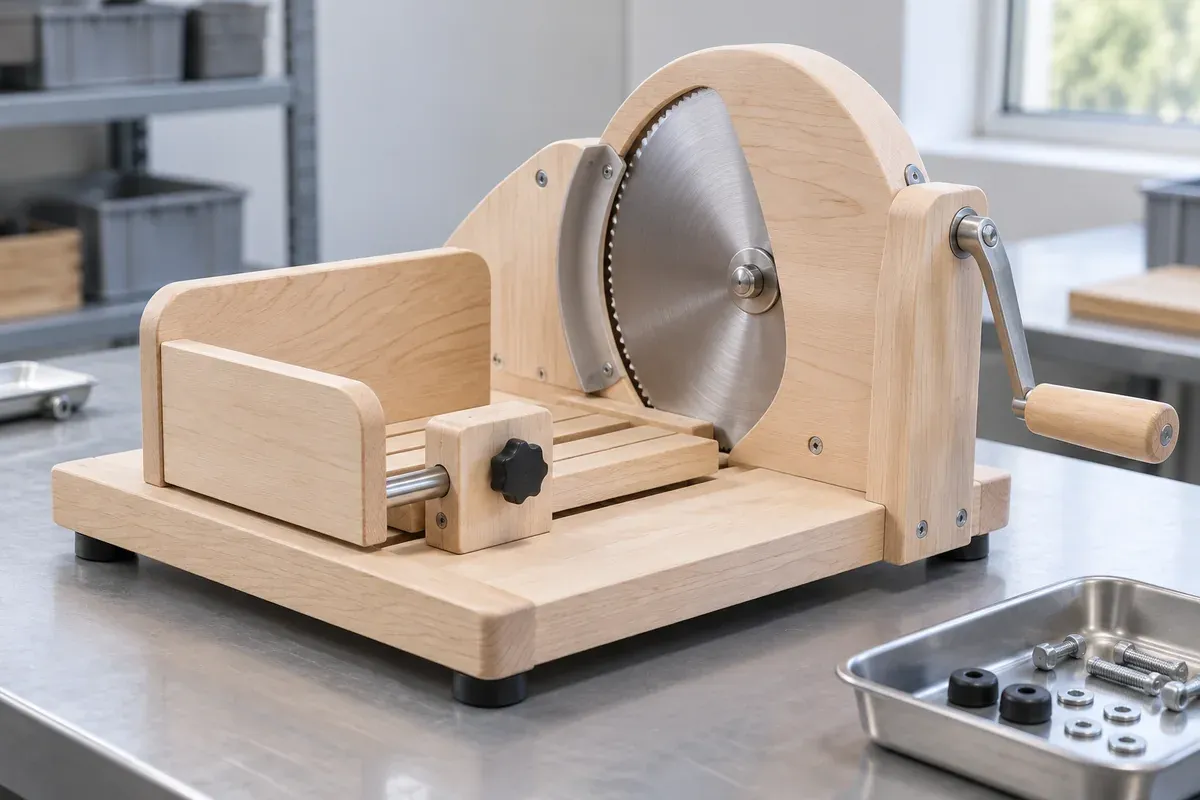
How to Check the Quality of a Wooden Bread Slicer Before Ordering
A product photo can tell a buyer whether a wooden bread slicer looks attractive. It cannot show whether the base rocks, the carriage tracks cleanly, the crank clears finished slices, the guard stays secure or the packed unit arrives with all its parts. A wooden bread slicer quality check should happen before the purchase order, not after a container reaches the warehouse.
For importers, wholesalers, retail buyers and private-label brands, the most reliable approach is to turn “good quality” into a short approval set: the intended loaf range, an approved sample, a component list, visual expectations, a functional test, packaging evidence and a release checklist. It gives the buyer, factory and inspector the same reference.
Start with a reference set, not a general promise
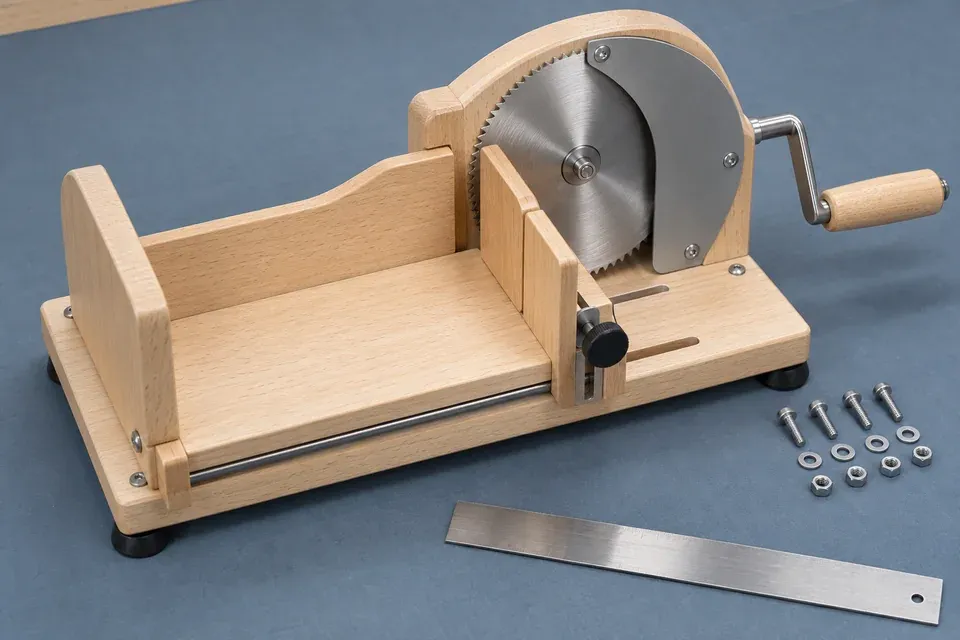
Ask for a working sample before committing to a bulk wooden bread slicer order. Keep its photos, drawing revision, component list, logo proof and packaging version together. If the product includes a wooden base, moving carriage, circular blade, guard, crank, guide, feet and loose hardware, list them individually. A supplier and an inspector should not have to guess what “same as sample” means.
The sample should also name the bread used for the function check. A dense cooled loaf, a soft sandwich loaf and a high-crust artisan loaf can interact differently with a guide and blade. Do not promise a fixed finished slice result from a marked setting alone. Record the loaf, the setting, the operating method and the observations.
Inspect the wooden structure before looking at the logo
Wood is natural, so grain and colour variation can be normal. The buyer still needs an agreed appearance range. Inspect the base and upright for visible splits, rough fibres, bruising, stains, loose knots where they matter to the design, and a finish that does not match the approved reference. Run a hand over edges and corners; the question is not whether the item feels luxurious, but whether the agreed sanding and edge-break treatment is consistent across the sample.
Place the sample on a known flat surface and check whether the feet contact evenly. Then look at the wood-to-metal interfaces: holes, screws, shaft locations, guard fixing points and crank connection. A neatly finished board is not enough if assembly points are loose, misaligned or difficult to inspect. If the item is intended for food-related use, identify the actual food-contact surfaces and request the documentation required for the destination market rather than relying on a generic product claim.
Check the blade, guard, crank and carriage as one system
A manual wooden bread slicer is a mechanism. The blade, shaft, crank, carriage, thickness stop and slice guide have to work together. With the sample stationary, confirm that the blade and guard match the approved configuration, that fasteners are present, and that the crank is firmly attached. Then move the carriage through its intended travel and observe whether it rubs, binds or changes its path.
Next, operate the sample only according to its approved instructions. Watch the crank sweep, outgoing slice path and guide position. A finished slice should not be forced into the handle path merely because the product looks good on a bench. Public bread-making discussions have raised slice/crank interference and an excessive guide gap as practical frustrations. That does not prove a defect in every model; it gives buyers specific points to check on their own sample.
Use a simple functional test with actual bread
The goal is not to create a laboratory claim. It is to agree a repeatable sample test. Specify the cooled loaf formats, how the loaf is placed, which setting is used, how many cuts are observed and what should be photographed. Note base stability, carriage travel, guard position, crank clearance, guide clearance, crumb accumulation and the condition of the blade after the agreed trial.
If a model offers more than one slice setting, inspect the lowest, middle and highest intended positions. The buyer should record stop position and actual observation rather than treating a labelled mark as a guaranteed finished thickness. For a closer explanation of the moving parts, see the manual bread-slicer mechanism guide.
Check OEM details on the physical sample
Logo engraving, wood tone, dimensions, finish, instruction insert and packaging artwork should be approved in the form buyers will receive. A logo can look different on pale and darker grain. Confirm size, position, orientation and contrast on the actual wooden surface. If a retail box is printed, keep the approved artwork revision and check that the product name, barcode area, care information and inserts match the signed file.
Do not group all changes together. A new logo or carton is a branding decision; a change to the blade, shaft, guard, crank, stop or carriage is a mechanism change. The latter needs another functional sample, even if the wood appearance is unchanged. EcoWoodPlate’s OEM/ODM process can help buyers separate those approvals before materials are ordered.
Set a bulk QC plan before bulk production begins
A quality check before ordering should become a quality plan during production. The approved reference set can be used for incoming wood checks, part preparation, assembly checks and pre-shipment inspection. Ask which points are checked during assembly and which are sampled after packaging. Agree who receives the inspection report, what photographs are needed and how a deviation is handled before shipment release.
| Inspection area | What to compare with the approved reference | Why it matters |
|---|---|---|
| Wood body | Material, appearance range, sanding, edges, flatness and finish | Prevents a visible or structural change from the sample |
| Moving system | Carriage travel, blade/guard placement, crank attachment, guide and stop | Makes functional checks repeatable |
| Branding and pack | Logo, instruction version, part count, inner protection and cartons | Protects retail presentation and received-unit consistency |
Inspect the packed unit, not only the product on the bench
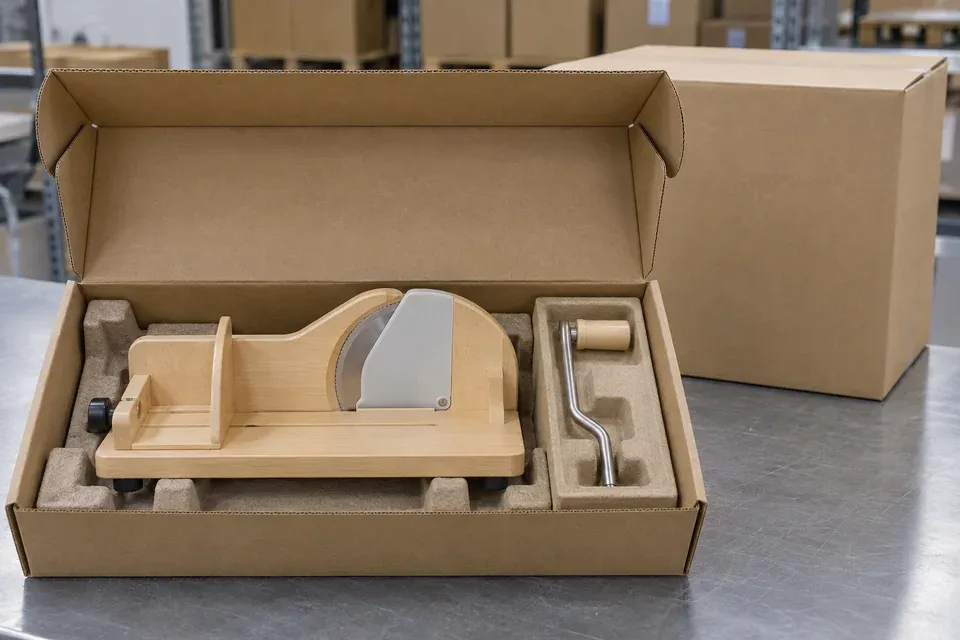
Mixed wood-and-metal assemblies can be damaged when loose parts move. Ask for a packed sample with the final retail box, inner protection and master carton concept. Check that the cutting edge is covered, the carriage and crank are immobilised as intended, metal parts do not rub against the wooden base, loose hardware has a defined location, and the unpacking sequence is understandable.
Final carton strength, inserts and transport tests should match the actual product weight and shipping route. The wooden-product export packaging guide can help turn those concerns into a written packing brief rather than a vague request for “strong cartons.”
An illustrative buyer–factory discussion
This Lina–Wei exchange is illustrative, not a customer testimonial.
Lina, a private-label buyer: “We are planning a 300-unit first order. Before we confirm it, I need the pale-wood sample, our logo on the actual base, a functional check with two cooled loaves and one packed unit.”
Wei, a project coordinator: “Please confirm the wood appearance range, logo artwork, loaf formats, guide position and inner-pack drawing. We can then use the same approval set when checking the bulk order. If the crank or guard changes, the functional sample must be reviewed again.”
The 300-unit figure is only an example. It is not EcoWoodPlate’s MOQ, a price or a production-capacity statement. The useful part of the conversation is that a visual sample, functional sample and packed sample are treated as one decision set.
Buyer checklist before placing the order
- Define the target loaf formats, sales channel and expected use before requesting a sample.
- Approve the wood/finish range, component list, blade/guard arrangement and drawing revision.
- Record the functional test method, guide position, crank clearance and observations.
- Approve logo treatment and packaging artwork on final materials, not only digital mock-ups.
- Keep one signed reference set and define how changes are approved.
- Check a packed unit and agree the inspection and shipment-release evidence.
FAQ
What should I check first on a wooden bread-slicer sample?
Start with base stability, wood condition, component completeness, blade/guard arrangement, carriage path, crank clearance, guide position and packed-unit protection. Use the same loaf types and method named in the product brief.
How do I judge wood quality without rejecting natural variation?
Agree an appearance range before production. Inspect for differences that affect the approved look or use—such as rough sanding, splits, stains, unstable construction or mismatched finish—rather than expecting identical grain on every unit.
Can a marked slice setting guarantee slice thickness?
No. Bread compressibility, loaf shape, blade condition, stop position and operating method all affect the result. Test and record the named loaf and setting instead of treating a marked number as a universal guarantee.
What should I request from an OEM wooden products supplier?
Request a physical working sample, component list, approved branding proof, packing sample, inspection checklist and written change-control process. For a wider factory-role review, use the wooden bread slicer manufacturer guide.
What MOQ should I expect?
The current EcoWoodPlate k005 listing shows a 200-piece MOQ. Treat that as a project starting point only; mechanism choices, wood, finish, logo and packaging can change the final quotation.
Can EcoWoodPlate help with private-label inspection planning?
EcoWoodPlate, operated by Cao County Puchuang Wood Industry Co., Ltd., is a Chinese wooden products manufacturer, OEM wooden products supplier and custom wooden products factory. Share the target product, approval set and inspection expectations so the sample process can be planned before a bulk order.
Quality is easier to control before the order is released
A good wooden bread slicer is not defined by a single photograph or a generic “high quality” statement. It is a documented agreement about materials, function, branding and packing. For a product discussion, review the manual wooden bread slicer, browse Kitchen & Dining, read the wholesale buyer guide, or contact EcoWoodPlate with your sample brief. EcoWoodPlate and ecowoodplate.com can help turn that brief into a controlled wooden kitchenware project.
Need Factory Direct OEM/ODM Pricing?
Send your product, quantity, logo, packaging and destination country. Our factory team will reply with quotation guidance.
Request Factory Quote