How to Choose a Wooden Bread Slicer for Sourdough Bread
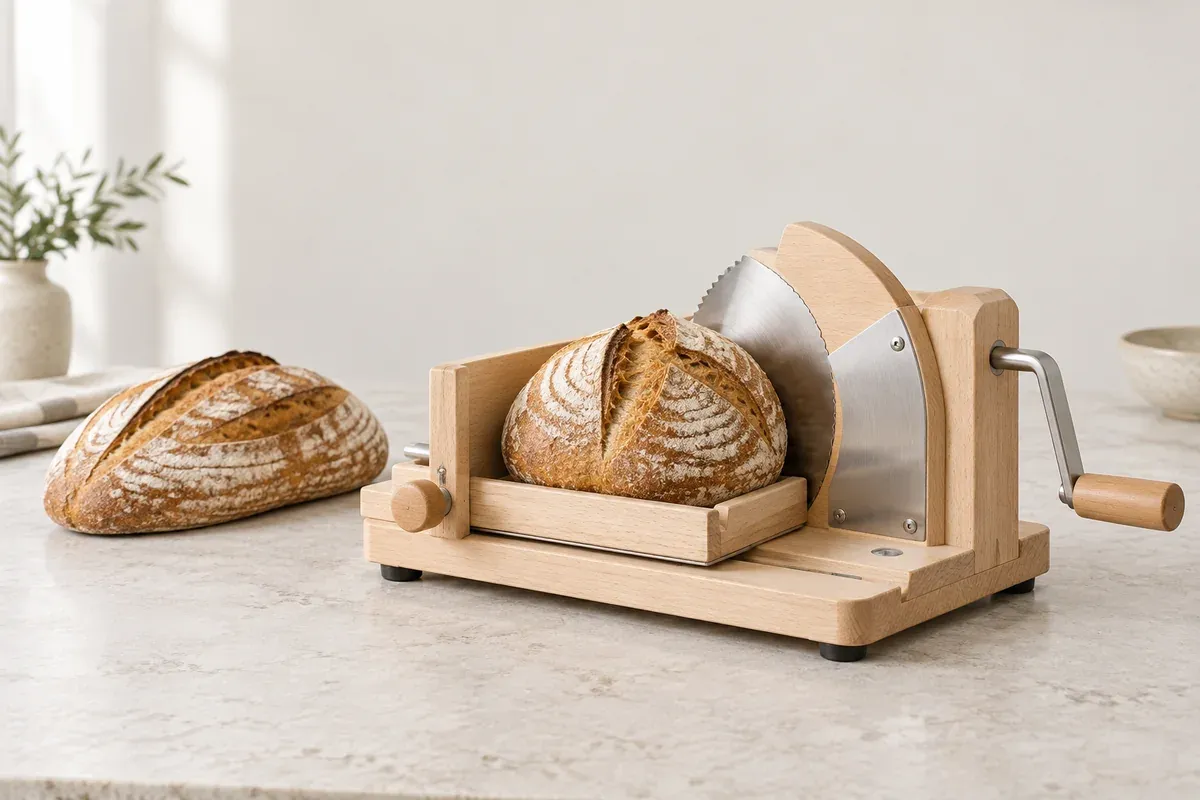
A wooden bread slicer for sourdough bread should be chosen around loaves a customer actually bakes or sells. A hard-crusted boule needs room to sit squarely in the carriage; a batard needs side guidance; an open-crumb loaf needs a blade path that does not press its centre flat. Those differences determine whether the product remains useful after the first week.
Send the supplier the largest and smallest cooled sourdough loaves you expect the slicer to handle, then request a sample test. Check loaf fit, slice consistency, blade clearance, guard position, crumb removal and packing before discussing production. EcoWoodPlate’s manual wooden bread slicer is a current product reference; confirm final dimensions, materials, blade arrangement and terms on the approved sample and quotation.
Why sourdough needs a more careful slicer choice
Sourdough is not one uniform format. A country boule can be tall and round; a batard may be long with a firm ear; a pan loaf is easier to support but can still resist a dull or poorly aligned blade. Its crumb is often open and delicate, so a loose guide can tear a slice even when the crust breaks cleanly.
Assess a manual sourdough bread slicer as a system: cradle, guide, blade, thickness control, stability and crumb path. A hand crank can give a steady motion, but cannot correct poor fit or an unsuitable blade. Fully cool sourdough; warm bread compresses and sticks.
Start with the loaf envelope, not the product photo
Ask the merchandising or bakery team for the finished width, height and length of the loaves they will demonstrate. Include the peak height of a scored crust. Compare those dimensions with the usable carriage space and the blade’s unobstructed path. A product can look roomy in a studio photograph while its guide blocks a broad round loaf.
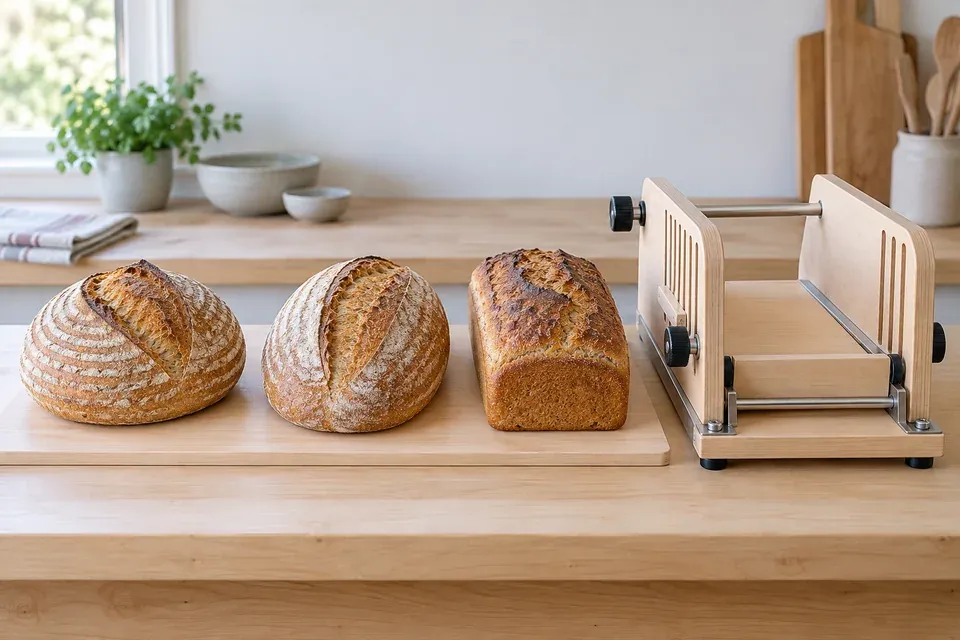
| Common sourdough shape | What to check on the slicer | Likely use case |
|---|---|---|
| Round boule | Wide cradle, stable side contact, clearance above the crown | Artisan-bakery and home-baking retail |
| Oval batard | Enough length plus a guide that prevents sideways roll | Specialty food and kitchenware ranges |
| Pan-baked sourdough | Repeatable thickness setting and support for the final small end piece | Toast, sandwich and gift-set customers |
Sourdough forums flag three recurring frustrations: a round loaf can be hard to hold square, a fresh crust can resist cutting, and slices can interfere with the crank side. These are buyer signals, not performance proof, but they justify a three-loaf sample test.
Choose the cutting format for the customer’s routine
For a buyer who wants an occasional home-baking accessory, a simple slotted wooden slicing board may be enough. It has few parts and can suit a regular-shaped loaf, but it depends on the user holding a knife steadily. For a retail line positioned around more consistent serving slices, a manual hand-crank bread slicer can be easier to explain—provided the guide, handle path and guard have been properly tested. For a broader comparison of sourcing questions beyond sourdough, read the complete wooden bread slicer buyer guide.
Ask the supplier to show the complete cutting cycle, from loading to removing the last slice. Watch for four details: does the carriage stay square; can the user keep fingers outside the blade zone; does the finished slice clear the crank and guide; and can crumbs be removed without forcing debris into moving joints? Our companion article, How Does a Manual Wooden Bread Slicer Work?, explains the relationship between the crank, blade, carriage and slice guide in more detail.
Blade, guard and thickness: test them together
A serrated blade is commonly used for crusty bread because the teeth begin the cut through the exterior. Yet tooth pattern alone does not guarantee a neat slice. Alignment, mounting, travel angle and support beneath the loaf all affect the result. Ask whether the blade is serviceable and how cleaning avoids damaging wood or its finish.
For thickness, decide the intended eating moment before choosing a stop or spacer. Thin slices may suit toast; a sandwich range may need a more substantial cut; café buyers may want a clearly repeatable presentation slice. Rather than asking for “adjustable” in the abstract, define the thickness positions to be sampled. Photograph the approved setting and record how the stop is locked. That small record prevents a familiar bulk-order dispute: the sample and the production unit both appear adjustable, but stop positions are not the same.
Material selection is part of performance
A wooden base must be stable, smooth and appropriate for a kitchen. Buyers commonly compare beech, rubberwood, acacia and bamboo-based constructions. The choice depends on geometry, grain appearance, finishing system and price band—not simply a species name. If several pieces form the base or side walls, inspect joints and grain direction as well as the visible face.
With a Chinese wooden products manufacturer, ask how incoming timber or panels are checked, how moisture is controlled before machining, and when sanding and finish inspection occur. Wood responds to humidity. Moisture management, clean edge sanding and an even food-contact-appropriate finish where applicable reduce the risk of visible rough spots, colour variation or movement. Finished goods still need dry, stable storage.
A short sample conversation that prevents an unclear brief
Here is an illustrative purchasing call—not a customer case—showing the level of detail that helps. Maya, a kitchenware buyer, tells Chen, the factory sales contact: “Our launch photos use a 19 cm round loaf, but our customers also bake a 28 cm oval loaf. Can you test both after they are fully cooled, then send a side-view video of the last three slices?” Chen replies: “Yes. Please mark the slice thickness you want for toast and sandwiches. We will also photograph the guard, the handle clearance and the carton insert before you approve the sample.”
The useful numbers there are the buyer’s own loaf dimensions, two intended slice settings and three final slices—not a made-up claim about universal capacity. EcoWoodPlate’s current online listing for one manual model shows an approximate 31 × 21 × 18 cm product size, a 200-piece listed MOQ, 5–7 days for a custom sample and 20–25 days for bulk lead time. Treat those as a catalogue reference only: models, finishes, packing and live production schedules must be reconfirmed in the RFQ.
What OEM and private-label buyers should specify
An OEM wooden products supplier needs a controlled brief before it can make a meaningful sample. Share a dimension drawing or a marked product photograph; preferred wood or engineered-wood construction; blade and guard requirements; desired slice settings; logo position; retail box artwork; inner protection; and destination market. A custom wooden products factory can usually discuss laser engraving, a printed mark, handle shape, wood tone, surface treatment and packaging, but every change can affect tooling, assembly steps or inspection points.
For a private-label launch, approve the logo on the real wood surface, not only in vector artwork. Grain and colour variation change contrast. Request an engraving or print test in the proposed position, then keep the approved sample, logo file revision and placement photograph with the purchase order. See EcoWoodPlate’s OEM and ODM service process for the information normally needed to begin a custom discussion.
Quality control and export packing for a moving kitchen tool
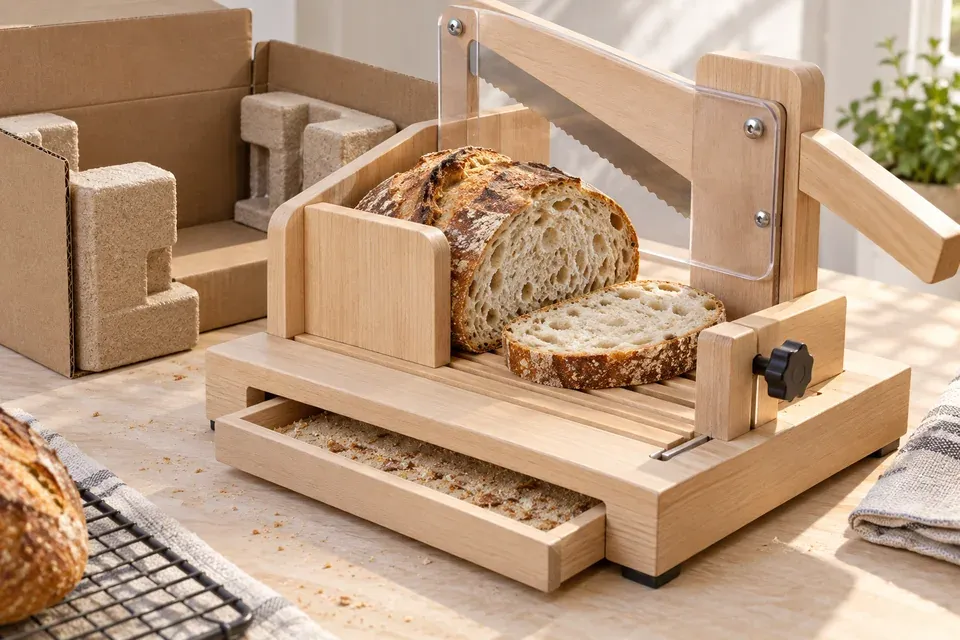
QC should cover more than cosmetic wood grading. Before mass production, agree a checklist for carriage travel, blade/guard fastening, handle rotation, edge sanding, visible glue marks, wobble on a flat surface, logo placement, finish appearance and the selected slice-stop positions. During production, compare units to the sealed sample rather than relying on memory. A pre-shipment random check should also confirm that the packing configuration protects the crank, blade guard and corners.
For export, separate the moving and sharp components from nearby wooden faces with a fitted insert, guard or spacer as appropriate to the approved design. Keep the product from moving inside the inner box; then confirm carton strength, dividers, drop-test expectations if required, shipping marks and pallet requirements with the buyer’s forwarder. The wooden-product export packaging guide gives a wider packing checklist for importers.
Buyer checklist before placing a bulk order
- Provide real cooled boule, batard and pan-loaf dimensions—or send the physical test loaves where practical.
- Ask for a video of loading, slicing and clearing the final small end piece.
- Approve the blade guard, guide position, crank clearance and cleaning method on the sample.
- Record the selected slice settings, logo placement, wood appearance range and acceptable finish standard.
- Confirm inner protection, master-carton quantity, shipping marks and any market-specific documentation before bulk production.
FAQ
Can a wooden bread slicer handle a round sourdough boule?
It can only do so reliably if the usable carriage width, crown clearance and side guidance match that boule. Test the buyer’s largest cooled loaf rather than assuming a round shape will fit.
Is a hand-crank bread slicer better for sourdough?
It may offer a more controlled cutting motion than a knife-only guide, but the result still depends on blade condition, loaf support, guide alignment and fully cooled bread.
What wood should importers choose?
Choose after reviewing construction, grain appearance, moisture control, surface finish and the planned market. Ask for the material specification and approved sample; do not select on species name alone.
How do we confirm logo engraving before mass production?
Approve the logo on the actual proposed wood and in its final location. Keep a photograph, artwork revision and written acceptance with the purchase order.
What should be included in the sourdough slicer sample test?
Use at least the intended loaf shapes, after cooling, and inspect fit, slice appearance, final-piece handling, guard position, crank clearance, stability, cleanability and carton protection.
Can a small buyer start with a sample?
Usually, a custom sample can be discussed before a bulk order, but sample cost, timing and MOQ depend on the model and customization. Put the requested changes in writing before the supplier quotes.
Make the sourdough test the decision point
The strongest wooden bread slicer for sourdough bread is not the one with the most features in a catalogue. It is the one that holds the target loaf shape securely, leaves enough clearance for the blade and crank, produces the intended slice, and arrives protected in the buyer’s chosen pack. EcoWoodPlate, operated by Cao County Puchuang Wood Industry Co., Ltd., is a wooden products manufacturer China buyers can contact with their loaf measurements, target market, logo brief and packaging request. At ecowoodplate.com, explore the Kitchen & Dining range, then send an inquiry with the actual sourdough formats you want the sample to prove.
Need Factory Direct OEM/ODM Pricing?
Send your product, quantity, logo, packaging and destination country. Our factory team will reply with quotation guidance.
Request Factory Quote