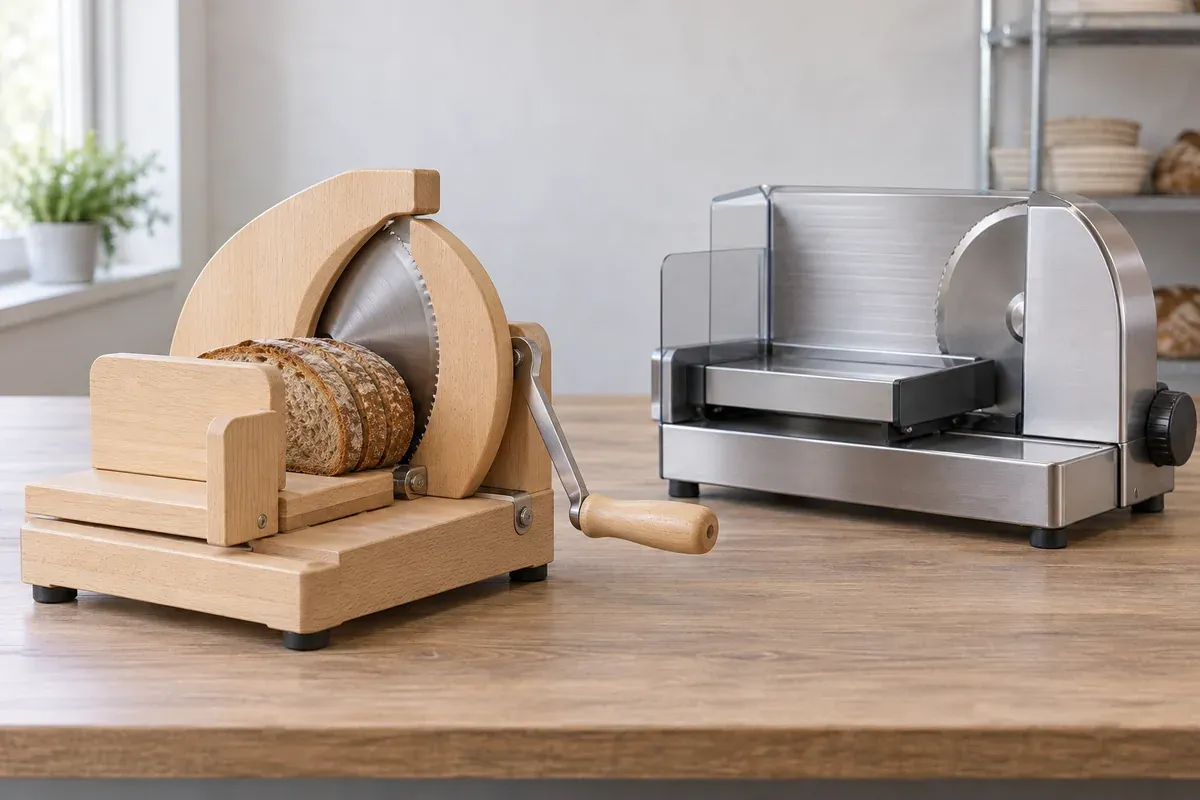
Wooden Bread Slicer vs Bread Slicing Machine: Which Is Better?
A wooden bread slicer is not automatically better than a bread slicing machine, and a machine is not automatically the better business purchase. They belong to different buying categories. A wooden hand-crank slicer can be a sellable kitchenware product for home bakers, specialty retailers and gift programs. A bread slicing machine is equipment selected around a bakery’s loaf range, operating pattern, space, power and service plan.
For an importer or purchasing manager, the useful question is: are we sourcing a branded wooden product to resell, or are we equipping a bakery to process bread? Once that is clear, the RFQ, sample, quality plan and packaging all change.
The direct answer: choose the job, not the faster-looking product
A manual wooden bread slicer suits a compact, product-led offer. It can sit in a home-baking range, be paired with a board or bread box, and be customised with a logo, wood appearance and retail pack. A hand-crank version has a base, carriage, blade, guard, guide and crank. A slotted wooden guide uses the buyer’s own knife. Neither should be quoted as a replacement for a bakery production line.
A bread slicing machine is the better route when a bakery needs a defined operating workflow and has established what it must process. That purchase needs a machine supplier who can confirm the actual model’s loaf envelope, blade system, slice setup, power requirement, cleaning method, guards, documentation, service parts and destination-market requirements. The term covers many designs, so a photo cannot select one.
| Decision point | Wooden bread slicer | Bread slicing machine |
|---|---|---|
| What is being bought? | A retail kitchenware product or lower-volume countertop tool | A defined bakery or food-service equipment configuration |
| First information to provide | Loaf formats, product finish, logo, retail pack and sample checks | Peak workflow, loaf dimensions, slice requirement, space, power, cleaning and service needs |
| Main order risk | Sample-to-bulk changes in wood, mechanism fit or pack-out | An unspecified machine is unsuitable for the site, bread or support requirement |
Start with the sales channel and the daily bread routine
A retailer may need a wooden slicer because it belongs in a curated kitchenware assortment. The purchaser is balancing product appearance, shelf presentation, instructions, outer carton and the customer’s experience of a hand-operated tool. In this case, a manual wooden bread slicer can be commercially sensible even if it is not the quickest way to process a loaf.
A bakery or commissary needs a different brief. Ask what bread is sliced, whether it is cooled before processing, the largest loaf length, width and height, the expected slice format, the busy period, and who will clean and maintain the equipment. A buyer should size a machine around the busiest realistic workflow rather than an average day or an attractive product video. Crust, crumb and loaf shape can matter as much as volume.
Public user discussions often turn up practical frustrations rather than neat product categories: a finished slice reaching the crank, a guide getting in the way, a machine that does not fit a particular loaf, or a product that is awkward to store. Those are useful prompts for a sample test or technical brief, not proof that every model has the same issue.
What makes a wooden bread slicer a product program
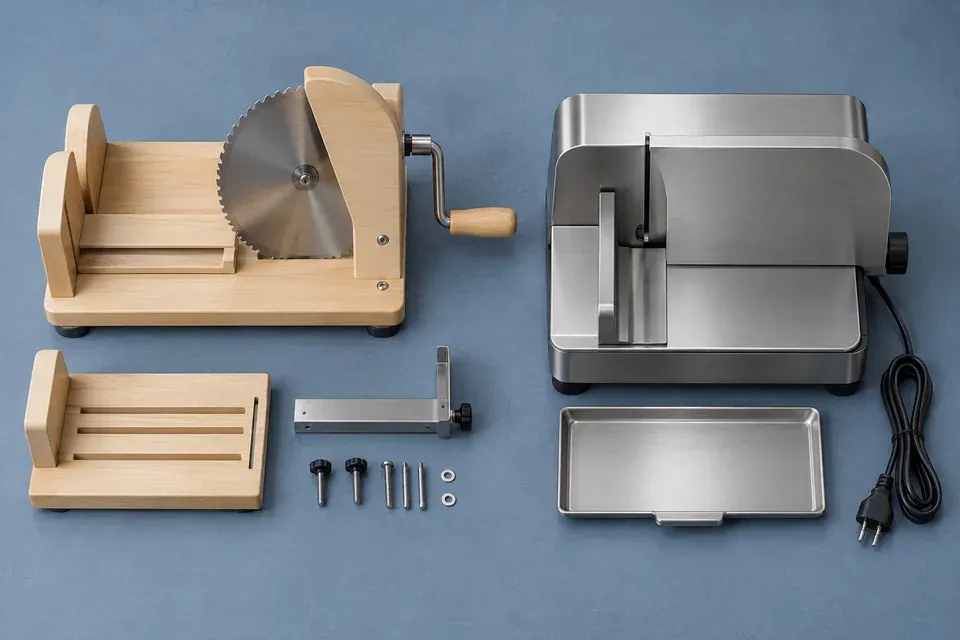
A wooden hand-crank slicer is an assembly, not just a wood base. The buyer should specify the proposed wood or wood-based construction, visible grain and colour range, sanding and finish, base flatness, carriage path, crank attachment, guard position, guide placement, fasteners and small parts. The interfaces between wood and metal deserve as much attention as the visible surface.
EcoWoodPlate’s current manual hand-crank bread slicer is a wooden kitchenware product. It provides a useful starting point for discussing a retail program, not a claim that the item is an industrial bread slicing machine. The current catalog shows a 200-piece MOQ, but any buyer should reconfirm the minimum and what it includes in the project quotation: wood selection, finish, logo method, inner protection, printing and order sequence can alter the assumptions.
What makes a bread slicing machine an equipment purchase
For a machine, state the actual loaf range before asking for a quote. Record maximum cooled loaf dimensions, bread type, crust and crumb, target slice format, peak demand, operating area and the handling route from loading to bagging. Then document the available voltage, frequency, plug or connection expectation, installation space, ventilation/access clearance, cleaning routine and expected service support.
Ask the machine supplier to identify the model-specific blade arrangement, guard and control configuration, parts route, operating instructions, cleaning process and documents available for the destination. A powered bread machine should not be evaluated by borrowing claims from a meat slicer, a household appliance or an unrelated bakery line. It is the supplier’s configuration, not the generic phrase “electric,” that must be reviewed.
Compare samples and technical proof differently
A wooden-slicer sample should prove the agreed material appearance and function. Test the named loaf types and record whether the base sits flat, the carriage moves as intended, the crank clears finished slices, the guide position is repeatable, the guard stays where agreed and the hardware is complete. The hand-crank mechanism guide explains the components that should be visible in that review.
For a bread slicing machine, a sample, demonstration or technical review should establish the actual machine model, loaf fit, operating instructions, cleaning access, electrical configuration, guards and controls, and planned parts support. If an importer cannot see the machine in person, request clear model-specific information and agree what the pre-shipment review must verify. Do not call two products equivalent merely because both can cut bread.
OEM and branding: keep the scopes honest
With a wooden product, OEM work can focus on logo engraving, wood tone, an instruction card, retail-box artwork or coordinated kitchenware. Approve a logo on the actual wood surface because grain and colour can alter contrast. Keep the approved artwork, placement, orientation, component list and pack-out photographs with the purchase order. A change to the blade, shaft, carriage, guard or stop is a mechanism change and needs its own sample review.
For a machine, a colour or label request does not automatically make an easy private-label project. A change to an electrical, guard, control or documentation detail may affect the final configuration and supplier responsibility. EcoWoodPlate’s OEM/ODM process is for its wooden-product scope. It should not be read as electric-machine design or compliance support.
QC and export packing should follow the chosen category
For a wooden bread slicer, the pre-shipment plan can cover material appearance, edge finishing, base flatness, hardware count, blade/guard attachment, carriage and crank movement, guide/stop position, logo location and inner-pack protection. Compare ready goods with the signed sample and approved component list, not only with a chat image. For a sourcing review, use the wooden bread slicer manufacturer checklist.
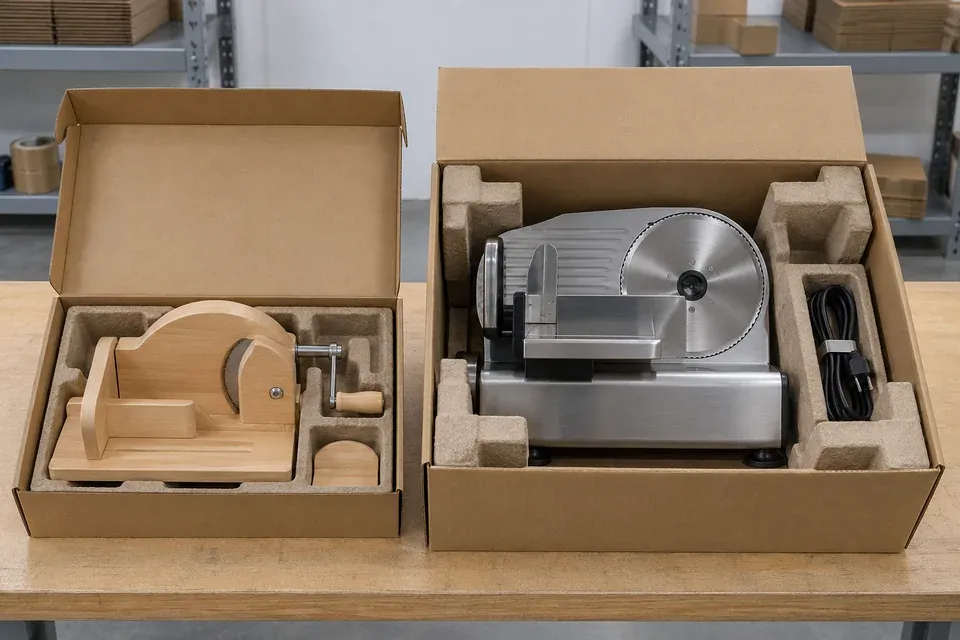
For a bread slicing machine, the inspection plan should reflect the selected model: stated power configuration, moving parts, guards and controls, labels, manuals, accessories, parts and the relevant shipping protection. Never assume a carton designed for a light manual product will protect powered equipment. The product and its route determine the final pack-out.
An illustrative sourcing conversation
This Elena–Noah exchange is illustrative, not a customer testimonial.
Elena, a retail buyer: “We are planning a 180-unit first order for independent kitchen stores. We want a pale wood appearance, a logo on the base and a box that keeps the crank from moving.”
Noah, a sourcing coordinator: “That is a wooden product brief. Let us approve the logo test, the real component list, the operation check and the packed sample. If your bakery customer also needs to slice a regular morning production run, make that a separate machine enquiry with bread sizes, peak workload, power and site requirements.”
The 180-unit quantity is only an example. It is not an MOQ, price, capacity statement or recommendation for a bakery. It shows why “which is better?” has to be answered against a real purchase purpose.
Buyer checklist before the RFQ
- State whether the purchase is a resale product, low-volume tool or bakery equipment project.
- Provide actual cooled-loaf dimensions, bread characteristics and desired slice format.
- For wooden products, approve wood/finish range, components, logo proof, functional sample and packaging.
- For machines, document power, space, cleaning access, guards/controls, support and destination requirements.
- Use one written acceptance reference for the supplier, buyer and any inspector.
- Review cartons, inner protection and handling needs before the bulk order starts.
FAQ
Which is better, a wooden bread slicer or a bread slicing machine?
A wooden slicer is better for a product-led kitchenware or lower-volume use case. A machine is better when the buyer has an equipment workflow with documented loaf, power, cleaning and service requirements. There is no universal winner.
Can a wooden hand-crank slicer replace a bakery bread slicing machine?
Do not assume that it can. A hand-crank retail product should not be marketed as a bakery production-line replacement. Select equipment against the actual model specification and operating need.
What should a bread slicing machine RFQ include?
Include bread type, maximum cooled-loaf dimensions, required slice format, peak demand, power supply, installation space, cleaning workflow, operating context, destination market and documentation/service expectations.
What should a wooden bread-slicer sample prove?
It should prove the agreed wood appearance, component fit, base stability, carriage path, crank clearance, guide and guard position, logo treatment, hardware count and approved pack-out.
Can EcoWoodPlate make a bread slicing machine?
EcoWoodPlate, operated by Cao County Puchuang Wood Industry Co., Ltd., is a Chinese wooden products manufacturer and OEM wooden products supplier. Buyers needing powered equipment should work with a specialist able to document the actual machine configuration, power, parts and destination requirements.
How do I start a wooden bread slicer project?
Send target loaf formats, intended sales channel, preferred construction, logo request, packaging expectations and order sequence. A custom wooden products factory can then define the sample and bulk-order checks. Visit Kitchen & Dining, read the wholesale buyer guide, review the export-packaging guide, or contact EcoWoodPlate with the brief.
Make the category decision before ordering
The better choice is the one that matches the job. A wooden bread slicer can be a well-controlled private-label kitchenware offer. A bread slicing machine can be the right equipment purchase once its specific workflow, power, safety, cleaning and support needs are defined. EcoWoodPlate and ecowoodplate.com can help buyers build the wooden-product side with an approved sample and clear bulk-order controls.
Need Factory Direct OEM/ODM Pricing?
Send your product, quantity, logo, packaging and destination country. Our factory team will reply with quotation guidance.
Request Factory Quote