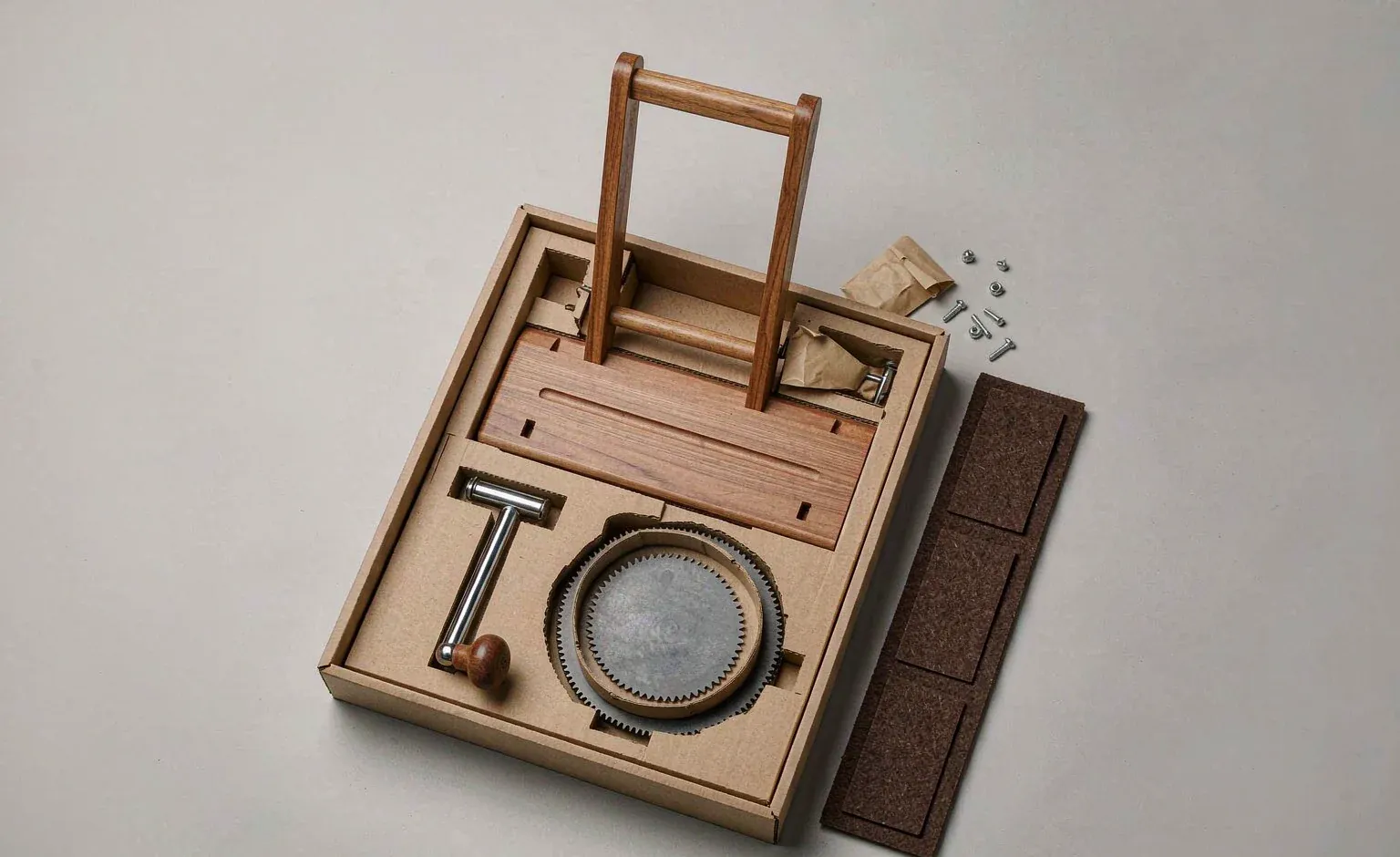
AI-generated concept illustration, not an EcoWoodPlate product photograph, pack-out or approved production sample. Each moving part is assigned a defined position rather than simply wrapped.
A retail pack for a manual wooden bread slicer has to do four jobs at once: keep a sharp circular edge away from everything it can reach, keep a metal crank from migrating across a finished wood surface, hand the customer every loose part, and explain how to care for what they just unpacked. Miss one and the return reason gets written by the buyer's customer.
This is about the box a consumer opens. Master cartons, pallets, ISPM 15 and freight handover belong to EcoWoodPlate's international shipping guide for wooden bread slicers.
The retail box is the marked surface
A printed box is not only a brand surface. Under 19 CFR 134.11, every article of foreign origin — "or its container" — must be marked to indicate the English name of the country of origin to an ultimate purchaser in the United States, and 19 CFR 134.22(d)(1) defines a usual container as the one in which a good will ordinarily reach that purchaser. If the slicer reaches the consumer in a printed box, that box can carry the origin statement — an artwork approval item, not an afterthought.
The barcode is the second marking decision. A GTIN-12 is the only type encodable in UPC-A; GS1 US states each distinct option needs its own, while a GTIN-14 identifies a case grouping. GS1 US also advises placing the symbol lower right on the back panel with an unprinted quiet zone either side, and warns against truncation or stretching — a symbol that does not fit must be rebuilt at target size.
Example Conversation: Two marks on one artwork file
Buyer: "We want the front clean. Can we move the country of origin to a sticker under the unit?"
Supplier: "19 CFR 134.11 lets the article or its container be marked, and 134.22(d)(1) treats the box the product reaches the consumer in as a usual container. Safer, and it does not depend on a sticker surviving."
Buyer: "Can the acacia and beech versions share a barcode?"
Supplier: "A different material is a distinct trade item needing its own GTIN. Reusing one gets caught at the register, not in the sample room."
Protect the blade edge like it is the product
No packaging standard specifies a blade guard for a countertop slicer, and that is worth saying: the requirement cannot be looked up, so it has to be written and proven. What gives the writing a target is the test. ISTA 3A covers packaged-products of 70 kg (150 lb) or less through a parcel system, running nine drops with height varying by weight, then random vibration with and without a top load, then eight further drops including hazard drops.
Seventeen drops plus vibration is what the blade retention has to survive. Put that in the specification and "please protect the blade" becomes something a factory can build and an inspector can fail.
| What can move | What holds it | How you judge it |
|---|---|---|
| Circular blade | Full-edge sleeve, seated so teeth cannot reach a wall | After test: sleeve intact, no mark on the liner |
| Hand crank | Deep channel with end stops, or bagged | Crank has not moved; no rub mark on the base |
| Guard and slice guide | Captured by the insert, not free-floating | Same position before and after |
| Loose fasteners | Sealed bag in a defined recess | Count matches the label; bag still sealed |
Keep metal off the wood
The wood is the surface the customer looks at, and a crank that can move will find it. The Fibre Box Association glossary defines inner packing as materials or parts used to support, position or cushion an item within a container, or to fill voids — three functions bought as one vague line. Write them as three, because the rule fits in one sentence: no bare metal touches a finished wood surface anywhere in the pack. Then name what achieves it — a sleeve, a divider, a top pad, a bagged crank.
Example Conversation: Stronger carton, same complaint
Buyer: "Last season we had scuffed bases. Use a stronger carton."
Supplier: "Board grade answers compression. Your complaint was a rub mark — a movement problem, not a strength one."
Buyer: "So change the insert?"
Supplier: "Change both if you like, but keep them as separate lines — when one fails you will want to know which."
The hardware count is a packaging problem
EcoWoodPlate's current hand-crank wooden bread slicer lists one piece per inner box and six per export carton, with a 200-piece MOQ and 20–25 day lead time — catalogue reference points, not a quote. The arithmetic stops packaging being cosmetic: seven fasteners across nine hundred units is more than six thousand pieces to count and keep off finished wood.
Decide three things in writing: whether a spare kit ships in the box and where; whether the bag is sealed and labelled; and what evidence closes it — dated photos of the open pack with the count visible.
Write the instruction sheet around the product you shipped
For a general-use adult kitchen product there is no federal mandate for a care or hazard label. The Federal Hazardous Substances Act's mechanical-hazard path runs to a "toy or other article intended for use by children," per 15 U.S.C. 1261(f)(1)(D), though its hazard definition covers surfaces and edges. Nor is "hand wash only" required: the only federal care-labelling rule, 16 CFR 423.3, covers textile wearing apparel.
So the sheet is a commercial decision, and the cheapest one available. Name the loaf sizes tested, say whether the guide bracket is removable and which tool fits, and match the care text to the finish that shipped.
California is the one place a warning may be owed. Wood dust is on the Prop 65 list for cancer, listed 18 December 2009 under the Labor Code basis, and the obligation is triggered by exposure rather than by containing a listed chemical. The call belongs to your compliance counsel — what the factory needs is narrower: a required warning sits on the retail pack and carries a revision number.
Example Conversation: The knob that invalidated the insert
Buyer: "We changed the crank knob. Can we finish the old sheets first?"
Supplier: "The sheet says how the old one fits. A customer following it will read the difference as a defect."
Buyer: "It is only a knob."
Supplier: "It is the only part they touch."
Specify the carton before the artwork
Dimensions should come out of the packed unit, not precede it. The Fibre Box Association glossary puts it directly: inside dimensions assure proper fit around a product, outside dimensions are used in carrier classifications and pallet patterns. Add insert thickness to the real product, get the inside dimensions, then read the outside dimensions into the pallet plan. Choosing a stock carton first and hoping the insert absorbs the difference is how voids and crushed corners arrive.
The board has a vocabulary worth using. Edge crush resistance is the force needed to cause compressive failure of an on-edge specimen of corrugated board and a primary factor in predicting a box's compression strength; the Mullen bursting test relates only indirectly to a box's ability to withstand internal or external forces. Singlewall is two liners around one fluted medium, doublewall three with two media. ISTA 3A cites 200 lb/in² burst or 40 lb/in ECT — a usable reference when a supplier asks what "strong" meant.
Then ask for the box maker's certificate, printed within a border on the box guaranteeing that the carrier classifications' construction requirements have been observed and naming the box manufacturer. It is a guarantee from the box maker, not the factory.
| Written as | Means nothing until you add |
|---|---|
| "Strong carton" | Board, flute, ECT or burst, box maker's certificate |
| "Good protection" | Which part is restrained by what, and what failure looks like |
| "Same as sample" | Revision number and dated photos of the open pack |
| "Tested" | Procedure, packaged weight, pass/fail criteria |
Test the retail pack, not a drawing
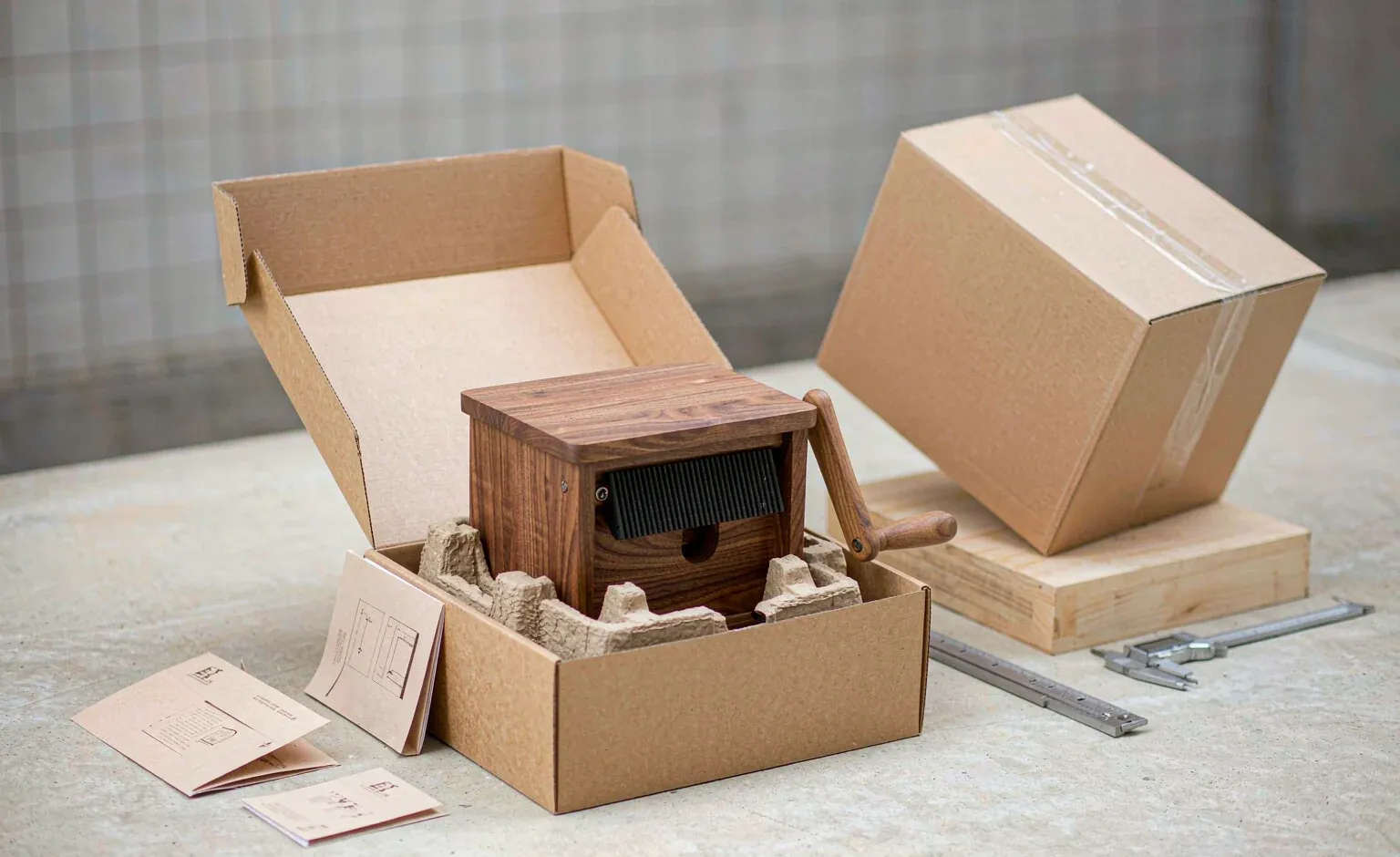
ISTA's series definitions separate the options. The 1-Series are non-simulation integrity tests challenging the strength and robustness of the product and package combination, useful as screening tests; the 3-Series are general simulation tests of the damage-producing motions, forces and conditions of transport environments. The 6-Series are member performance tests reflecting supply chain elements of Global 500 retailers or carriers, including Project 6-AMAZON.COM-SIOC and 6-SAMSCLUB.
One detail saves time at quotation: ASTM D4169 itself directs users to Practice D7386 for single parcel shipments.
Screening or simulation is a budget decision. Pick one, name it in the purchase order, and write pass and fail before anything is dropped — "no damage" is not a criterion an inspector can score.
A retail-pack specification you can send
- Unit. Model, drawing revision, component list, crank attached or separate.
- Blade. Edge protection type, seated position, check that it stayed.
- Crank and guard. Restrained by what; movement allowed.
- Wood surfaces. No metal contact; separation material named; finish cured before packing.
- Loose parts. Bag type, count, label, location, spare kit or not.
- Printed matter. Instruction version, languages, care text, origin, warning if applicable, GTIN and placement.
- Box. Inside dimensions from the packed unit; outside for the pallet pattern; board, flute, ECT or burst; box maker's certificate.
- Test. Procedure, packaged weight, written pass/fail criteria.
- Evidence. Dated photos of the open pack, closed box and tested carton.
Nine lines, each answerable with a number, a name or a photograph. For inspection, see the bread slicer quality check guide.
Frequently asked questions
Does the country of origin have to be engraved on the slicer?
No. 19 CFR 134.11 allows the article or its container to be marked, and 19 CFR 134.22(d)(1) defines a usual container as the one reaching the ultimate purchaser — a printed box can be the marked surface.
Does each version need its own barcode?
Yes, where it is a distinct trade item. A GTIN-12 is the only type encoded in UPC-A and each distinct option needs its own; a GTIN-14 identifies a case grouping.
Is an instruction sheet legally required?
Not for a general-use adult kitchen product: the FHSA mechanical-hazard path is limited to articles for children, and 16 CFR 423 covers textiles. It remains the cheapest way to avoid preventable returns.
Which test should a first order use?
ISTA 1A for screening, or 3A if the unit ships as a parcel — 3A covers packaged-products of 70 kg (150 lb) or less. Define pass and fail before the test, not after seeing results.
Preparing a retail-pack brief?
EcoWoodPlate produces wooden kitchenware and coordinates retail packaging for private-label programs. Send your component list, printing requirements and target channel through the contact page.
Need Factory Direct OEM/ODM Pricing?
Send your product, quantity, logo, packaging and destination country. Our factory team will reply with quotation guidance.
Request Factory Quote