How to Package Wooden Bread Slicers for International Shipping
A wooden bread slicer can pass a bench inspection and still arrive with rubbed wood, a bent crank, a loose accessory or a damaged retail box. That gap usually starts with a vague instruction such as “use strong cartons.” International packing needs a written sequence: protect the moving mechanism, separate hard parts from finished wood, define the inner unit, design the master carton and then agree how the load is handed to the forwarder.
This guide explains wooden bread slicer shipping packaging for importers, wholesalers, private-label brands and e-commerce teams. It concerns manual wooden slicers with a base, carriage, crank, blade/guard arrangement, guide and small hardware. It is not a claim about powered bakery equipment or a substitute for the destination market’s freight, customs or product rules.
For a current product reference, see EcoWoodPlate’s manual wooden bread slicer with hand crank. The final packing plan must follow the approved model, part list, destination and shipment route—not a generic photo.
Why this product needs a packaging plan of its own
A hand-crank bread slicer combines wood with metal, moving parts and visible surfaces. Each has a different transport risk. The wood can pick up pressure marks and abrasion. A crank or loose fastener can rub against the base. A guard or guide can be pushed out of position when a carton is compressed. A retail box can look acceptable at the factory yet lose its presentation after consolidation, unloading and warehouse handling.
The useful question is not “Is the box strong?” Ask instead: what can move; what can touch; what is allowed to bear load; and what record will prove the final packed unit matched the approved sample? Those questions give an OEM wooden products supplier something practical to build and inspect.
Begin with the shipping route and handovers
Describe the route before choosing protection. A full-container delivery, an LCL consolidation, air freight and parcel fulfilment do not expose cartons to identical handling. The product might move from factory to export warehouse, to a consolidator, to a port, to a destination warehouse and then to a retail store. Each handover can add stacking, vibration, corner impact or relabelling risk.
Tell the factory whether the final order is going to a distributor, an Amazon-style fulfilment program, direct retail or another forwarder’s warehouse. Confirm the quantity per inner box and master carton, carton restrictions, pallet requirements and any additional protection expected by the forwarder.
Pack the finished slicer before closing the retail box
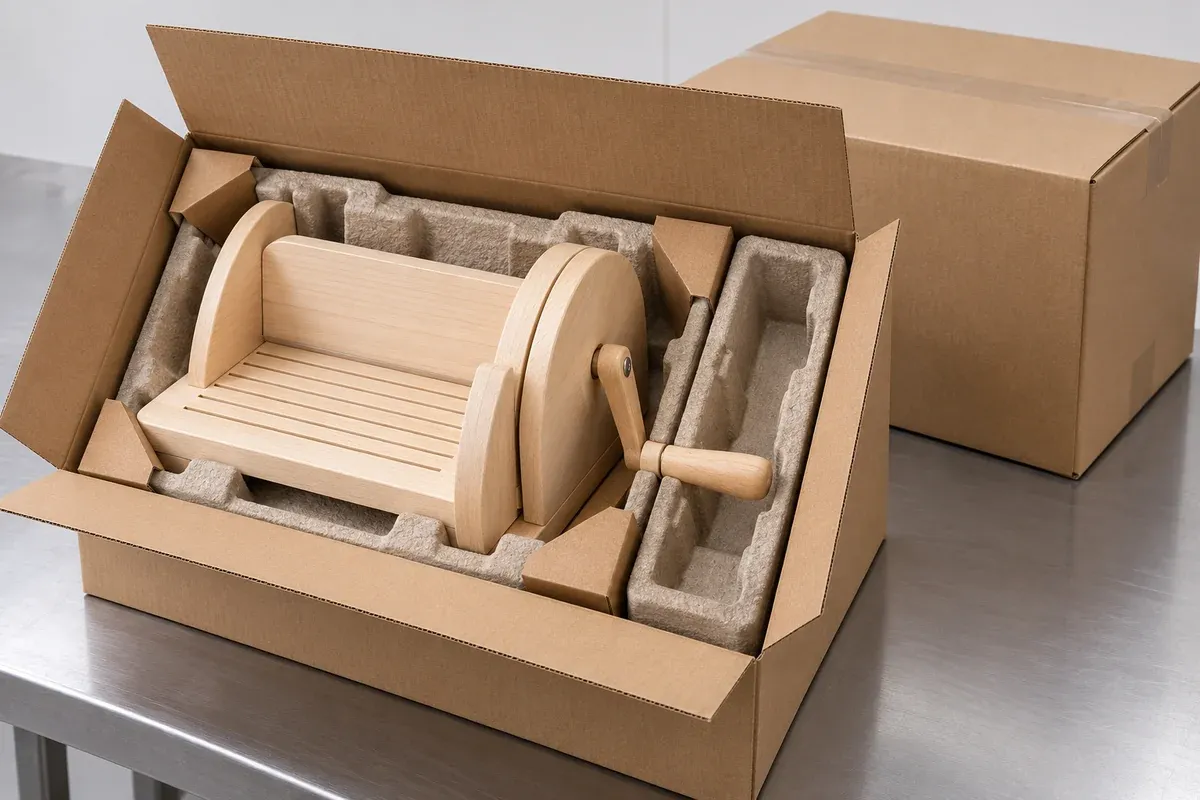
The unit-level pack should hold the approved configuration still. Check the blade/guard arrangement, carriage, guide, crank, feet, hardware and instruction material as one set. If a part is removable, define its protected location. If a part remains assembled, define how it is immobilised so it cannot strike the wood base or carton wall.
Protect the visible wooden surfaces from rubbing. Keep loose screws or accessories in their own retained pack rather than allowing metal to travel against finished wood. If a coating or oil is part of the agreed product, its cure and packing sequence should be reviewed before materials are ordered; wrapping a surface too early can create a received-unit problem that is difficult to diagnose later.
Use the retail box for presentation, not as the whole export solution
A colour box or gift box may be part of the buyer’s brand experience. It can hold the unit, care card and logo treatment, but should not automatically be assumed to handle stacking or side pressure. The export plan often needs an inner pack, retail box, separation and master carton.
Approve packaging artwork on the materials that will ship. That includes logo placement, colour, barcode area, instructions, origin or handling information required by the buyer, and any insert. A brand change can affect both visual approval and carton fit. EcoWoodPlate’s OEM/ODM service can help separate a packaging-artwork change from a change to the slicer mechanism.
Build the master carton around stable, separated units
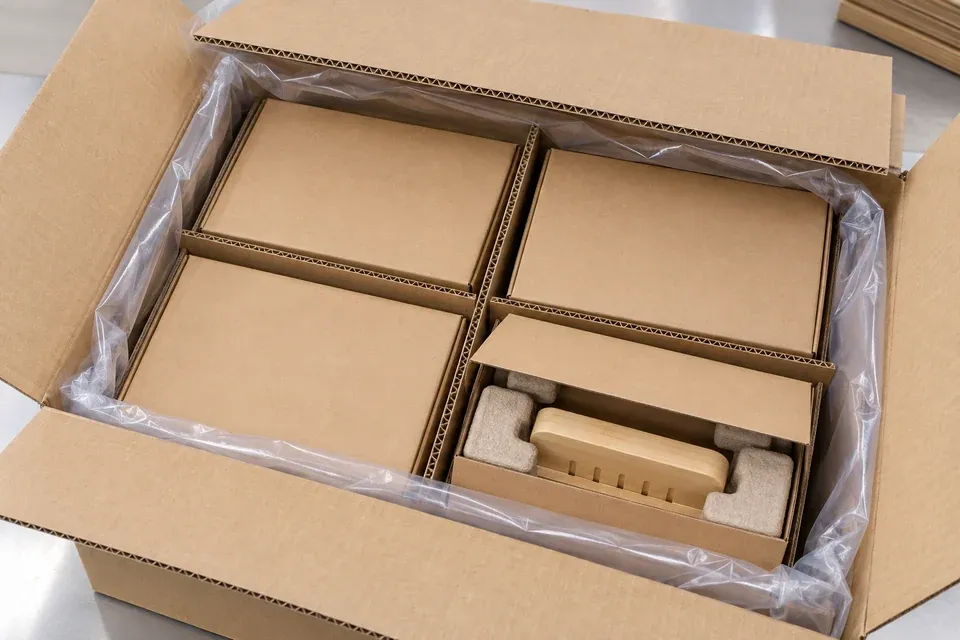
Carton quantity should be chosen around the real packed dimensions and handling plan, not a target number alone. Retail boxes that can slide into each other may scuff. Empty space can allow a carton to deform or a packed unit to move. Dividers, top pads, corner protection and defined orientation can help, but they should be approved on the actual pack-out rather than selected by name only.
Ask for photos of an open master carton before shipment release. A buyer should be able to see the unit count, separation, top clearance, accessory position and closure sequence. The broader wooden-product export packaging guide explains how to turn those requirements into a pack specification for a wider wooden-product program.
Control moisture and surface condition before sealing the carton
Packaging does not fix unstable wood or a surface that has not been fully checked. Material selection, incoming inspection, cutting or machining, sanding, assembly, final finish, logo treatment and packing should form one sequence. If the base, guide or slots change after the sample, the inner insert and carton fit may need to be reviewed again.
Keep the product clean and dry according to its agreed specification before it enters its final pack. Ask the supplier how it handles visible surface checks, wood condition, dust removal and packed-unit approval. For a fuller buyer discussion of storage and moisture concerns, link the product plan to the moisture-control guide for wooden product importers.
Discuss pallets, dunnage and destination requirements early
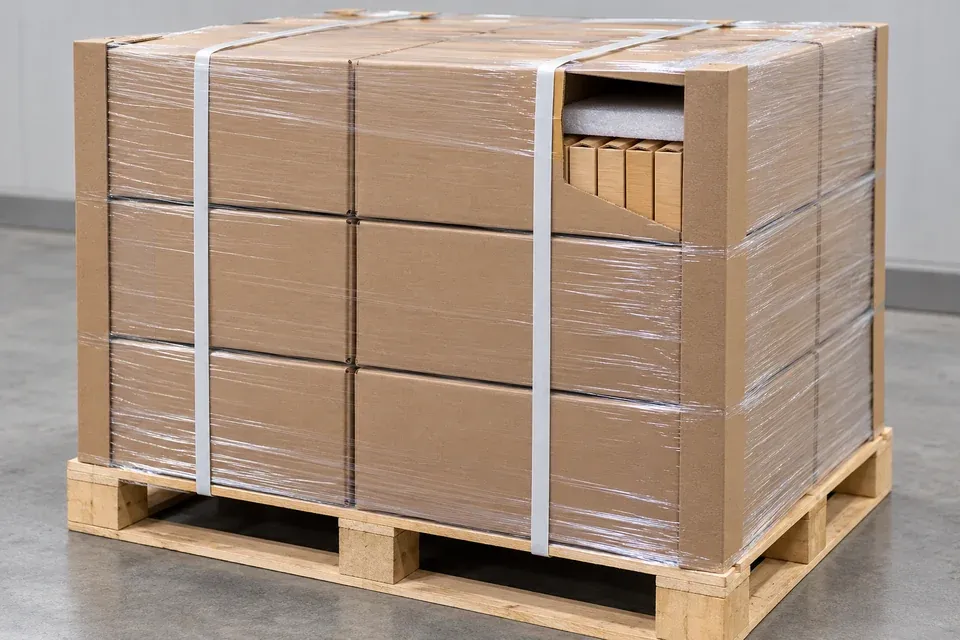
Pallets, frames and dunnage are transport packaging, not the bread slicer itself. If a shipment uses raw solid-wood packaging material, buyer and forwarder should check destination rules before dispatch. The International Plant Protection Convention explains that ISPM 15 covers raw-wood packaging material and dunnage used in international trade, while processed wood such as plywood is excluded from that standard’s scope.
Do not use a compliance mark as decoration in product photography or carton artwork. Ask the freight partner which packing evidence, marks or documents it needs, and keep that requirement separate from a retail-brand design decision.
Make packaging approval part of the sample process
A product sample proves product appearance and function. A packaging sample proves a different set of decisions: unit completeness, insert fit, retail-box layout, master-carton quantity and protection against movement. For a first order, request both when the product has a crank, metal parts, sharp areas, a logo surface or a customer-facing box.
MOQ and sample scope need to be discussed against the project brief. The current EcoWoodPlate product listing shows a 200-piece MOQ, but this is a reference point only. Materials, mechanisms, logo treatment, printing and packing can change the final quotation. Confirm the live requirement and whether a packaging change calls for another sample.
| Packing point | Buyer approval question | Useful release evidence |
|---|---|---|
| Finished unit | Are the carriage, crank, guard, guide and accessories in their approved positions? | Photos of the complete packed unit and part count |
| Retail pack | Do logo, artwork, instruction version and insert match the signed revision? | Approved retail-pack sample |
| Master carton | Are units separated, top-protected and closed in the agreed orientation? | Open-carton and sealed-carton photos |
| Freight handoff | Does palletisation or additional protection match the appointed route? | Forwarder-confirmed packing instruction |
An illustrative buyer–factory packing conversation
This Nora–Jian conversation is illustrative, not a customer testimonial.
Nora, a private-label buyer: “We are considering 420 units for a distributor and an online channel. I need one complete unit pack, the finished retail box, photos of an open master carton and our forwarder’s pallet requirement before we approve the release.”
Jian, a project coordinator: “Please send the route, final artwork, product revision and forwarder instructions. We can review the insert with the actual crank and guard arrangement. If the product size or accessory count changes, the box layout and master carton need to be checked again.”
The 420-unit figure is an example only. It is not a price, MOQ, delivery promise, capacity statement or customer order. The important point is that product approval and freight preparation are treated as connected decisions.
International-shipping checklist for bread slicers
- State the model, final part list, destination, route and sales channel.
- Protect and immobilise the crank, moving carriage, guard area and accessories.
- Keep wood, metal parts and hardware from rubbing against one another.
- Approve the real logo, retail box, insert and instruction revision.
- Check an open master carton for quantity, dividers, top protection and closure.
- Confirm the forwarder’s pallet, dunnage, marking and handoff requirements.
- Keep the final sample, packing photos and release checklist with the purchase order.
FAQ
What is the most important packaging check for a wooden bread slicer?
Confirm that the moving and hard parts cannot travel against the finished wooden surfaces inside the approved unit pack. Then check that the complete unit remains separated and stable in the master carton.
Is a retail colour box enough for export shipping?
Not automatically. A retail box is often a presentation layer. The buyer should also approve the unit protection, master-carton separation and route-specific handoff plan.
Should the crank be removed for shipment?
That depends on the approved product design and insert. Whether it remains attached or is packed separately, its position and protection should be visible in the final packing sample.
Does ISPM 15 apply to the wooden bread slicer itself?
ISPM 15 concerns raw-wood transport packaging material and dunnage, not a consumer product merely because it is wooden. Confirm destination-country requirements with the importer and appointed freight partner.
What should I ask for before releasing a bulk shipment?
Ask for the approved product and packing reference, part count, final artwork revision, open/closed carton photos, master-carton plan, inspection evidence and the freight partner’s packing instructions.
Can EcoWoodPlate help plan private-label packaging?
EcoWoodPlate, operated by Cao County Puchuang Wood Industry Co., Ltd., is a Chinese wooden products manufacturer, OEM wooden products supplier and custom wooden products factory. Share your product, logo, route and packing brief so the sample scope can be discussed before bulk production.
Pack the route, not just the product
The right packaging makes the bread slicer, retail presentation and freight handoff easier to inspect as one system. EcoWoodPlate and ecowoodplate.com can discuss a manual slicer project with importers who need sample approval, custom logo work, controlled packing and export coordination. Review the wider Kitchen & Dining range, see the bulk-buying guide, or contact EcoWoodPlate with the product configuration, destination and expected order details.
Need Factory Direct OEM/ODM Pricing?
Send your product, quantity, logo, packaging and destination country. Our factory team will reply with quotation guidance.
Request Factory Quote