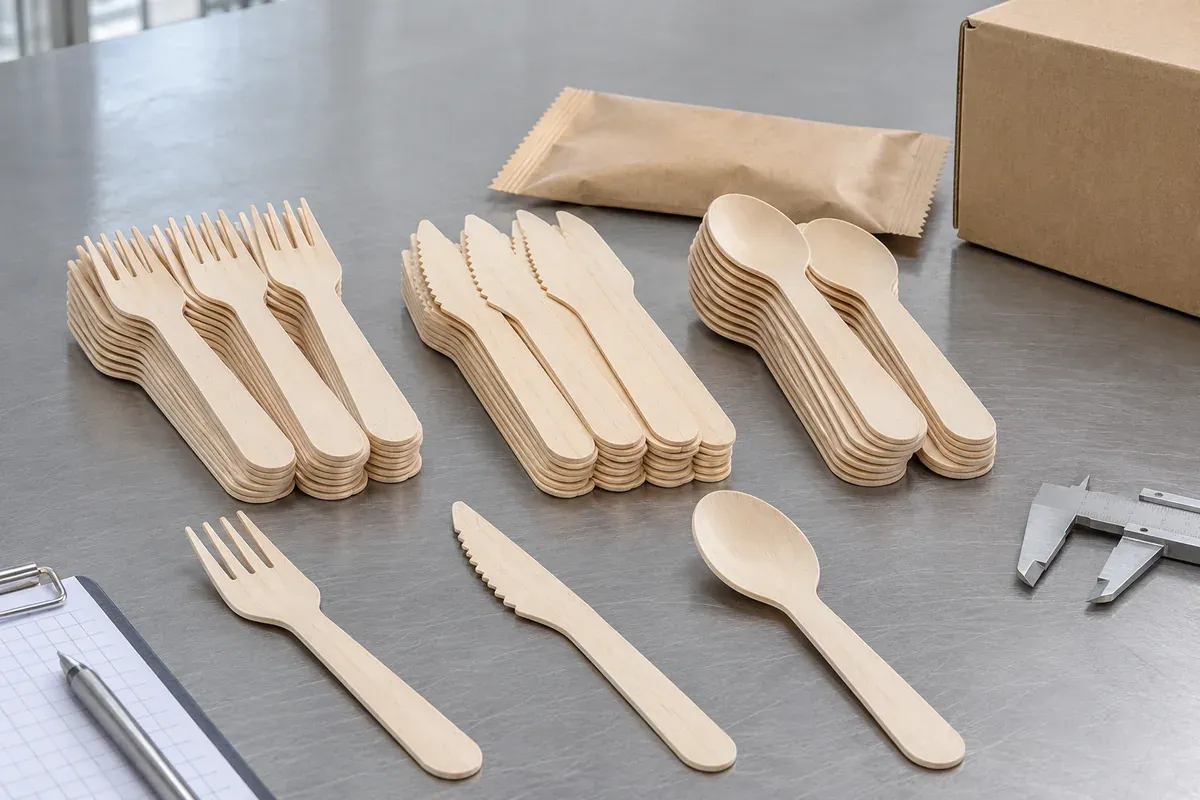
목제 식기 대량: 포크, 나이프, 숟가락 지정 방법
A fork that looks fine in a photograph may split at the tines. A wooden knife may have a neat serrated edge but fail on the food your customer serves. And a spoon can meet the stated length while its bowl is too shallow for soup. For bulk wooden cutlery, buyers need three functional specifications—not one shared line that says “wooden fork, knife and spoon.”
This guide is for catering suppliers, event distributors, restaurant-group purchasers and private-label brands buying disposable wooden cutlery. The aim is to make a quote, sample and shipment comparable. If you are buying reusable cooking utensils instead, ask for a different material, finish and care specification.
Start with the meal and the unit of sale
Write down what people will actually eat: salad, rice, cake, pasta, soup, soft fruit or a food that needs cutting. A tasting spoon and a meal spoon are not the same product. Nor does a wooden knife replace a metal steak knife. Decide whether the customer receives loose pieces, individually wrapped items, a fork-and-knife pair, or a fork-knife-spoon set. That choice determines both the pieces required and the packing line.
A real catalogue reference is EcoWoodPlate’s disposable wooden plates and cutlery set. Its shown configuration lists a 165 mm knife and 158 mm fork and spoon. These are product-page reference dimensions, not universal sizes or a promise that a custom order will use the same tooling. Ask for the current drawing and physical samples before treating any catalogue measurement as your purchase specification.
Specify the fork by its tines and neck
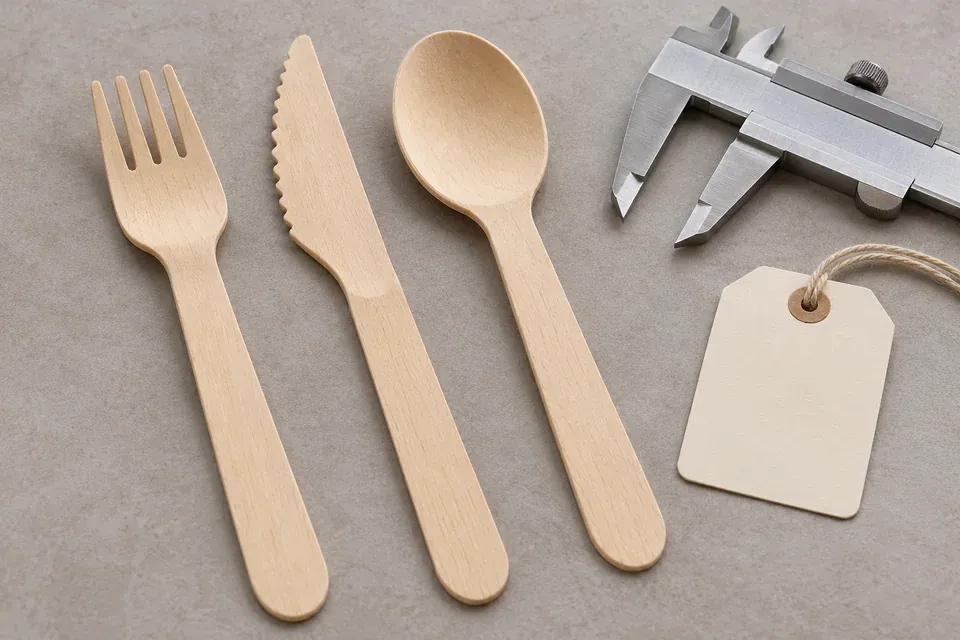
Overall length matters for grip and pack fit, but the working end matters more. Record the fork-head width, tine count, tine length, spacing and tip shape. Check the neck where the head narrows into the handle: that is an obvious point to examine for cracks or flex. A fork that is comfortable with a green salad might struggle to pick up a dense piece of food. If your menu has both, test both.
Ask for a close photograph of several samples, then handle the samples yourself. Rub a finger carefully along the tine edges and inspect for lifting fibers; do not rely on a smooth-looking front face. Agree what counts as an unacceptable split, sharp burr or chipped tine, and whether the same check applies to both faces. Buyers often discover too late that “polished” was a process description, not an acceptance criterion.
Specify the knife by the food it can reasonably cut
For the knife, define blade length, serration shape, tip profile, handle width and minimum feel of stiffness against the intended food. Avoid asking for an unqualified promise that it “cuts well.” Give the factory a repeatable use test: for example, your own menu item at serving temperature and a photographed reference sample. A serration aggressive enough to catch a soft roll may leave a rough mouth-contact edge; a very shallow edge may be comfortable but ineffective.
Look at the grain direction and the area beside each serration. Splinters or rough cuts there are not merely cosmetic. Also check whether the knife can be separated cleanly from its stack or inner pack. If a caterer opens hundreds of packs during service, snagging edges become a handling problem as well as a product problem.
Specify the spoon by bowl capacity and mouth feel
For the spoon, record bowl length, width, depth and rim shape as well as total length. A flat spoon can be acceptable for dessert but poor for soup. Test the amount it carries with the food you actually serve rather than a random water-only demonstration. The outer rim should feel smooth, and the transition from bowl to handle should not have a thin, weak point.
Confirm whether the spoon will be used with hot food or cold food and how long it may sit in contact with that food. The material and any finish must be reviewed for the intended conditions and destination market. Do not assume the fork, knife and spoon need identical thickness simply because they share a package.
Choose the material and manufacturing route deliberately
For thin disposable cutlery, buyers commonly compare wood veneer and bamboo options. Wood species, veneer thickness and grain quality affect stiffness, edge finish and appearance. Bamboo has a different fiber structure and processing route; it should not be silently substituted for the wood shown in an approved sample. Request the material name, construction, treatment or coating if any, and the country or batch traceability information you need for your market. Do not infer “compostable” or “plastic-free” from a pale wood appearance alone.
A typical thin-utensil route can include veneer selection, cutting or forming, drying, smoothing or polishing, sorting and packing. The actual factory route should be confirmed for the quoted item. Ask where warped blanks, cracked tines, rough knife edges and thin spoon necks are removed. For a coated or treated item, request the relevant composition and test documentation for the finished product and stated food-contact use. The FDA’s food-contact-material guidance is a reminder to verify the status of the actual components; it is not a certificate for a supplier’s cutlery.
Make OEM changes visible before sampling
OEM or ODM work may change the utensil outline, handle length, color tone, logo position or packaging. A laser mark on a thin handle can reduce the useful marking area or show unevenly across grain, so approve a physical proof before placing it on three different items. Branding can also live on a sleeve, pouch or retail box instead of the utensil. Give the factory the artwork file, exact placement, print colors and barcode ownership, then freeze a dated revision.
As an OEM wooden products supplier and custom wooden products factory, EcoWoodPlate can discuss cutlery combinations and packaging by project; the OEM/ODM service page explains the broader sampling route. Cao County Puchuang Wood Industry Co., Ltd. operates ecowoodplate.com. A buyer searching for a Chinese wooden products manufacturer—or “wooden products manufacturer China”—should still ask for the actual sample, material and packing specification, not rely on the search label to establish them.
Count packs in the unit the buyer will receive
“One thousand sets” is ambiguous until a set is defined. If a set contains one fork, one knife and one spoon, an illustrative order of 1,000 sets requires 1,000 of each item, or 3,000 individual utensils before any agreed spare allowance. Those numbers illustrate the arithmetic only; they are not an EcoWoodPlate minimum order quantity or stock pack. If the venue needs two forks per guest, the ratio changes. Write the fork:knife:spoon ratio and whether the pieces are loose, sleeved or individually wrapped.
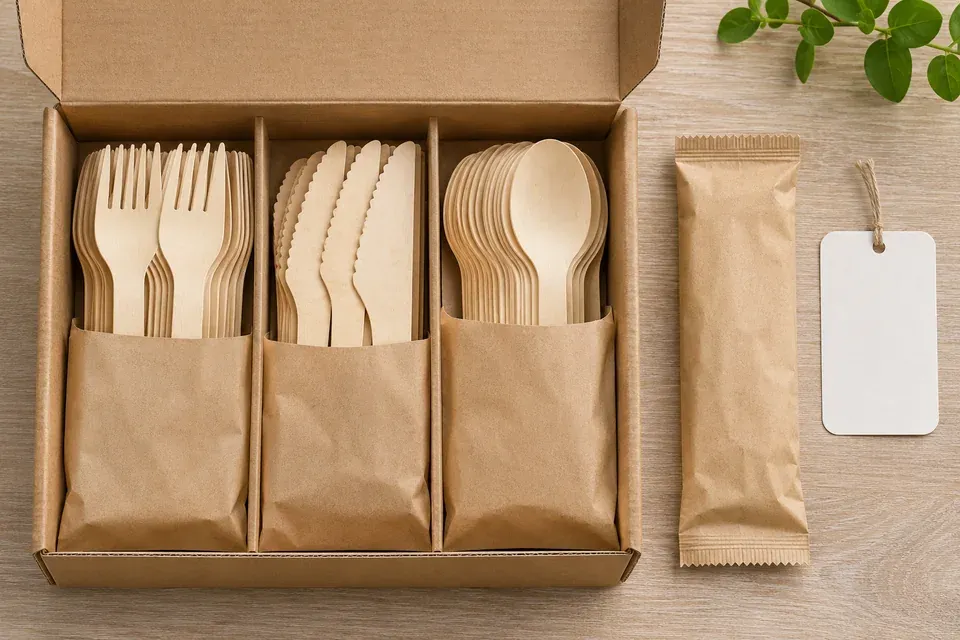
Then state pieces per inner pack, inner packs per master carton, total cartons, and whether mixed cartons are permitted. A retail buyer may require a barcode and pack artwork; a caterer may prefer easy-open bulk bundles. Request one fully packed sample, not just three loose utensils. Count it, open it, and check whether the knife or fork tines rub through the wrapper. Confirm carton labels, gross weight and dimensions from that packed sample before freight is quoted.
Approve the sample and bulk inspection plan
Ask whether a stock sample matches the quoted wood, thickness and pack. If not, use it only to judge the general shape. A custom approval set should include each utensil, the agreed package and the latest drawings. Save a dated reference, including acceptable natural color variation. The factory and buyer should agree how samples are taken during production and before shipment, what is checked and how defects are recorded.
Practical checks include length and thickness at agreed points; fork tines and neck; knife serrations; spoon bowl and rim; warping; odor; visible contamination; split fibers; sharp edges; count per pack; seal or sleeve condition; carton labels. Test a sample with the actual menu item. If a defect appears, agree whether the lot is sorted, reworked or held before release. For food-contact documentation, match the document to the selected material, treatment, intended use and destination; avoid treating a general marketing icon as batch evidence.
Send this specification with the RFQ
| Field | Buyer decision to write down |
|---|---|
| Use | Menu item, serving temperature, channel and destination market. |
| Fork | Length, head width, tine count/spacing, tip and neck acceptance. |
| Knife | Length, serration, grip and intended-food test. |
| Spoon | Length, bowl dimensions, rim feel and intended-food test. |
| 소재 | Wood or bamboo, construction, treatment, documentation request. |
| Branding | Logo location or package artwork, proof and revision. |
| Packing | Fork:knife:spoon ratio; inner pack, master carton and marks. |
| Release | Approved sample, defect definitions, inspection and quote terms. |
Compare supplier quotations against the same specification. A lower unit price may exclude wrapping, a branded sleeve, different material, a second fork per pack or the carton protection you assumed was included. MOQ, sample fee and lead time should be quoted per design and packaging version, not borrowed from another SKU. For related plate sizes and carton-count questions, see our bulk wooden plates quote checklist; this article deals with the cutlery itself.
자주 묻는 질문
What is the first thing to specify for bulk wooden cutlery?
Specify the food and the unit of sale. The correct fork, knife, spoon and pack ratio follow from actual service rather than a generic set photograph.
Can the same length be used for all three pieces?
It can be a design choice, but length alone does not make the pieces functional. Approve tine geometry, knife performance and spoon bowl separately.
Should a buyer choose loose cutlery or wrapped sets?
Choose by service workflow and retailer requirements. Loose pieces simplify selective replenishment; wrapped sets can make distribution easier but require a clearly defined mix, wrapper and pack count.
How should splinters and rough edges be controlled?
Approve smooth physical samples, define unacceptable defects at the working ends and necks, and include those checks in in-process and pre-shipment inspection.
What documents are needed for food contact?
Requirements depend on the market and the actual material or treatment. Ask the supplier for relevant documentation for the selected finished product and intended conditions; have your compliance team check its applicability.
If you need bulk wooden cutlery for a menu, event program or private-label range, send EcoWoodPlate the fork/knife/spoon ratio, target food, quantity, destination and pack format through ecowoodplate.com/contact. A marked-up sample and a clear carton count are a better start to an OEM quote than “wooden cutlery set” alone.