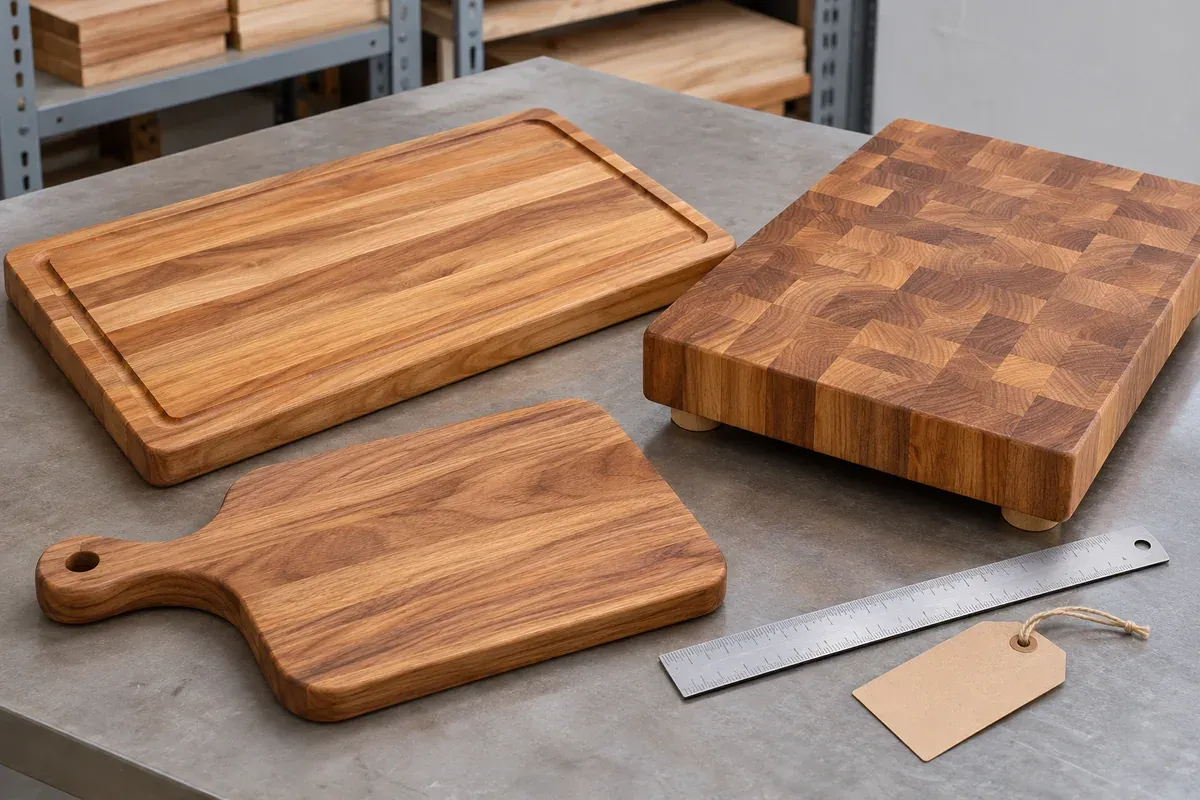
맞춤 원목 도마: 바이어 사양 체크리스트
“Acacia board, 40 by 30, with our logo” is not enough for a production quote. Is 40 by 30 measured in centimetres? Does it include the handle? Is the board edge-grain or a single wide piece? Which face carries the logo, and what does the box have to survive? For custom wooden cutting boards, the useful starting point is a signed specification that a sample maker, packing team and purchasing manager can all read the same way.
This checklist is for importers, kitchenware wholesalers, private-label brands and foodservice buyers. It is deliberately narrower than our manufacturer/OEM overview. Here the job is to turn a product idea into a quote-ready drawing, an approved sample and measurable bulk-order checks.
1. State the use before the material
Is the board for daily chopping, bread service, charcuterie display, a gift set or a restaurant prep station? A handled presentation board and a heavy end-grain chopping block may both be called “cutting boards,” but the correct construction, thickness, finish and packing differ. State the destination market, sales channel and intended food-contact conditions. If a buyer wants both cutting and serving use, write that explicitly rather than assuming the factory will infer it from a photo.
EcoWoodPlate's wood cutting board product page shows a kitchen-prep and serving direction with size, logo, finish and packaging customization offered by project. That is a starting reference, not proof that every custom design has the same material, MOQ or finish.
2. Put the dimensions on a drawing
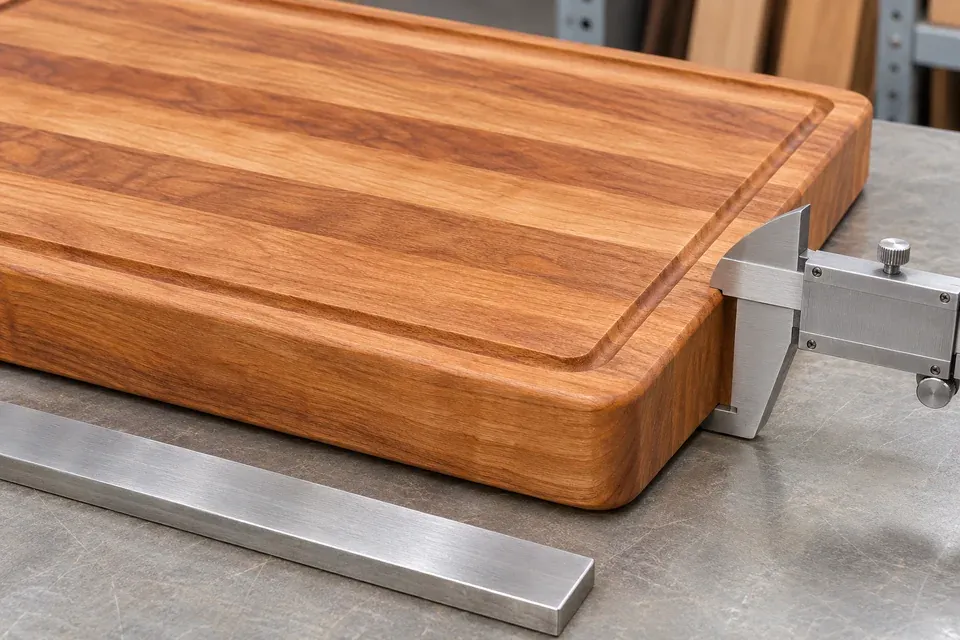
Write length, width and finished thickness in one unit system. Mark whether length includes a handle or hanging hole. Show corner radius, edge profile, juice-groove position and depth, any feet and their locations, and the usable flat cutting area. If a retail sleeve or shelf slot sets the outside size, give its limit too. A dimensioned top view plus side view is much more useful than “large rectangular board.”
For example, a buyer might propose 400 × 300 × 25 mm as an initial design brief. That is an illustrative number, not an EcoWoodPlate catalogue specification or a default tolerance. The drawing still needs an agreed tolerance for each important feature. A generous tolerance might be fine for overall length but not for a board that must fit a printed sleeve. Decide which dimensions are critical before the sample is cut.
3. Choose the board construction, not just the wood name
Acacia often has strong color contrast; beech can give a lighter, more even look. Bamboo has a different laminated appearance and should not be presented as a solid hardwood. Ask the supplier to identify the actual species or panel construction and show a reasonable color-and-grain range. A beautiful one-off photo is a poor bulk acceptance standard if the natural variation has not been discussed.
Then choose face grain, edge grain or end grain. These terms describe how the wood is oriented at the cutting surface; they are not interchangeable patterns. A laminated board also needs a defined strip arrangement, joint quality and adhesive specification suitable for its intended use. If the design mixes species, ask whether the different pieces have been conditioned and joined in a way that is compatible with the finished board. The answer belongs in the project file, not only in a sales message.
4. Agree how moisture and flatness will be checked
Wood changes dimension as its moisture condition changes. The USDA Wood Handbook's moisture-relations chapter explains the underlying behavior; it does not supply a universal factory pass number for your particular board. Ask the manufacturer where and when the wood is checked, what meter or method is used, what acceptance range is agreed for the selected material and destination, and whether the finished board is rechecked before packing.
Flatness is a separate acceptance item. Put the sample on a known flat surface, turn it over, and inspect rocking and cupping. Check the handle and underside too. A board can look flat from the top while one corner lifts on a countertop. Do not set a moisture percentage or warp tolerance by copying an unrelated product listing; establish it with the factory against the chosen construction and sample.
5. Specify the cut, sand and finish sequence
A practical production route may include incoming wood inspection, selection by grain and color, cutting or CNC shaping, joint preparation and assembly where needed, sanding, groove machining, finish application, logo processing and final inspection. The exact order depends on the board. Ask the supplier to identify where cracks, open glue lines, raised seams, splinters and rough groove corners are caught. A rounded outer edge does not compensate for a sharp or poorly sanded hanging hole.
For direct food-contact use, request the finish and adhesive details relevant to the destination and intended conditions, along with applicable test documentation for the actual product where required. “Food safe” on a website banner is not a substitute for matching the report to the wood, coating, adhesive and use being ordered. If the board is left unfinished or treated with an oil, the care card should say how the buyer should clean, dry and maintain it. Do not invent a certification claim for a sample that has not been tested.
6. Prove the logo on the actual board
Private-label work can include laser engraving, printing, a branded sleeve, insert card or carton. Approve the logo file, size, location, orientation, contrast and permitted variation on the selected species and finish. A logo shown in a digital mock-up can look faint on dark grain or too close to a groove once the board is cut. Request a physical logo sample and photograph it next to the reference artwork before authorizing the production run.
If a product family has two sizes, do not assume the same logo coordinates work for both. Keep separate drawings or a clearly indexed revision table. The custom wooden kitchenware page shows the wider OEM context, while the cutting-board project file should fix the exact mark and packaging details.
7. Approve the packed sample, not just the board
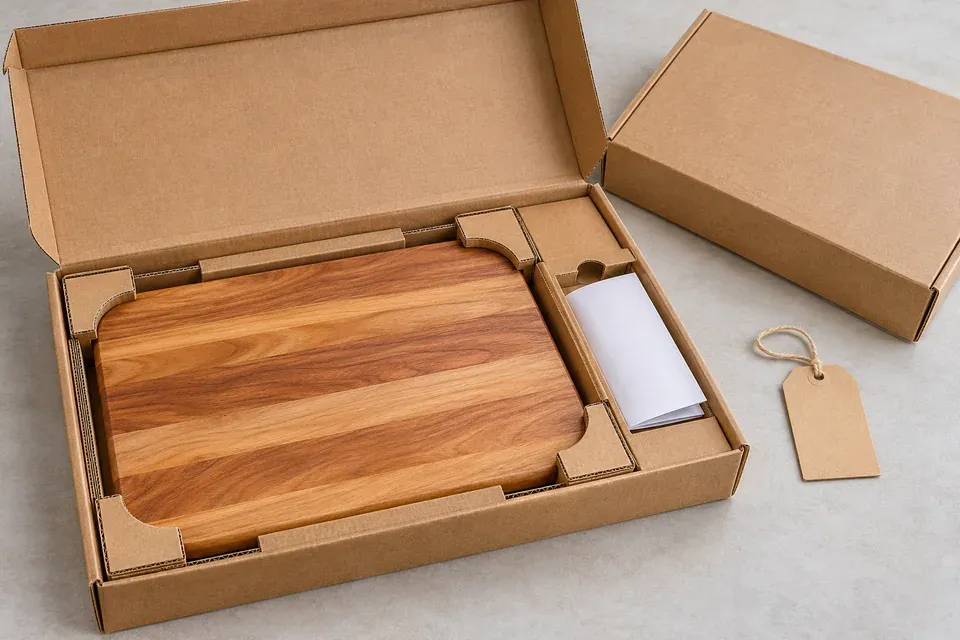
For a retail program, define whether the board ships in a paper sleeve, kraft box or another unit pack. Specify the care card, barcode, language panel and artwork revision. A heavy board needs protection at its corners and along its finished faces so it cannot rub against the carton. If several boards share a master carton, ask for separators, orientation and total count. A too-tight box can mark the finish; a loose one can let boards collide.
Request one fully packed sample and open it as a customer would. Check that the printed size matches the board, the logo is visible where expected, and the care instructions describe the approved finish. Then record the retail-box dimensions, master-carton quantity and gross weight from the packed sample. Those details affect landed cost and retailer receiving, not just appearance.
8. Freeze the sample before the bulk order
Ask whether a stock sample uses the quoted wood, thickness and finish. If not, treat it only as a rough feel-and-size reference. A custom sample should show the chosen construction, logo, groove, edge profile, finish and retail pack. Sign off a sample ID or dated photograph set together with the drawing and artwork revision. If the material, thickness or logo changes, update that reference before production starts.
MOQ and sample cost depend on the design, material, processing and packaging. The standard product page may show a starting quantity, but a custom quote should state whether its MOQ applies per size, per logo version or across a mixed order. Ask for the quote basis, trade term, sample terms, production schedule and what happens if the approved sample must be revised. Do not treat a sample fee or lead time from a different SKU as a promise for this one.
Buyer’s specification and release checklist
| Item | What to record |
|---|---|
| Use | Chopping, prep, serving or gift; food-contact conditions and destination market. |
| Geometry | Length, width, thickness, handle, hole, groove, corner/edge profile, critical tolerances. |
| Construction | Species, grain orientation, lamination layout, glue/adhesive requirement, color range. |
| Moisture and flatness | Agreed inspection method, sampling point, acceptance range and rocking/cupping check. |
| 표면 | Sanding, finish, odor, edge feel, groove quality and relevant documentation. |
| Branding | Logo file, method, placement, contrast, approved physical mark and revision. |
| Packing | Unit pack, care card, barcode, corner protection, master-carton count and marks. |
| Release | Signed drawing/sample, defect limits, pre-shipment check and quote terms. |
Use the checklist to compare quotations for the same board. A lower piece price can disappear once thicker stock, more sanding, a branded box or extra carton protection is added. The important comparison is the approved specification and packed deliverable, not the headline price per board.
자주 묻는 질문
What should a custom cutting board RFQ include?
Send the use, dimensioned drawing, wood and construction preference, finish, logo artwork, target quantity, destination, packing format and required documentation. Ask the supplier to mark any assumption it has made.
Should buyers specify a fixed moisture percentage?
They should agree a measurable range for the chosen material and market with the manufacturer. One number copied from another board or climate is not enough; also define when and how it is measured.
Is an end-grain board automatically better?
No. It serves a different use and has a different construction, thickness, assembly and cost profile. Choose it only when the intended product and customer justify those choices.
Can one sample approve several sizes or logo versions?
Usually not by itself. Each change can affect fit, appearance, carton size and engraving position. Keep the approved references linked to each SKU.
What is the last check before shipment?
Inspect boards and cartons against the signed sample and purchase specification: dimensions, flatness, joint/edge condition, finish, logo, care card, unit pack and carton marks. Record any deviations before release.
EcoWoodPlate is operated by Cao County Puchuang Wood Industry Co., Ltd. If you are comparing a Chinese wooden products manufacturer, an OEM wooden products supplier or a custom wooden products factory for a private-label board, send your drawing and this checklist through ecowoodplate.com/contact. For custom wooden cutting boards, a precise brief lets both sides discuss the same sample and the same packed product.