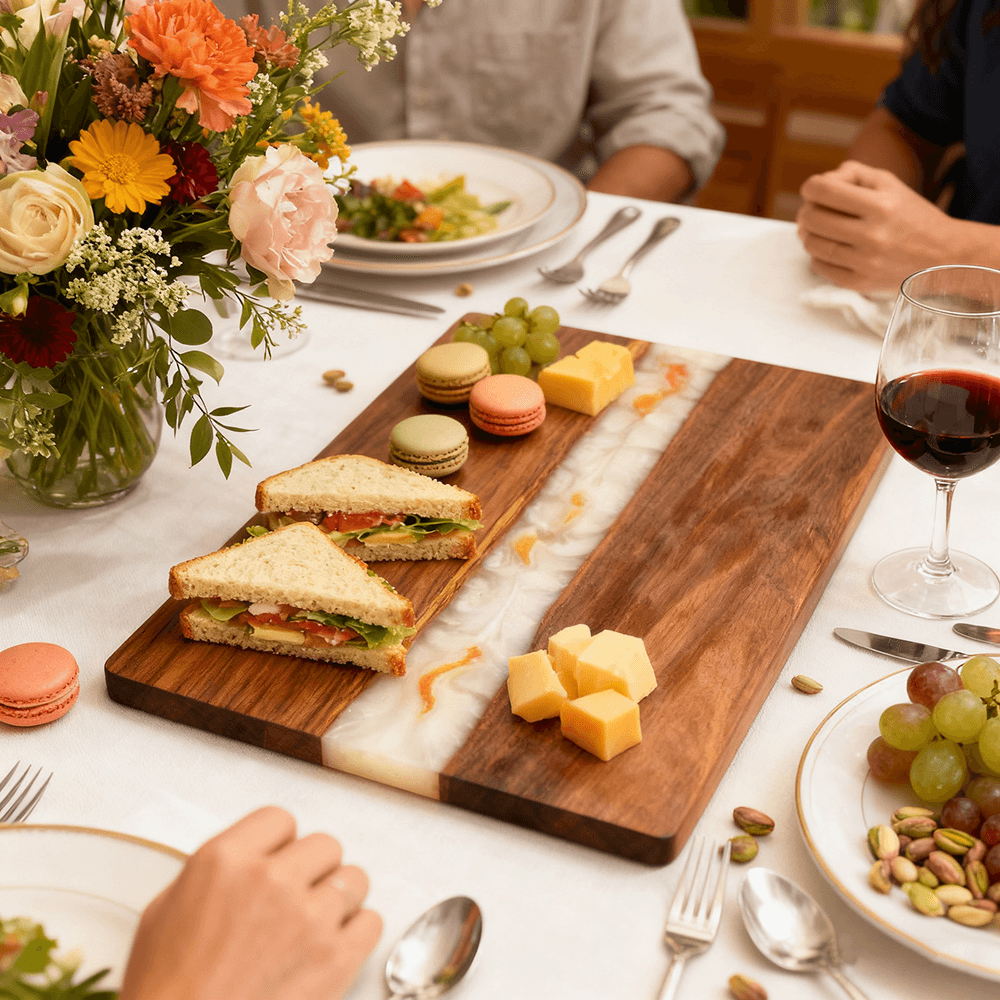
An acacia and epoxy resin charcuterie board is a presentation board, not automatically a chopping board. That distinction should be fixed before an importer approves the resin system, artwork, care label, testing plan, and retail claims. For a bulk order, the hard work is not choosing a dramatic resin color. It is making the wood, resin band, finish, logo, and packaging repeatable across hundreds of pieces.
This guide is for importers, wholesalers, brand owners, hospitality suppliers, e-commerce sellers, and private-label teams sourcing from a wooden products manufacturer China partner. It explains how to specify a board without relying on 鈥渟ame as photo.鈥?/p>
What is an acacia epoxy resin charcuterie board?
It is a wooden serving board made from acacia sections joined with a cured decorative resin section. Typical uses include cheese, fruit, bread, appetizers, deli presentation, gifting, and restaurant service. The product sits between kitchenware and giftware: buyers care about food-contact documentation, but they also judge grain, resin pattern, color, engraving, and unboxing quality.
The format suits a wooden kitchenware supplier, gourmet gift brand, housewares distributor, hotel supplier, or private label wooden products program. If knives will repeatedly cross the resin, that use must be assessed separately from short-term serving contact.
A documented EcoWoodPlate product case
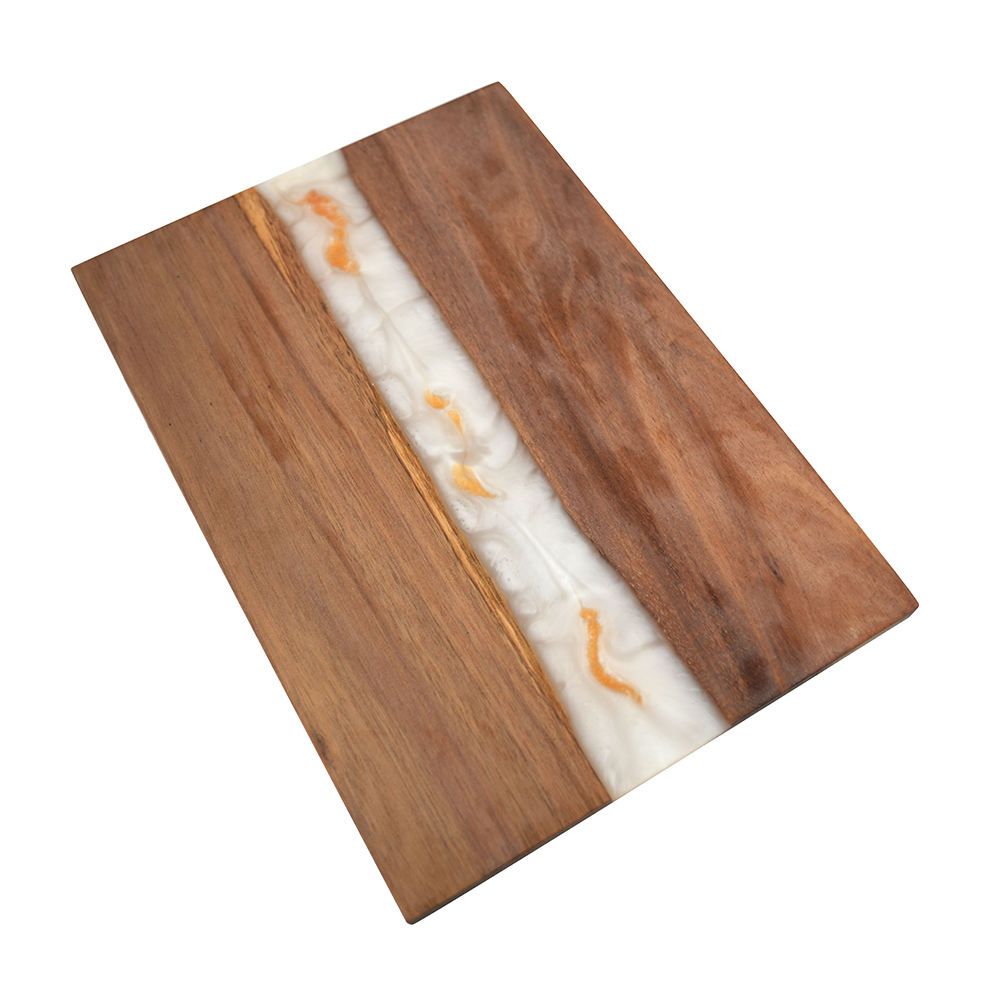
EcoWoodPlate SKU k006 is a real acacia wood and epoxy resin serving-board example. Its public product specification lists a 200-piece MOQ, regular bulk production of 18鈥?5 days after specification and sample approval, and kiln-dried wood at 8%鈥?2% moisture content. It also lists custom board shape, resin color, size, logo engraving, and gift-box options. These are catalog figures, not a blanket promise: the factory must reconfirm them against quantity, resin formula, artwork, packing, and delivery date.
A representative buyer鈥揻actory exchange
The following dialogue is a transparent composite of normal RFQ checkpoints, not a customer testimonial.
Maya, kitchenware buyer: 鈥淲e need 600 serving boards in two resin colors. Can the 200-piece MOQ be shared across both colors?鈥?/p>
Leo, factory merchandiser: 鈥淲e should quote each resin color as a production version. Please send the color reference, board drawing, logo file, food-contact market, and packaging layout. We can then confirm whether 300 pieces per color works.鈥?/p>
Maya: 鈥淭he logo sample looks right, but the resin line must not move too close to it.鈥?/p>
Leo: 鈥淟et us add a logo datum and a protected resin zone to the signed drawing. The first article should show both colors before bulk pouring begins.鈥?/p>
鈥?00 pieces鈥?may become two resin batches, two approvals, and two packaging codes. MOQ depends on how many controlled versions the order creates.
Choose materials by intended use
| Decision | What to request | Main bulk-order risk |
|---|---|---|
| Acacia wood | Species statement, construction, moisture range, grain acceptance sample | Color variation, movement, checks, or uneven joining |
| Epoxy resin | Exact resin and hardener, pigment, cure schedule, supplier documents | Bubbles, tackiness, odor, scratches, color drift, unsuitable claims |
| Wood finish | Finish name, application method, intended contact use, care instructions | Uneven sheen, dry areas, odor, staining, inconsistent re-oiling |
| Feet or accessories | Material, position, adhesion method, replacement rule | Rocking, detached parts, carton marks |
Acacia varies naturally. Approve a range, not one perfect photograph. Open cracks, loose knots, resin voids, sharp edges, contamination, and rocking are workmanship issues; normal grain variation is not automatically a defect.
Food-contact claims must follow the finished product
Do not accept 鈥渇ood safe epoxy鈥?as the complete specification. The resin, hardener, pigment, mixing ratio, cure, and intended use all matter. Request documents tied to the exact formulation and finished-product testing when required. In the United States, resinous and polymeric coatings are addressed under 21 CFR 175.300 within defined conditions. In the EU, Regulation (EC) No 1935/2004 sets the general framework for food-contact materials.
A useful specification separates three questions: May food touch the cured surface? For what food types, temperature, and contact time? May consumers cut repeatedly across the resin? The third question should not be inferred from the first. For many retail programs, the clearer and lower-risk positioning is 鈥渃harcuterie or serving board,鈥?accompanied by 鈥渉and wash, do not soak, avoid high heat, and do not cut on the resin鈥?where appropriate.
How production should be controlled
- Incoming wood inspection: identify material, reject structural defects, and sort grain and shade into an approved visual range.
- Moisture conditioning: verify the agreed range before machining. EcoWoodPlate鈥檚 public k006 specification states 8%鈥?2% for kiln-dried material.
- CNC cutting and joining: machine the board outline and resin channel, then prepare clean, stable bonding faces.
- Resin preparation: control batch identity, mixing ratio, pigment reference, pour depth, bubbles, and cure time.
- Flattening and sanding: bring wood and resin to one plane; ease edges and remove scratches without rounding away the approved geometry.
- Finish application: apply the approved wood finish consistently and keep records for the production batch.
- Logo test: engrave first articles at the approved position, depth, size, and contrast before releasing the full lot.
- Final inspection and packing: check flatness, surfaces, odor, color grouping, labeling, accessories, and carton protection.

OEM and ODM details to put on the drawing
An OEM wooden products supplier needs measurable instructions. Specify overall length, width, thickness, corner radius, resin-band location, color reference, logo datum, finish, bottom treatment, retail label, and carton configuration. For an ODM project, also confirm which features the factory may revise for manufacturability.
Numbers should be buyer-approved. An illustrative drawing might state 420 脳 220 脳 18 mm, thickness tolerance of 卤0.8 mm, logo 20 mm from the short edge with 卤1.5 mm tolerance, and a maximum 1.5 mm rocking gap. These are examples, not EcoWoodPlate defaults. The signed sample and drawing control the order.
Color needs a physical standard. Approve a cured chip or sample under agreed lighting and define an acceptable range for swirl and pigment distribution. Natural patterns will not be identical.
Samples, MOQ, and sample-to-bulk consistency
Request a custom sample when resin color, size, logo, or packaging is unique. Record measurements and photograph both faces, edges, logo, and packed unit. Keep signed references with the buyer and custom wooden products factory.
The public MOQ for k006 is 200 pieces. Multiple sizes, pigments, artworks, or boxes may change it. Ask for MOQ by version. Sample fees and timing should be quoted after specification review.
Quality-control checklist for bulk boards
- Match the material, construction, dimensions, edge profile, and resin-band position to the signed sample and drawing.
- Check moisture using the agreed method and sampling locations before finishing and packing.
- Reject open cracks, soft or tacky resin, visible contamination, sharp edges, major bubbles, exposed voids, and delamination.
- Inspect both reflected-light scratches and direct-light color; polished resin can hide marks under one lighting angle.
- Place boards on the agreed reference surface to check rocking and twist.
- Confirm logo artwork revision, position, size, depth, contrast, and scorch limits against the approved first article.
- Use a defined inspection plan for appearance, dimensions, function, labeling, and carton count. Do not replace it with 鈥渞andom check.鈥?/li>
Packaging and shipping
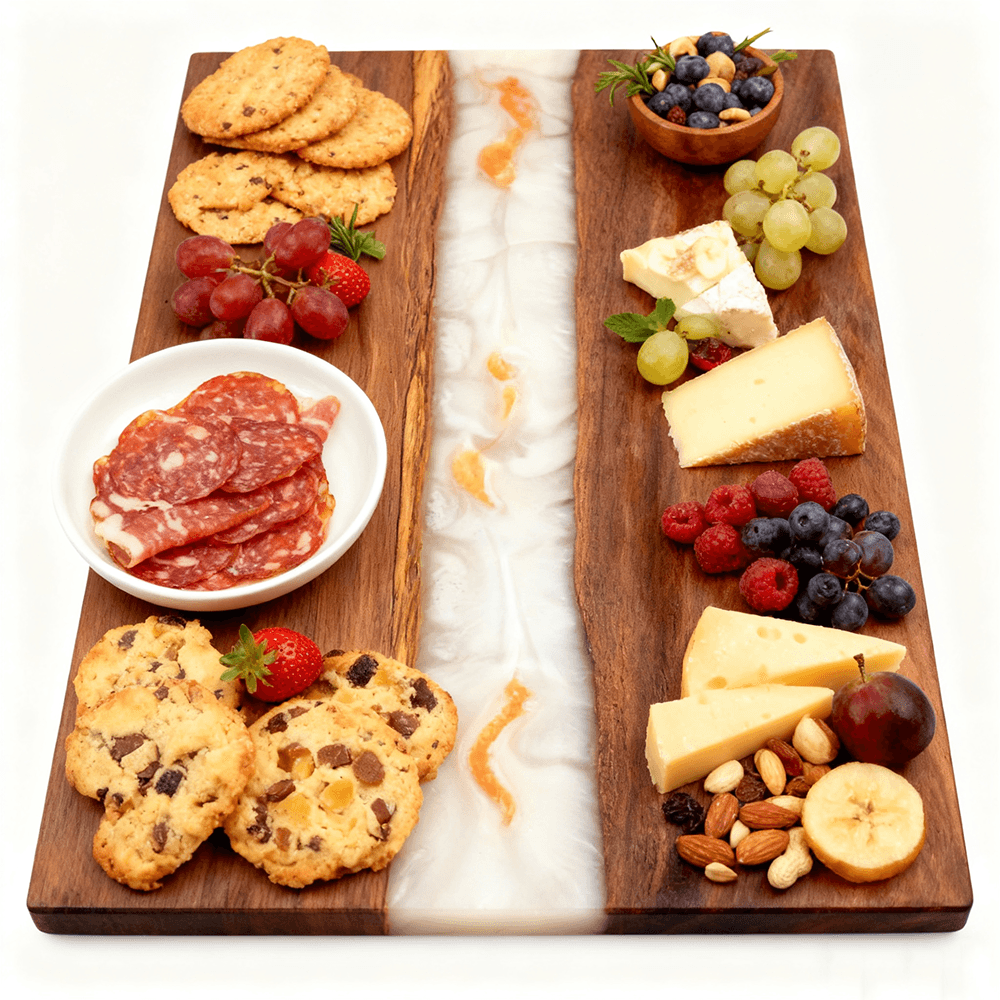
Polished resin scratches more visibly than oiled wood, while a heavy board can damage neighboring units if it moves inside the carton. Protect each face with a non-abrasive interleaf or sleeve, isolate corners, prevent board-to-board contact, and immobilize the retail box inside the master carton. If the item includes feet, handles, or care cards, add a component count.
For e-commerce, test the packed unit as a system rather than testing only the master carton. For wholesale pallet loads, confirm carton weight, orientation, void space, dividers, pallet pattern, and moisture protection. Add the destination label, barcode, country-of-origin marking, and care instructions to the packaging approval sheet. EcoWoodPlate鈥檚 wooden product export packaging guide covers the wider carton-planning process.
Buyer RFQ checklist
- Destination country and intended food-contact use
- Board drawing, quantity, and quantity per size or resin color
- Wood species, construction, moisture range, and visual acceptance
- Exact resin, pigment reference, cure documents, and required testing
- Logo vector file, position, dimensions, and first-article approval
- Finish, care wording, retail claims, barcode, inserts, and packaging
- Sample deadline, bulk delivery target, inspection plan, and shipping term
Buyers can also review EcoWoodPlate鈥檚 kitchen and dining range, custom service process, factory capabilities, and sample approval guide before sending an RFQ.
FAQ
Can an epoxy charcuterie board be sold as a cutting board?
Not by assumption. Confirm the exact finished construction, intended contact conditions, destination requirements, and whether repeated knife contact is supported. A serving-board claim is different from a cutting-surface claim.
How do importers control resin color in bulk?
Approve a cured physical sample or chip, define a visual range, lock the resin and pigment versions, and compare production under agreed lighting. Expect natural swirl variation without accepting a different overall color.
What should be checked before mass production?
Approve dimensions, moisture range, resin formulation and color, cure condition, flatness method, finish, logo, care text, retail claims, packaging, and the inspection plan.
What is the MOQ for EcoWoodPlate SKU k006?
The public listing states 200 pieces. Cao County Puchuang Wood Industry Co., Ltd. should reconfirm MOQ by size, resin color, artwork, finish, packaging, and total order plan.
How should acacia resin boards be packed for export?
Use non-abrasive face protection, corner protection, movement control inside the retail box, reinforced master cartons, and an approved pallet pattern. Keep polished resin away from rough paper or neighboring boards.
How can a buyer verify the sample matches the bulk order?
Use a signed sample, controlled drawing, resin and artwork revision codes, first-article approval, inline checks, and a final inspection report covering appearance, dimensions, labeling, and packing.
Discuss a charcuterie-board project
EcoWoodPlate is operated by Cao County Puchuang Wood Industry Co., Ltd. As a Chinese wooden products manufacturer, OEM wooden products supplier, and custom wooden products factory, the team at ecowoodplate.com can review a drawing, resin reference, logo, packaging plan, quantity split, and destination requirements. Send those details through the contact page for a specification-based sample and quotation discussion.
Need Factory Direct OEM/ODM Pricing?
Send your product, quantity, logo, packaging and destination country. Our factory team will reply with quotation guidance.
Request Factory Quote