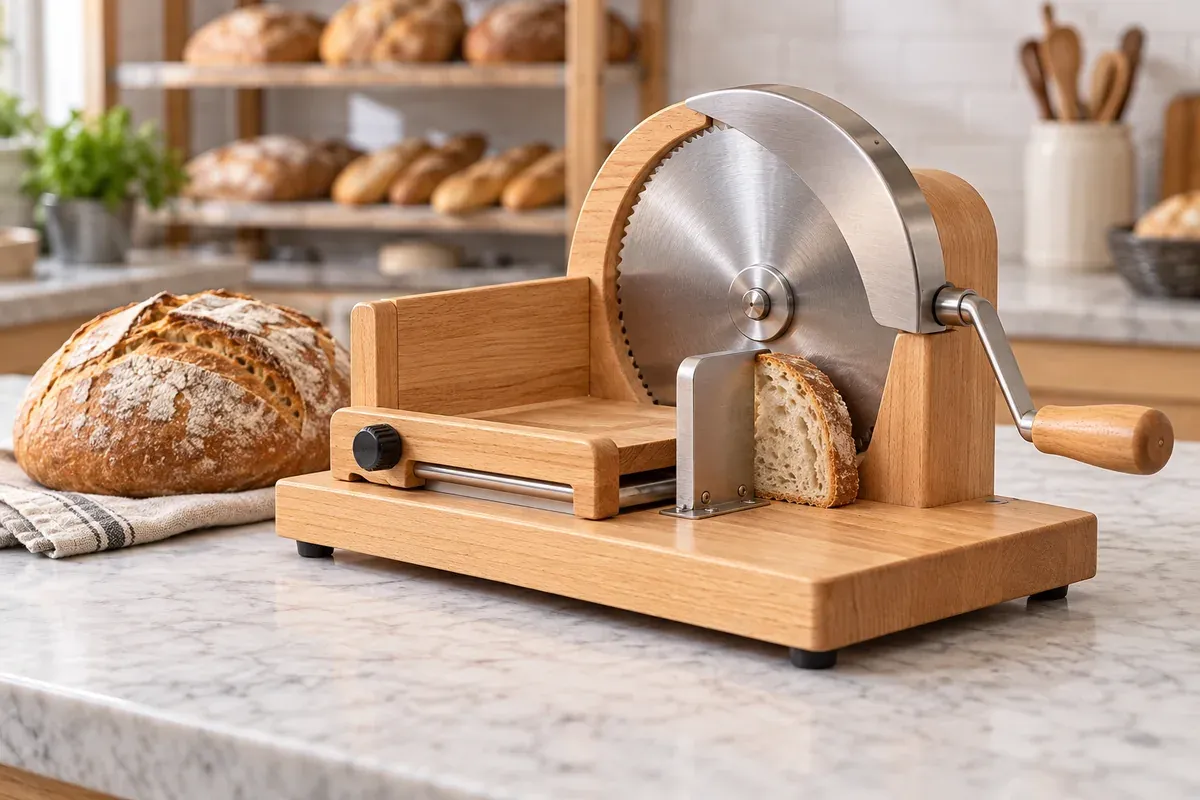
A wooden bread slicer manufacturer has to control more than the wood base. A B2B buyer is sourcing wood, a sharp metal cutting part, moving hardware, instructions and retail packaging. If responsibility is vague, a sample can look attractive while the delivered product is awkward to use, hard to clean or costly to return.
This guide is for importers and private-label teams. It explains what B2B buyers should check before choosing a manufacturer: product scope, component control, RFQ detail, sample approval and shipment release. For the live catalog configuration, see EcoWoodPlate's manual wooden bread slicer with hand crank. Use that product page for a current quote.
Verify the manufacturer, then choose the slicer model
“Bread slicer” describes several very different products. A buyer selling sourdough accessories may prefer a simple slotted guide. A specialty kitchenware range may need the theater and repeatable action of a hand-crank rotary slicer. A bakery processing line usually needs commercial equipment, which is a different purchasing category altogether.
| Type | Best fit | What the buyer must check |
|---|---|---|
| Slotted wooden guide | Low-complexity home baking accessory | Slot spacing, knife access, wood splinters, base stability and cleaning |
| Hand-crank rotary slicer | Giftable kitchenware, specialty retail and premium private label | Blade alignment, guard, crank clearance, loaf carriage, slice stop and packing |
| Commercial powered slicer | High-volume bakery operations | Electrical, guarding, output, service and local regulatory requirements |
EcoWoodPlate's current offering sits in the second category: a manual model with a wooden base, a stainless-steel blade, a metal guard and a hand crank. The live product page lists SKU k005, an approximate 31 × 21 × 18 cm size and a 200-piece MOQ. Use those figures to begin a conversation, then reconfirm the final drawing, materials, packaging and production plan before placing an order.
Check whether the manufacturer controls the full build
The first check is not whether a company calls itself a factory. Ask which work it controls: wooden fabrication, blade/guard and shaft sourcing, assembly, functional inspection, retail pack-out and export paperwork. A manufacturer can work with outside metal or printing partners; what matters is a clear answer about who owns each decision and who can correct a defect.
On a video call or factory visit, trace one unit from incoming boards to carton sealing. Ask for evidence of board sorting, hardware staging, a packing insert and an inspection record. A polished showroom or marketplace badge is only a starting point.
Material decisions that affect the finished product
| Part | Why it matters | Sample check |
|---|---|---|
| Wooden base and carriage | They provide the stable platform, visual character and mounting points | Flatness, sanding, grain/color range, finish, cracks and fastener holes |
| Blade, shaft and guard | They create the cutting path and protect the user | Approved specification, alignment, exposed-edge protection and cleaning access |
| Crank and handle | They affect force, comfort and clearance around the outgoing slice | Smooth rotation, attachment, sweep path and movement under the agreed test |
| Feet and inner protection | They keep the slicer steady and protect it in transit | Grip, marks on a worktop, secure attachment and packed movement |
Wood selection should follow the intended price level, appearance range and finish plan. It should not be used to hide a weak mechanism. Incoming boards need sorting before machining; finished wooden parts need inspection after sanding and before hardware is assembled. Approve a color range; reject cracks around fastener points.
What a marketplace badge does not tell you
Recent sourcing discussions make a useful distinction: a company can exist, show a badge or send a factory video and still be a poor fit for an order. Confirm the legal/payment entity, product scope, sample process, written specification and control of the production location. This is not an EcoWoodPlate customer case or a substitute for due diligence; it is why a manufacturer needs to mean more than a listing label.
Ask for a slice-support bracket or guide to be shown on the drawing. Then test the thinnest and thickest proposed settings with the loaf sizes named in the instructions. The guide must move the slice away from the crank without creating a pinch point or making crumb removal impossible.
What happens between the drawing and the sample
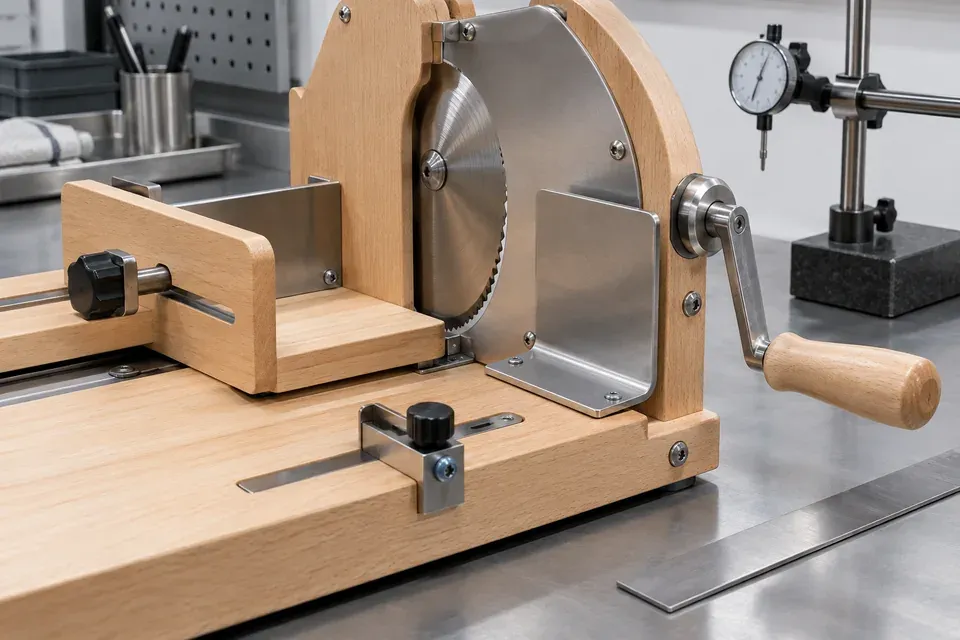
A reliable development sequence is unglamorous, which is exactly why it works. The factory first confirms the drawing revision, component list, wood, blade/guard specification, logo file and packaging requirement. Wooden parts are cut, drilled, sanded and finished; metal parts are checked; then the slicer is assembled around the same reference points used during machining.
At this stage, inspect more than the appearance. Turn the crank through its full path. Check that the carriage moves as intended, the stop adjusts and locks as intended, the base does not rock, the guard stays secure and the blade follows the agreed path. Ask how the team checks shaft play and blade alignment. A supplier who can describe the measurement method is giving the buyer better information than one who only says the blade is “sharp.”
How to make the sample review useful
The Maya–Chen exchange below is an illustrative sourcing example, not a customer testimonial.
Maya, a retail buyer: “We are planning 600 units. We want three slice settings and a logo on the base. What should we approve before you buy the cartons?”
Chen, a factory coordinator: “First approve the working sample, the actual loaf-size envelope, the stop positions and the slice-support guide. Then we can pack the crank separately, protect the full blade edge and make the retail insert from the same approved configuration.”
Maya: “Please show the 8 mm, 14 mm and 20 mm settings in the sample report.”
The important point is not the exact numbers. A marked stop setting does not guarantee an identical finished slice: bread compressibility, loaf shape, blade condition and user feed all play a part. The sample report should say how the setting was measured and what bread was used. Keep one signed reference sample, approved drawings and packaging artwork together as the standard for bulk production.
OEM and private-label choices
OEM changes can include the wood appearance, base dimensions, carriage travel, thickness-stop range, guard shape, handle material, feet, logo, instruction card and box. A logo-only project is usually more straightforward than changing the blade, crank or carriage geometry. When the mechanism changes, build in time for another sample review rather than treating it as a simple decoration change.
Laser engraving on the wooden base gives brands a practical identity point. Approve the artwork, size, position, orientation and appearance on a real sample. For the box, check the product name, barcode, warnings, assembly order, cleaning guidance and destination-language copy before printing. EcoWoodPlate's OEM/ODM service process can be used to organize the drawing, sample and packaging discussion.
QC that separates cosmetic issues from functional ones
The pre-shipment checklist should distinguish between a natural color variation and an assembly fault. Inspect base flatness, sanding, cracks, finish condition, hardware count, guard attachment, crank clearance, blade alignment, stop movement, instruction accuracy and carton condition. Define critical, major and minor defects before inspection begins so the buyer, supplier and any third-party inspector are using the same standard.
For a 600-unit order with seven loose hardware items per unit, receiving control covers 4,200 pieces of hardware—not just 600 finished slicers. That one calculation often changes how a buyer thinks about spare-part bags, count checks and pack-out photos.
Packaging and shipping
Wood scratches easily against metal. A blade, crank or guard can mark the base during a long shipment if it moves inside the box. A good pack keeps the wooden base and carriage still, covers the entire blade edge, separates the crank, retains loose hardware and protects corners. The final package must be reviewed with the actual product weight and intended delivery route; a retail shelf carton and an e-commerce parcel do not face the same handling risks.
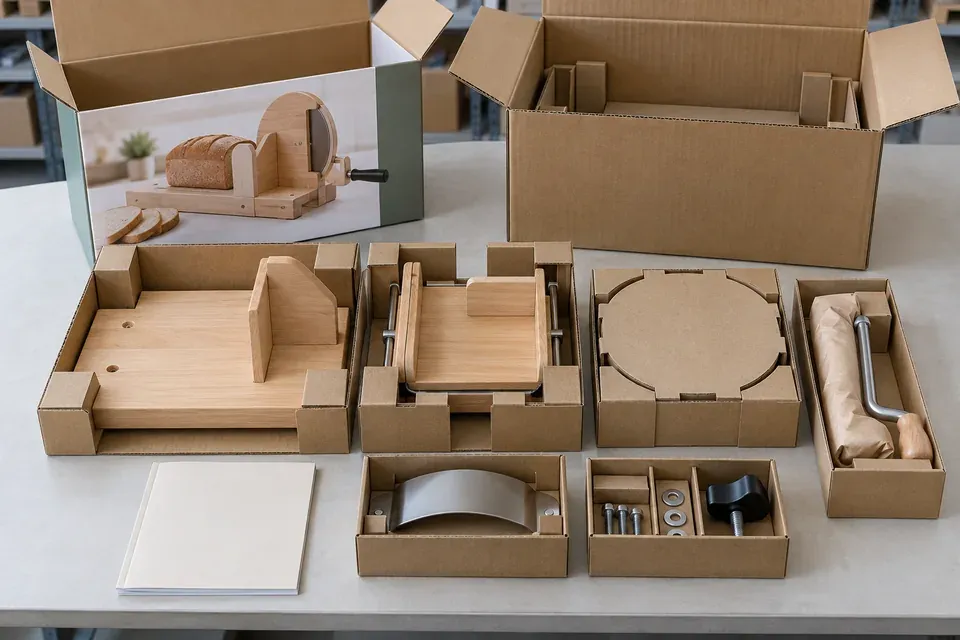
Before release, inspect the inner supports, retail box, master carton and pallet plan as one system. EcoWoodPlate's export-packaging guide for wooden products is useful for translating that review into a written pack specification.
Buyer checklist before the PO
- Confirm supplier identity and who controls wooden parts, hardware assembly and final packing.
- Approve the drawing revision, component list and loaf-size envelope.
- Specify the blade, shaft, guard, crank, stop, guide and fasteners.
- Approve wood, finish, logo location, appearance range and relevant food-contact documentation.
- Test the sample at every agreed stop position and record the method.
- Keep the golden sample, artwork and pack-out standard together.
- Agree on inspection sampling, defect classes, carton marks and shipment-release evidence.
For broader product scenarios, the earlier manual wooden bread slicer wholesale guide is also available. When comparing a Chinese wooden products manufacturer, ask whether the quoted company controls both wooden fabrication and the assembled mechanism. EcoWoodPlate, operated by Cao County Puchuang Wood Industry Co., Ltd. through ecowoodplate.com, works with buyers as a wooden kitchenware supplier, OEM wooden products supplier and custom wooden products factory.
FAQ
What is the difference between a wooden bread slicer and a hand-crank slicer?
A wooden slicer may be a simple slotted guide or a mechanism-based product. A hand-crank model uses a rotating blade, carriage and guard, so it requires closer inspection of the moving parts.
Can the slice thickness be customized?
It can be evaluated as part of an OEM project, but the buyer should define the adjustment method and sample-test every proposed setting. A dial or stop mark is not a guaranteed finished bread thickness.
How should buyers verify a wooden bread slicer manufacturer?
Check the legal and payment entity, product scope, who controls woodwork and assembly, the approved sample process, written specifications and a buyer-arranged pre-shipment check where appropriate. A badge or a factory video alone is not enough.
Can a logo be added?
Laser engraving on the base, labels and private-label packaging can be discussed. A physical approval sample is the right place to confirm the logo appearance and position.
How should the blade be packed?
The entire edge should be enclosed and immobilized, with metal parts separated from the wooden base. Check the unpacking sequence as well as the transport protection.
What should be checked before bulk production?
Approve the working sample, drawing, component list, material/finish, mechanism test method, logo, instructions and packaging—not only the product photo.
Bring the product brief, not just a reference photo
For the current product setup, begin with the hand-crank wooden bread slicer and the wider Kitchen & Dining range. Then share the target quantity, market, loaf sizes, logo, packaging concept and delivery window through the OEM/ODM process. When the specification is ready, contact EcoWoodPlate for a project-specific discussion.
Need Factory Direct OEM/ODM Pricing?
Send your product, quantity, logo, packaging and destination country. Our factory team will reply with quotation guidance.
Request Factory Quote