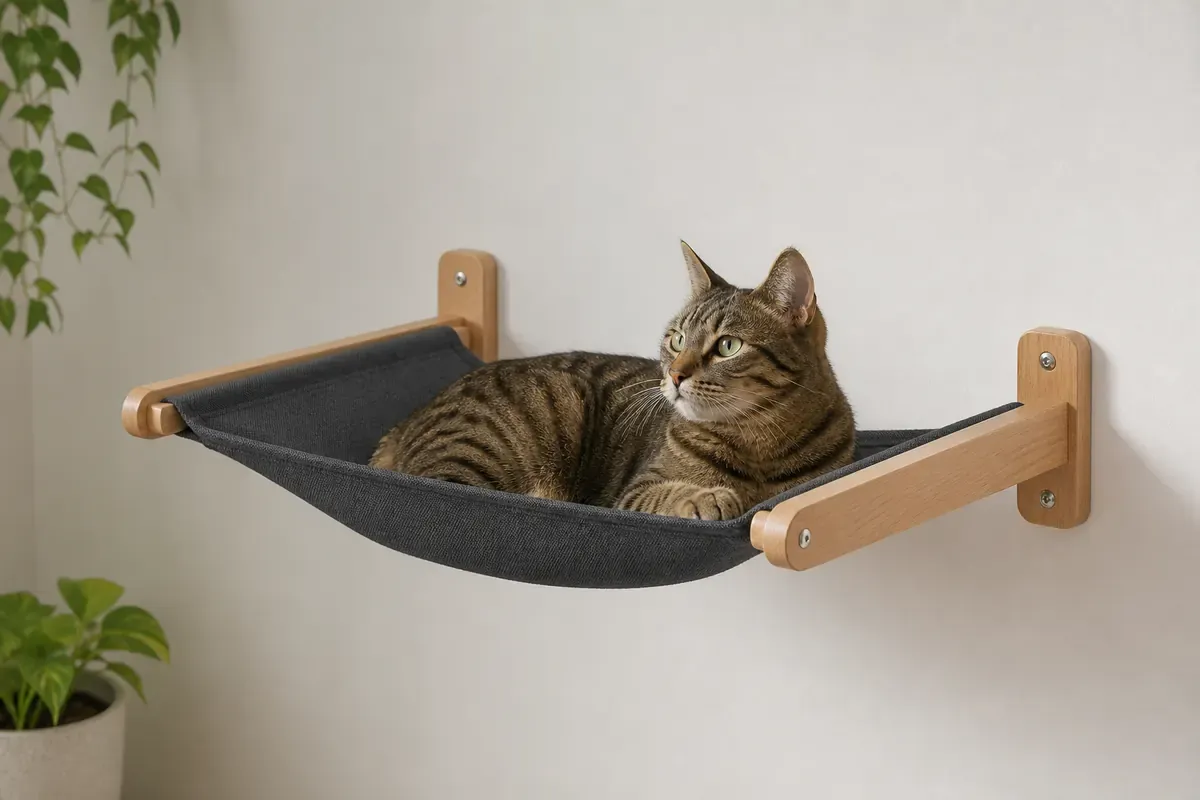
A wall-mounted cat hammock is not simply a fabric sling attached to two pieces of wood. For a retail-ready product, the buyer must define the wall interface, wooden frame, fabric sleeve, fasteners, installation instructions, claimed load, test method, and packaging as one system. If the mounting method is vague, a good-looking sample can still become a return or safety complaint after installation.
This guide is for pet-product importers, wholesalers, private-label brands, retail buyers, and e-commerce sellers sourcing from a wall-mounted wooden cat hammock manufacturer. It explains what to specify before sampling, how to compare materials, and how to control bulk production without relying on a generic “heavy duty” claim.
What is a wall-mounted wooden cat hammock?
A wall-mounted wooden cat hammock uses wooden side rails or brackets to support a suspended fabric bed above the floor. It gives cats an elevated resting place while using less floor area than a cat tree. The product can be sold alone or combined with steps, shelves, scratching panels, and bridges in a modular cat-wall program.
The current EcoWoodPlate product listing identifies SKU pet017 as a solid-wood and fabric wall-mounted cat bed. It lists an MOQ of 200 pieces and a regular bulk-production reference of 15–20 days, subject to the final specification and quantity. These are useful project references, not a promise for every customized version.
Which B2B buyers can use this product?
- Pet retailers can add compact furniture for apartment and indoor-cat ranges.
- Online sellers can use a flat-pack structure to reduce parcel volume.
- Private-label brands can coordinate wood tone, fabric color, packaging, and instructions.
- Distributors can build modular assortments with wall steps, bridges, and resting shelves.
- OEM customers can adjust dimensions, mounting plates, fabric construction, and branding for a defined market.
Material choices change the product’s risk
| Component | Common options | What buyers should check |
|---|---|---|
| Wooden rails | Pine, beech, rubberwood, or suitable plywood | Moisture condition, grain defects, edge radius, hole position, and screw holding |
| Fabric hammock | Canvas, woven polyester, or blended upholstery fabric | Seam construction, sleeve fit, abrasion, wash method, colorfastness, and odor |
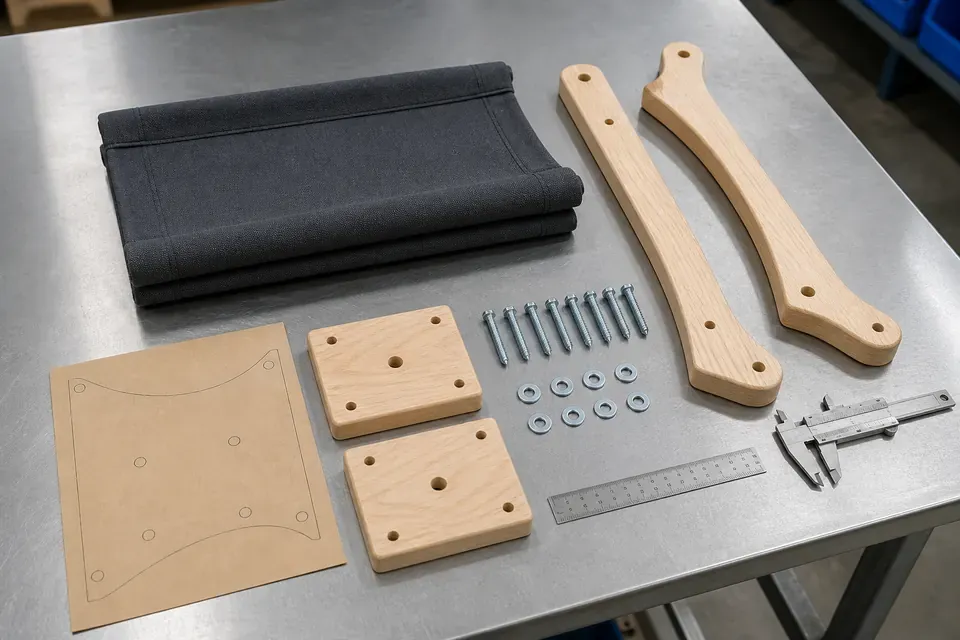
| Mounting plate | Solid wood or engineered panel | Thickness, hole spacing, countersink quality, and flat contact with the wall |
| Hardware | Screws, washers, bolts, inserts, and wall-dependent anchors | Material, finish, dimensions, quantity, and compatibility with the installation plan |
| Surface finish | Clear coating, stain, paint, or natural oil system | Drying, odor, scratch resistance, color range, and buyer-market requirements |
Solid wood gives a natural appearance, but grain and color will vary. Plywood can offer repeatable thickness and stable shapes when the visible edge is acceptable. The choice should follow the bracket geometry and test plan, not a broad assumption that one wood is always stronger.
Wall type must be part of the product brief
Forum discussions about cat shelves and hammocks repeatedly show the same problem: buyers receive a product with generic plastic plugs, but the customer may have drywall, plaster, masonry, timber studs, or another wall system. A cat also creates a dynamic load when it jumps, which is different from placing the same weight gently on a shelf.
An importer should not ask a wooden pet products manufacturer to select one universal anchor for every wall. Instead, define the target market, expected wall types, mounting guidance, warnings, and validation method. If attachment to structural framing is required, say so clearly. If alternate anchors are permitted, the instructions should identify who must select them. Product claims should follow a documented test performed with the intended bracket and mounting setup.
Use measurable drawings before sampling
The drawing should show the overall width, projection from the wall, fabric-bed area, rail thickness, wall-plate size, hole spacing, hole diameter, countersink, edge radius, fabric sleeve width, seam allowance, and hardware position. Include separate part numbers for every wooden, textile, and metal component.
As an illustrative RFQ, a buyer might request a 520 mm overall width, a 380 mm projection, 18 mm wooden rails, two mounting holes per wall plate, and a 25 mm fabric sleeve. It might set a ±1 mm tolerance for machined wood parts and ±3 mm for the cut-and-sewn fabric. Those figures are examples for discussion, not EcoWoodPlate’s standard dimensions or guaranteed tolerances.
Production process for an OEM cat hammock
- Incoming inspection: check wood moisture condition, visible defects, thickness, fabric roll color, hardware dimensions, and odor.
- CNC cutting and drilling: machine the rails and mounting plates from an approved drawing and hole pattern.
- Sanding: remove fibers and sharp edges, especially around fabric contact points and mounting holes.
- Surface treatment: apply the approved finish and allow it to dry before assembly or packing.
- Fabric cutting and sewing: control sling size, reinforced ends, sleeve width, stitch density, and loose threads.
- Trial assembly: confirm that the fabric can be installed without excessive force and that both sides sit evenly.
- Mounting and functional test: use the agreed wall fixture or test rig, load method, duration, and inspection criteria.
- Final packing: count hardware, protect finished wood, include the correct template and instructions, and seal the retail box.
OEM and ODM customization that matters
A practical OEM wooden products supplier program may include custom width, projection, wood species, finish color, fabric weight, fabric color, embroidered or printed branding, laser logo, removable sling, mounting-plate shape, hardware bag, drilling template, instruction language, barcode, retail box, and master-carton marks.
ODM development should also consider how the hammock connects to a larger cat-wall range. If customers must jump from a step onto the bed, the approach direction and clearance matter. A visually attractive module can still be difficult to use if another shelf blocks entry or if the hammock is too close to a ceiling or corner.
A representative buyer–factory conversation
The following conversation is a composite example, not a customer testimonial:
Emma, a private-label pet buyer: “We need 800 units in four fabric colors. Can the carton include the same wall plugs in every market?”
Leo, a factory project coordinator: “Please confirm the wall types and installation responsibility first. Four colors also mean 200 fabric sets per version. We should approve one structural sample, four color swatches, the hardware list, and a market-specific instruction before bulk sewing.”
Emma: “Keep one wood finish, use four fabric colors, and quote the wall hardware separately. We will have our local compliance team approve the instructions and mounting method.”
The 800-unit example is illustrative, but the decision process is useful: separate the structural specification from color and market-specific installation content.
Samples and MOQ planning
Begin with a structural sample when the bracket, mounting plate, or fabric geometry is new. The approved pre-production sample should use the intended wood, finish, fabric, stitching, fasteners, template, instructions, and retail pack. Keep a signed sample and a dated specification sheet for bulk comparison.
The EcoWoodPlate listing gives 200 pieces as the current MOQ reference for SKU pet017. Exact MOQ may change with custom fabric dyeing, multiple colors, special hardware, new packaging, or a new mounting structure. Buyers should ask for quantity by version, not only one total order number.
Quality-control checklist
- Confirm wood species or panel specification and the approved visible color range.
- Measure overall dimensions, projection, rail thickness, wall-plate size, and hole spacing.
- Inspect rounding, sanding, finish coverage, scratches, cracks, and rough countersinks.
- Check fabric shade, cut size, sleeve width, stitch path, reinforcement, and loose threads.
- Assemble the sample and confirm that the sling is centered without twisting.
- Verify every screw, washer, insert, tool, and anchor item against the bill of materials.
- Run the agreed static and dynamic test on the defined fixture; record the setup instead of reporting only “passed.”
- Compare logo position, instruction revision, barcode, color name, and carton marks.
Packaging and e-commerce delivery
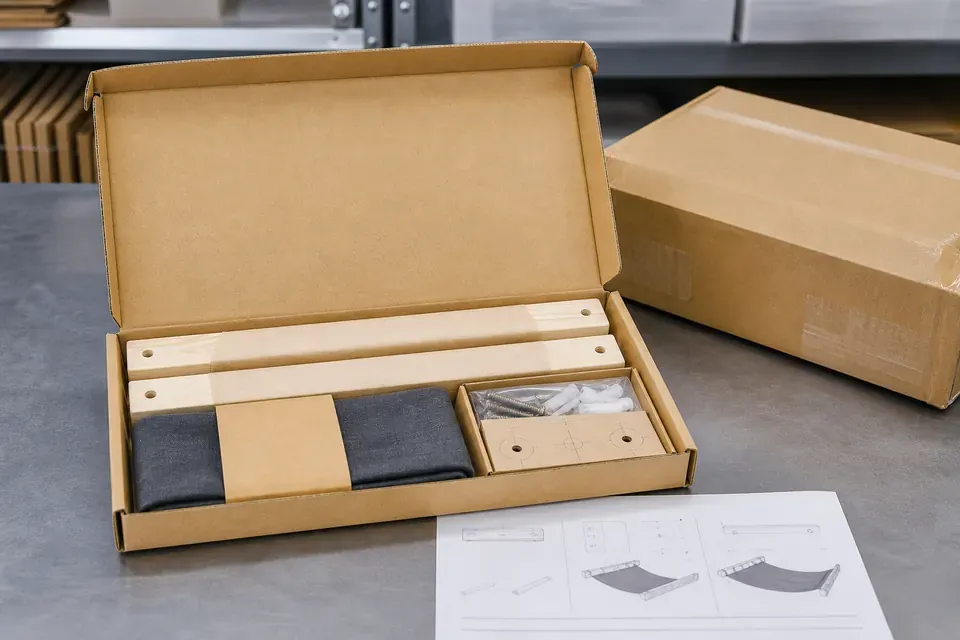
Flat packing can lower volume, but parts must not rub against finished faces. Wrap paired rails with paper or a soft sheet, isolate metal hardware in a sealed compartment, fold the fabric without creating permanent creases, and protect the ends of the wooden parts. A drilling template should stay flat and readable.
Pack one complete sample carton before mass packing. Confirm retail-box dimensions, gross weight, component count, internal movement, master-carton quantity, and parcel-delivery protection. If several fabric colors share similar cartons, use a visible color code or label so the warehouse does not mix versions.
Buyer RFQ checklist
- Destination market, sales channel, target quantity, and required arrival date
- Overall dimensions, projection, wall-plate geometry, and hole spacing
- Wood, finish, fabric construction, color versions, and removable-wash requirements
- Mounting responsibility, target wall types, hardware list, instructions, and warnings
- Agreed load-test fixture, method, duration, acceptance criteria, and report format
- Logo, label, barcode, retail box, master carton, and inspection plan
FAQ
How should buyers specify mounting hardware?
Start with the target wall construction and local installation requirements. Define the screws, washers, brackets, and any supplied anchors by dimensions and material. Do not describe one small plastic plug as suitable for every wall.
How is a wall-mounted cat hammock tested?
The buyer and factory should agree on the fixture, mounting method, static load, dynamic or repeated-load method, duration, inspection points, and failure criteria. A load number without the method is incomplete.
Can the fabric sling be removable and washable?
Yes, if the rail and sleeve construction allows removal. Confirm wash method, shrinkage expectation, colorfastness, reassembly, and whether replacement fabric can be supplied.
Can several fabric colors share one MOQ?
It can be discussed, but the factory needs the quantity per color. Fabric sourcing and sewing setup may create a separate minimum for each version.
What should importers inspect before shipment?
Inspect dimensions, hole position, finish, fabric sewing, full hardware count, assembly fit, test records, instructions, barcode, unit protection, and carton assortment.
How can buyers start a project with EcoWoodPlate?
Send the product drawing, target wall market, quantity, fabric versions, packaging, destination, and delivery window through ecowoodplate.com/contact. EcoWoodPlate is operated by Cao County Puchuang Wood Industry Co., Ltd., a Chinese wooden products manufacturer supporting OEM pet furniture and private-label programs.
Build the claim around the test method
A reliable wall-mounted wooden cat hammock manufacturer should help convert a product concept into drawings, parts, test criteria, instructions, and packaging that can be repeated in bulk. The safest buying decision is not the biggest unsupported load claim. It is the clearest match between structure, mounting method, target wall, documented test, and end-user instructions.
Review the wall-mounted cat bed product reference, wooden pet products range, OEM/ODM service, factory capability page, sample approval guide, and export packaging guide before sending an RFQ to this custom wooden products factory.
Need Factory Direct OEM/ODM Pricing?
Send your product, quantity, logo, packaging and destination country. Our factory team will reply with quotation guidance.
Request Factory Quote