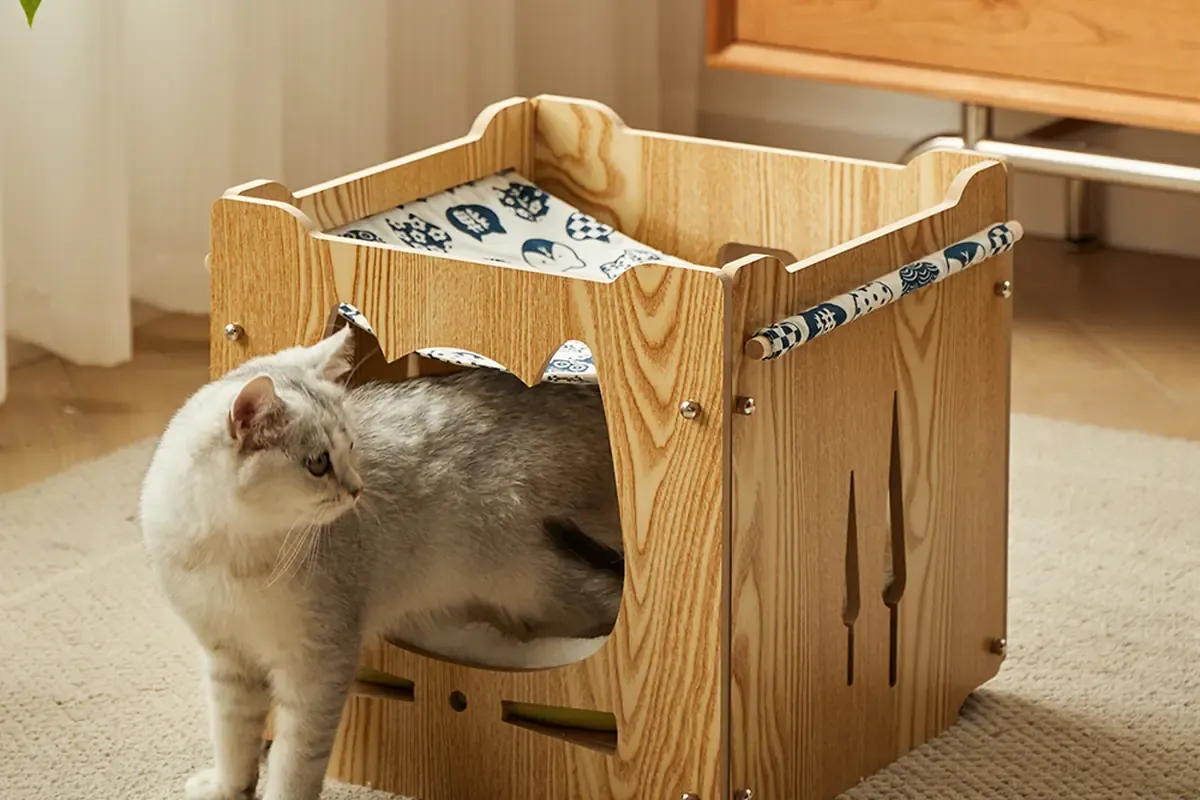
Wooden Cat House Side Tables: OEM Guide for Pet Brands
A wooden cat house side table manufacturer must control two functions in one product: a quiet enclosed resting space for the cat and a stable furniture surface for the owner. For importers, retailers and private-label pet brands, the key checks are internal space, entrance geometry, ventilation, top-panel load, cleanability, edge finishing, hardware retention and mail-order packaging—not simply whether the sample looks attractive beside a sofa.
This guide is for pet-product importers, home-lifestyle retailers, e-commerce sellers and brand owners specifying OEM production in China. A furniture-style cat house is not a travel carrier, escape-resistant crate or suitable choice for an animal that persistently chews wood.
What is a wooden cat house side table?
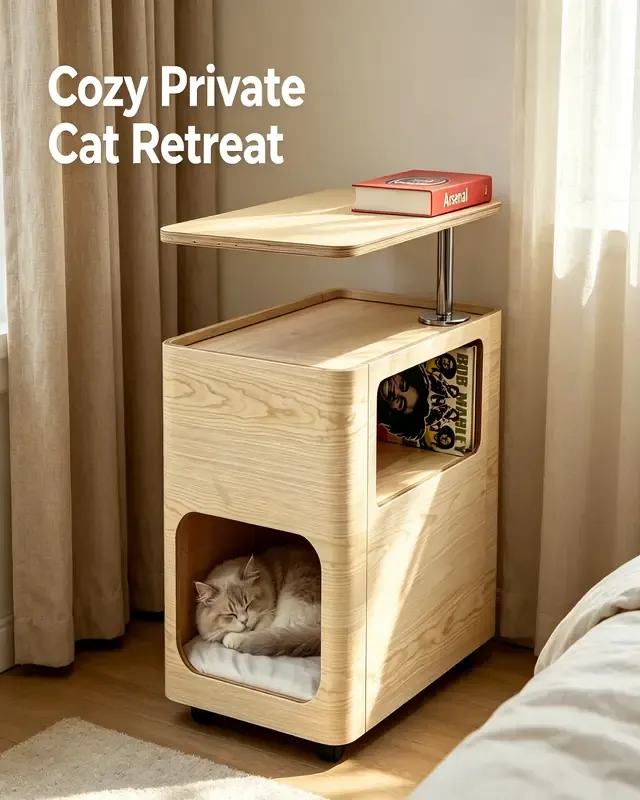
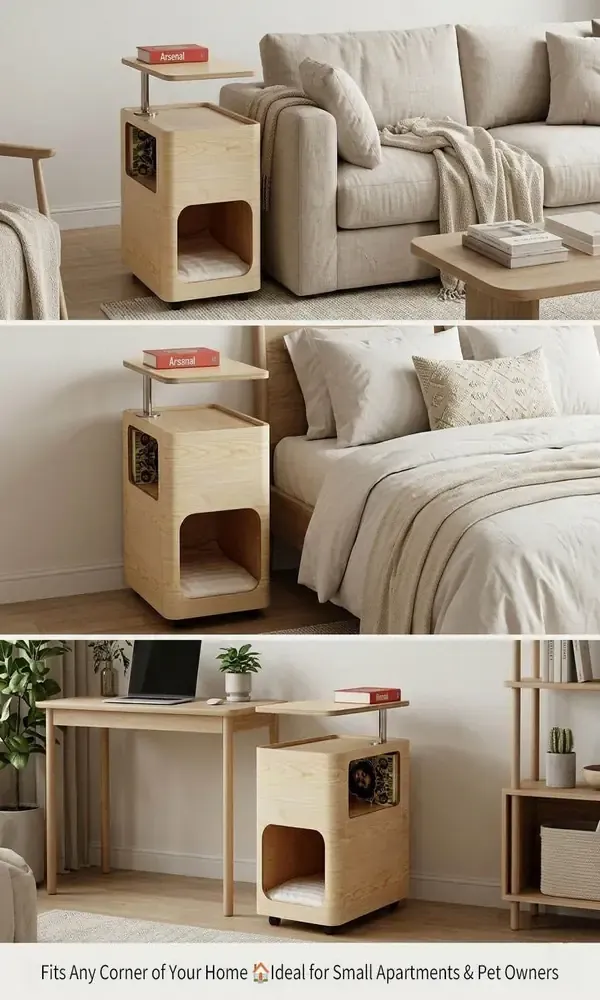
It is an indoor unit with an enclosed lower compartment for a cat and a usable upper surface for light household items. Some models add a shelf, drawer, removable panel or adjustable top. Buyers need both pet-use and furniture-use specifications.
For a useful market reference, buyers can review this wooden cat house side table design, which shows how a sleeping enclosure can be combined with storage and a raised tabletop. The broader custom wooden pet furniture collection also illustrates cat beds, caves, sofas and climbing furniture. These are external design references; EcoWoodPlate quotations and specifications are confirmed separately for each project.
Which buyers and sales channels suit this product?
- Pet brands developing furniture that blends into living rooms or bedrooms
- Home-lifestyle retailers adding pet products without changing their interior-design positioning
- E-commerce sellers needing knock-down structures and parcel-ready cartons
- Wholesalers building coordinated cat bed, feeder and storage ranges
- Private-label buyers customizing entrance shapes, colors, cushions, logos and packaging
The product is not secure animal containment. A cat that scratches, bites or pushes aggressively may need another product category. Instructions should discourage children from climbing or sitting on the top unless that use was designed and validated.
Choose material by structure, finish and shipping weight
| Material | Useful characteristics | Buyer concern | Suitable discussion |
|---|---|---|---|
| Solid pine or poplar | Visible natural grain and straightforward machining | Color, knots and moisture movement vary | Premium natural-finish ranges and replaceable parts |
| Birch or poplar plywood | Good panel stability and exposed layered edges | Core quality, edge finishing and formaldehyde requirements | Knock-down bodies, curved corners and e-commerce programs |
| MDF | Flat painted surface and consistent CNC routing | Weight, edge sealing and destination-market emissions scope | Painted indoor models where the buyer defines documentation |
| Bamboo panel | Distinct linear appearance and hard surface | Weight, glue-line appearance and machining wear | Design-led collections after sample review |
Specify panel construction, thickness, visible grain range, moisture-control method, finish and destination market. Do not call plywood or MDF “solid wood.” Define emissions or coating requirements by product, material, test method and market before sampling.
Turn the concept into a measurable drawing
The drawing should show overall size, usable top, internal space, entrance, ventilation, panel thickness, floor clearance, cushion, hardware and assembly sequence. For an adjustable top, state its lowest and highest positions and locking method.
“Rounded” and “large entrance” are not measurable. State the radius and clear finished opening, not only the CNC cutout.
A composite sourcing case with concrete numbers
The following Maya–Chen exchange is a composite example based on recurring pet-furniture RFQ gaps. It is not a customer testimonial. Every number is an illustrative project criterion, not a standard EcoWoodPlate tolerance or safety guarantee.
Maya, category buyer: “We need 600 cat side tables for an online launch. The top must hold a lamp, the opening should fit a large cat, and the carton must pass parcel delivery.”
Chen, factory engineer: “Please define the cat-use envelope, tabletop load and test method. Does ‘large cat’ mean an entrance reference of 260 × 280 mm and an internal space of 430 × 440 × 400 mm, or do you have another target? What parcel test protocol will your retailer accept?”
They freeze a working sample sheet: overall size 480 × 450 × 620 mm; 18 mm nominal plywood panels; a buyer-defined 15 kg evenly distributed working load on the top; an illustrative 22.5 kg proof load held for 60 seconds without joint separation; entrance position within ±2 mm of the drawing; four non-marking feet; one removable cushion; and a 10-set pilot pack. The retail channel requests a packaged drop sequence from 76 cm, but the buyer confirms the exact orientation count and acceptance criteria with its packaging lab.
Replace these example values with criteria supported by the final construction, intended use, market and test plan.
Production flow for repeatable bulk orders
- Material inspection: Confirm panel identity, thickness, visible-face grade, moisture method and abnormal odor before cutting.
- CNC cutting: Machine the entrance, ventilation slots, hardware recesses and knock-down joints from the approved drawing revision.
- Trial assembly: Check squareness, wobble, door or panel movement, floor clearance and whether the cushion can be removed without tools.
- Edge finishing: Sand entrances, ventilation openings and hand-contact edges. Inspect by touch after the first finish coat because fibers can rise.
- Finish application: Record coating identity, color reference, lot and drying or curing conditions. Keep the interior low-odor and easy to wipe according to the approved specification.
- Logo trial: Approve laser engraving, printing, metal badge or label position on the actual material. Keep branding away from surfaces likely to be scratched or washed.
- Functional checks: Verify top load, assembly hardware, feet, cushion fit, entrance size and ventilation against the agreed plan.
- Pack-out audit: Count panels and hardware, protect finished faces, scan barcodes and compare carton marks with the purchase order.
OEM and ODM customization options
EcoWoodPlate can discuss custom dimensions, entrances, shelves, panels, cushions, finishes and knock-down structures. Branding may include engraving, printing, labels, instructions, retail cartons and barcodes. Begin a new shape with a dimensioned drawing or physical reference, then approve a functional sample.
As an OEM wooden products supplier, the factory should record every revision. Moving the entrance, adding a drawer or increasing tabletop height changes weight distribution and carton size. A change that looks cosmetic may affect assembly, stability and shipping cost.
Samples and MOQ
MOQ depends on panels, machining, finish, cushion, hardware, logo and packaging. Approve the furniture sample and packed sample separately; an attractive unit does not prove that its hardware and corner protection will survive e-commerce handling.
Keep one signed master sample with the buyer and one with the factory when practical. Record the drawing revision, finish code, cushion fabric, hardware list, carton specification and approved care text. EcoWoodPlate's sample approval guide provides a broader workflow.
Quality-control points pet brands should not skip
- Overall dimensions, clear entrance size and internal usable space
- Panel flatness, cabinet squareness and wobble on a hard floor
- Rounded entrances with no sharp fibers or exposed fastener tips
- Ventilation openings and cushion clearance consistent with the drawing
- Top-panel load test using the agreed load position and duration
- Hardware torque or retention check appropriate to the fastener system
- Finish color range, dry surface, odor screen and wipe-clean method
- Removable cushion size, seam quality and care-label accuracy
- Complete hardware bag, spare-part policy and readable assembly steps
Define foreseeable misuse. If the top resembles a stool, add a visible “not for sitting or climbing” instruction unless designed for that load. Review pinch points and locks on moving parts. Convert recurring concerns about ventilation, chewing and cleaning into drawings and tests.
Packaging and shipping for a furniture-size pet product
Knock-down packing usually lowers carton volume, but it transfers risk to hardware control and customer assembly. Place interleaving between finished panels, protect corners, isolate metal parts and prevent the adjustable column or feet from striking wood surfaces. Cushion fabric should be protected from dust and finish transfer.
The instruction sheet should identify every panel and fastener, show orientation clearly and include the intended-use warnings. For e-commerce, confirm the retailer's package test, barcode location, master-carton rules and maximum accepted dimensions before mass production. The wooden product export packaging guide covers carton planning in more detail.
Buyer RFQ checklist
- Target cat size range and intended indoor use
- Overall and internal dimensions, entrance size and ventilation layout
- Panel material, thickness, visible-face grade and finish
- Top working load and buyer-approved test method
- Fixed, adjustable or removable tabletop construction
- Cushion dimensions, filling, cover fabric and washing instruction
- Logo method, artwork size, color and position
- Assembly hardware, spare parts and instruction language
- Retail or mail-order carton, barcode and package-test requirement
- Quantity, destination, target timing and inspection plan
FAQ
Is a wooden cat house side table suitable as a secure crate?
No. It should be marketed as indoor resting furniture unless a separate containment use has been designed and validated. It is not appropriate for transport or for animals likely to chew through wooden parts.
Which material is best for a custom cat house side table?
There is no universal best material. Solid wood offers natural grain; plywood can provide stable panels and exposed layered edges; MDF suits painted surfaces but adds weight. Choose after comparing appearance, structure, emissions scope, shipping weight and price position.
How should buyers confirm tabletop load?
State the working load, load distribution, duration, test surface and acceptable deflection or damage. Test the final assembled construction, not only a loose top panel.
What should be checked before mass production?
Approve the drawing, material, finish, entrance, ventilation, cushion, logo, hardware, assembly instruction, load test and complete pack-out. Retain traceable master samples or signed records.
Can the product use private-label packaging?
Yes. Retail cartons, mail-order cartons, inserts, barcodes, labels and assembly manuals can be developed. Packaging MOQ and cost depend on print method, carton structure and quantity.
How can an importer source this product from China?
Send a complete RFQ to a wooden pet products manufacturer, review a functional and packed sample, define inspection points, then approve bulk production only after revisions are closed.
Prepare the product brief before requesting a quote
EcoWoodPlate, operated by Cao County Puchuang Wood Industry Co., Ltd., works through ecowoodplate.com as a Chinese wooden products manufacturer for overseas B2B buyers. Importers comparing a custom wooden products factory or wooden products manufacturer China program can review our pet products category, related wooden cat house reference, factory capabilities and inquiry page.
Send the intended use, dimensioned drawing, material preference, top-load requirement, finish, cushion, logo, packaging, quantity and destination. The clearer the brief, the easier it is to build a cat house side table that works as both pet furniture and a repeatable retail product.
Need Factory Direct OEM/ODM Pricing?
Send your product, quantity, logo, packaging and destination country. Our factory team will reply with quotation guidance.
Request Factory Quote