Wooden Kitchenware Finish and Odor Control for Bulk Orders
A reliable wooden kitchenware finish control plan does more than ask whether an oil is “food-safe.” An importer should approve the exact finish identity, its supplier and intended use, application amount, drying or curing conditions, odor limit, cleaning instructions and batch records. Those details determine whether a wooden spoon, bowl or serving utensil arrives dry, even in color and free from an objectionable smell.
This guide is for importers, kitchenware brands, retail buyers, Amazon sellers and private-label teams ordering wooden utensils and related food-contact products. It explains how EcoWoodPlate and Cao County Puchuang Wood Industry Co., Ltd. can turn a vague finish request into an auditable OEM specification. It is purchasing guidance, not a substitute for legal advice or testing for your destination market.
Why “food-safe finish” is not a complete specification
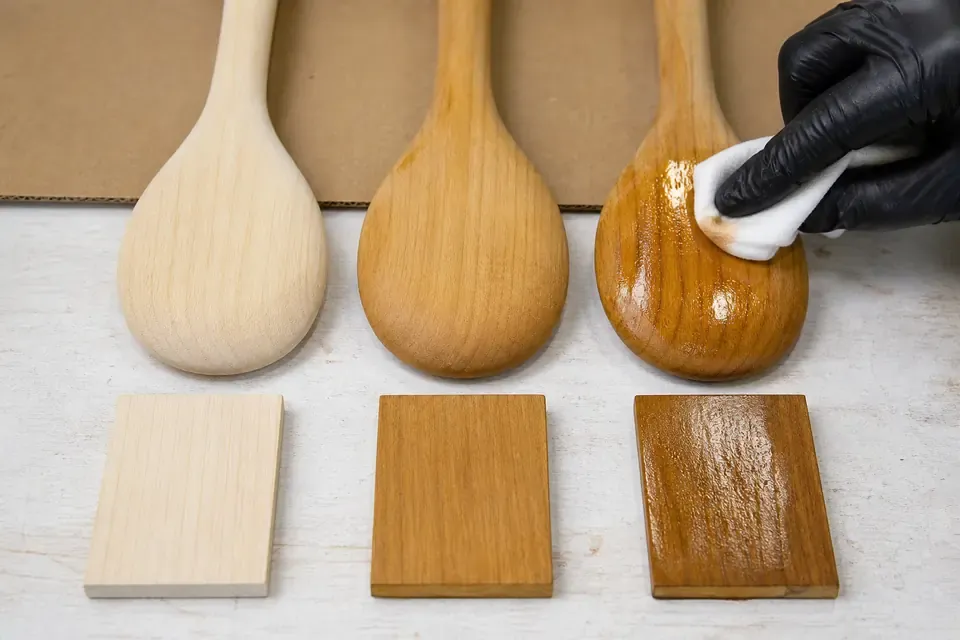
Two finishes can look similar on a sample but behave differently after washing, warm-food contact or several weeks inside a sealed carton. Even the same finish may produce different results if the wood species, surface preparation, application weight or drying time changes.
For the United States, the FDA explains that food-contact status depends on each substance, its specifications and conditions of use. An authorization may also be tied to a particular manufacturer. Request the finish's exact identity and supporting documentation rather than accept a generic “FDA approved” sentence. See the FDA's food-contact material guidance.
For the EU, Regulation (EC) No 1935/2004 addresses transfer that could endanger health, unacceptably change food composition or deteriorate taste and odor under normal or foreseeable use. Regulation (EC) No 2023/2006 adds good-manufacturing-practice requirements. Define the real use—dry serving, oily food, repeated washing, warm food or prolonged contact—before selecting documents or tests.
Match the wood and finish to the use
| Material | Useful characteristics | Finish-control concern | Typical buyer check |
|---|---|---|---|
| Beech | Close, even grain; suitable for spoons and spatulas | Pale wood makes uneven oiling and stains easy to see | Approve a color range under neutral light |
| Acacia | Distinct grain and natural color variation | Heartwood and sapwood can absorb finish differently | Set acceptable light/dark distribution, not one exact color |
| Teak | Naturally oily feel and warm color | Surface preparation affects coating adhesion and final feel | Confirm whether the product is wiped, oiled or left unfinished |
| Bamboo | Uniform appearance and efficient sheet processing | Glue lines and edge absorption require separate review | Inspect exposed edges after the cleaning simulation |
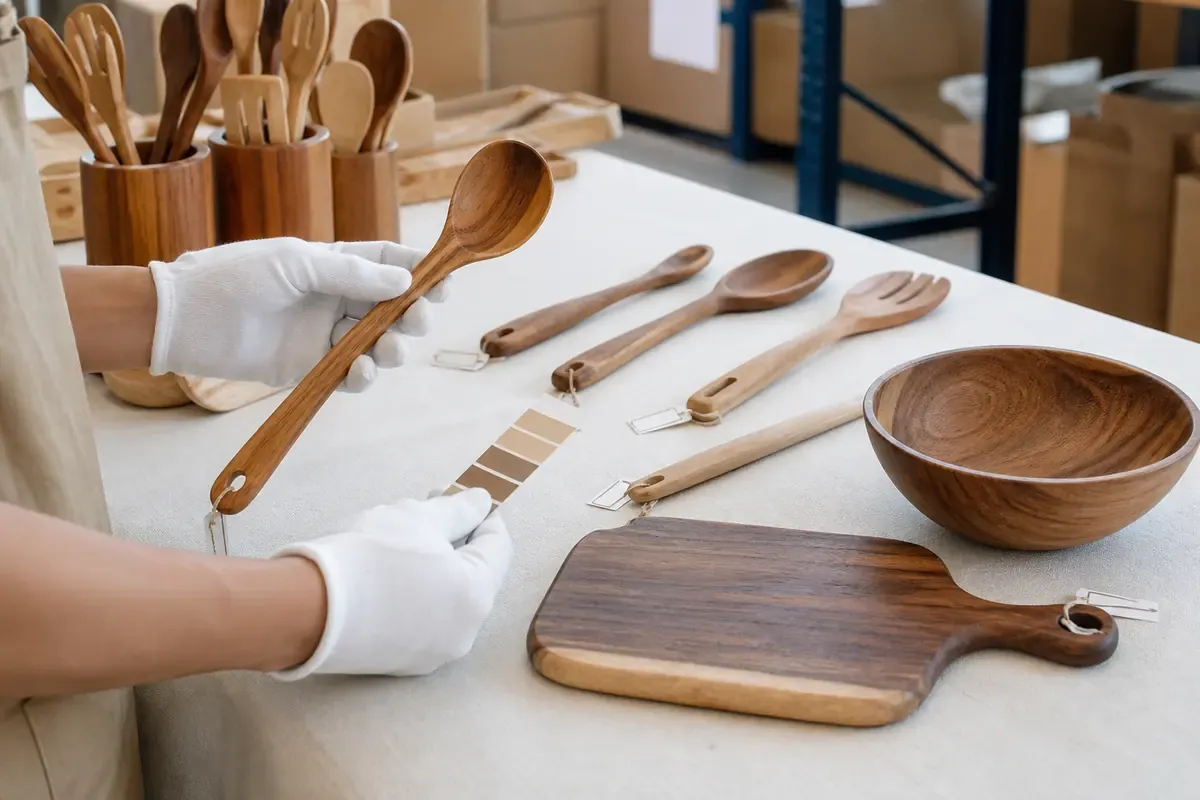
Wood is naturally variable. Control an acceptable range rather than demanding that every utensil copy one photograph. State the species, permitted sapwood, knot policy, project moisture target, grain direction and color-sorting rule. For moisture-related cracking and odor risk, see our moisture control guide for importers.
A composite buyer case: replace adjectives with numbers
The following Emma–Leo conversation is a composite purchasing example built from recurring RFQ problems. It is not a customer testimonial and the numbers are illustrative project criteria, not EcoWoodPlate's universal tolerances.
Emma, purchasing manager: “We need 2,400 six-piece utensil sets. Please use a natural food-safe oil, medium brown, no smell, and the logo must match our sample.”
Leo, factory engineer: “Which oil reference, destination market and intended use should we follow? Does ‘no smell’ mean immediately after opening the master carton, or after the set has aired for 30 minutes?”
They convert the request into a sample sheet: one named finish and supplier; matte visual appearance; no wet or sticky residue on a clean white cloth; an agreed odor score of 0 or 1 on a 0–3 internal comparison scale after 30 minutes of airing; laser logo position within an illustrative ±1 mm location window; six utensils per paper sleeve; and 20 retained sample sets divided between buyer and factory. The buyer also specifies hand washing only and excludes dishwasher use from the claim.
The value is repeatability, not the particular numbers. “Natural,” “medium brown” and “no smell” cannot be audited until tied to a reference, method and timing.
Eight production controls for OEM wooden kitchenware
- Incoming material inspection: Verify species and dimensions, screen obvious cracks, contamination and abnormal odor, then segregate wood outside the approved grain or color range.
- Conditioning: Allow material to stabilize under the factory's project conditions. Record the measuring method and sampling positions instead of relying on a single moisture reading.
- CNC cutting or shaping: Use the approved drawing for outline, thickness, handle hole and functional edges. A spoon bowl, spatula slot and hanging hole each need separate dimensional checks.
- Sanding: Define the sequence and final surface reference. Inspect end grain and transitions by touch because rough fibers often reappear there after wetting.
- Logo trial: Test laser power and speed on the actual production species. Approve position, darkness and edge scorching before mass engraving. A dark acacia section may need a different visual reference from pale beech.
- Finish application: Record the finish lot, application method, time and operator. Keep over-wet pieces separate; extra finish is not automatically better protection.
- Drying, curing or resting: Follow the finish supplier's documented process. Do not pack simply because the surface looks dry. Check feel, cloth transfer and odor at an agreed time.
- Final sampling: Compare dimensions, color range, logo, surface feel, set count and packaging with the signed master sample. Retain traceable samples from the bulk lot when the program requires them.
What can be customized—and what must stay traceable
As a wooden kitchenware supplier, EcoWoodPlate can discuss OEM or ODM changes to utensil shape, length, bowl depth, spatula slots, hanging holes, set composition and packaging. Logo options may include laser engraving or other methods appropriate to the product. Color and surface feel can be adjusted through species selection and an agreed finish system.
Every change should update the drawing or bill of materials. If a buyer changes from beech to acacia, enlarges a laser mark or replaces a paper sleeve with a closed box, the approved appearance and odor risk may change. A disciplined OEM wooden products supplier should not treat those as invisible substitutions.
Samples, MOQ and bulk consistency
MOQ depends on species availability, tooling, number of shapes, finish, logo process, color sorting and packaging. Ask for a prototype when geometry is new, then a pre-production sample made with the intended material and finish. For a multi-item set, approve the whole set—not only one spoon—because different thicknesses and grain orientations absorb finish differently.
Keep the signed master sample, drawing revision, finish record, packaging mock-up and care text together. Our sample approval guide explains how to freeze these details before a bulk order.
Odor, residue and cleaning checks buyers can specify
- Closed-carton opening check: State carton age, opening conditions and when the odor is assessed.
- Reference scale: Use the same trained reviewers and a simple written scale. An internal odor screen improves consistency but does not replace laboratory testing.
- White-cloth wipe: Define cloth type, number of strokes and what counts as unacceptable oil or color transfer.
- Water exposure: Agree the water temperature, exposure time and drying method; inspect raised grain, whitening, tackiness and joint changes afterward.
- Care instruction review: Confirm hand-wash, soaking, dishwasher and drying statements match the validated use. Do not print a dishwasher-safe claim without supporting evidence.
Forum discussions show recurring uncertainty over whether odor comes from wood, excess oil, storage or an unstabilized finish. Resolve that uncertainty before production by defining the material, finish identity, airing time and acceptance method.
Packaging and shipping without trapping finish odor
Pack only after the approved resting or curing stage. A sealed retail box can concentrate a smell that was barely noticeable at the workbench. Run a packed-sample check using the real sleeve, insert and carton rather than an open sample.
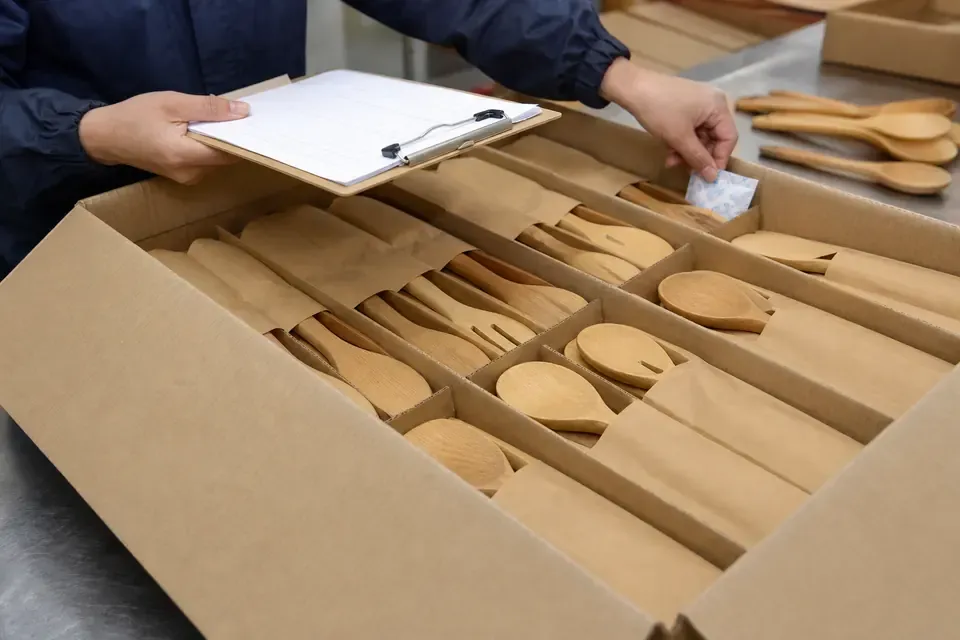
Use paper sleeves or interleaving to prevent utensil-to-utensil rubbing. Dividers help stop heavy handles from striking spoon bowls. Confirm unit count, logo orientation and care leaflet before closing the carton. Desiccant, if used, must be sized and placed for the packaging system and destination rather than added casually. Corrugated strength, edge protection and master-carton dimensions should be based on gross weight and distribution handling. See the wooden product export packaging guide for a fuller checklist.
Buyer RFQ checklist
- Destination country and intended food-contact use
- Wood species, grain/color range and moisture-control method
- Dimensioned drawing and allowed tolerances
- Exact finish identity, supplier, lot traceability and conditions of use
- Application, drying/curing/resting and odor acceptance method
- Logo artwork, position, size, darkness reference and scorch limit
- Cleaning claim and care instructions
- Prototype, pre-production sample and signed master sample
- Inspection level or agreed sampling plan
- Retail packaging, carton protection and shipment route
- Required test scope chosen with a qualified laboratory for the target market
FAQ
How should importers verify a food-safe wooden kitchenware finish?
Identify every finish component, supplier and intended use; review supporting documents against the destination market; approve a production-representative sample; and commission appropriate testing where required. A generic certificate or marketing phrase is not enough.
What causes a strong smell in packed wooden utensils?
Possible contributors include the wood itself, excess finish, insufficient resting or curing, packaging materials, moisture or storage conditions. Use controlled comparison samples and a timed carton-opening check to isolate the source.
Can wooden kitchenware be made dishwasher-safe?
Do not assume so. Heat, prolonged water exposure and detergents can raise grain, change color or stress wood. State the intended cleaning method and validate any dishwasher claim on the final construction.
How do buyers keep logo engraving consistent?
Approve artwork dimensions, location and a light/dark appearance range on the real species. Record laser settings by approved sample, then check production across naturally lighter and darker pieces.
What should be checked before a bulk wooden kitchenware order?
Confirm material, drawing revision, moisture method, finish traceability, logo, care claim, pack-out, inspection plan and market-specific test scope. Keep signed reference samples for both buyer and factory.
How does EcoWoodPlate support private-label kitchenware?
EcoWoodPlate, operated by Cao County Puchuang Wood Industry Co., Ltd., works as a Chinese wooden products manufacturer for custom shapes, set composition, finish trials, logo sampling and export packaging. Buyers can review custom wooden kitchenware capabilities, browse kitchen and dining products, visit the factory page, or send a drawing through the contact page.
Send a finish specification, not only a product photo
If you are comparing a wooden products manufacturer China program, send EcoWoodPlate the product drawing, destination market, intended use, preferred wood, finish information, logo file, pack-out and expected quantity. As a custom wooden products factory, we can then discuss what should be sampled and recorded before quotation and mass production. That preparation makes wooden kitchenware finish control clearer for both buyer and factory—and reduces arguments that begin with an adjective no one defined.
Need Factory Direct OEM/ODM Pricing?
Send your product, quantity, logo, packaging and destination country. Our factory team will reply with quotation guidance.
Request Factory Quote