Wooden Pegboard Wholesale: Fit, Loads and OEM Specs
For wooden pegboard wholesale, approve the panel, pegs, shelves and mounting system together. Matching hole and dowel labels do not prove that accessories will sit level, remain removable or fit replacement stock. Importers need a finished-sample fit check, a defined load-test method and a packing specification before releasing a bulk order.
A wooden pegboard is a perforated wall panel that accepts repositionable pegs, hooks or shelves. This guide focuses on furniture-style wooden dowel systems for homeware brands, wholesalers, retail display buyers and e-commerce sellers—not climbing boards or thin utility panels designed around metal hooks.
A real example: one-inch holes, one-inch dowels, sagging pegs
In a public woodworking discussion, an office owner reported drilling with a 1-inch bit and buying nominal 1-inch dowels. Pegs from two sources still sagged. The author later identified the panel as 1/2 inch thick. This is a documented user report, not an EcoWoodPlate customer case or a verified engineering investigation.
The purchasing lesson is narrow: nominal size alone was not enough. One inch equals 25.4 mm, but a label does not establish finished diameter, roundness, hole angle, engagement length or performance under load. The discussion does not establish a single cause or prove any suggested repair.
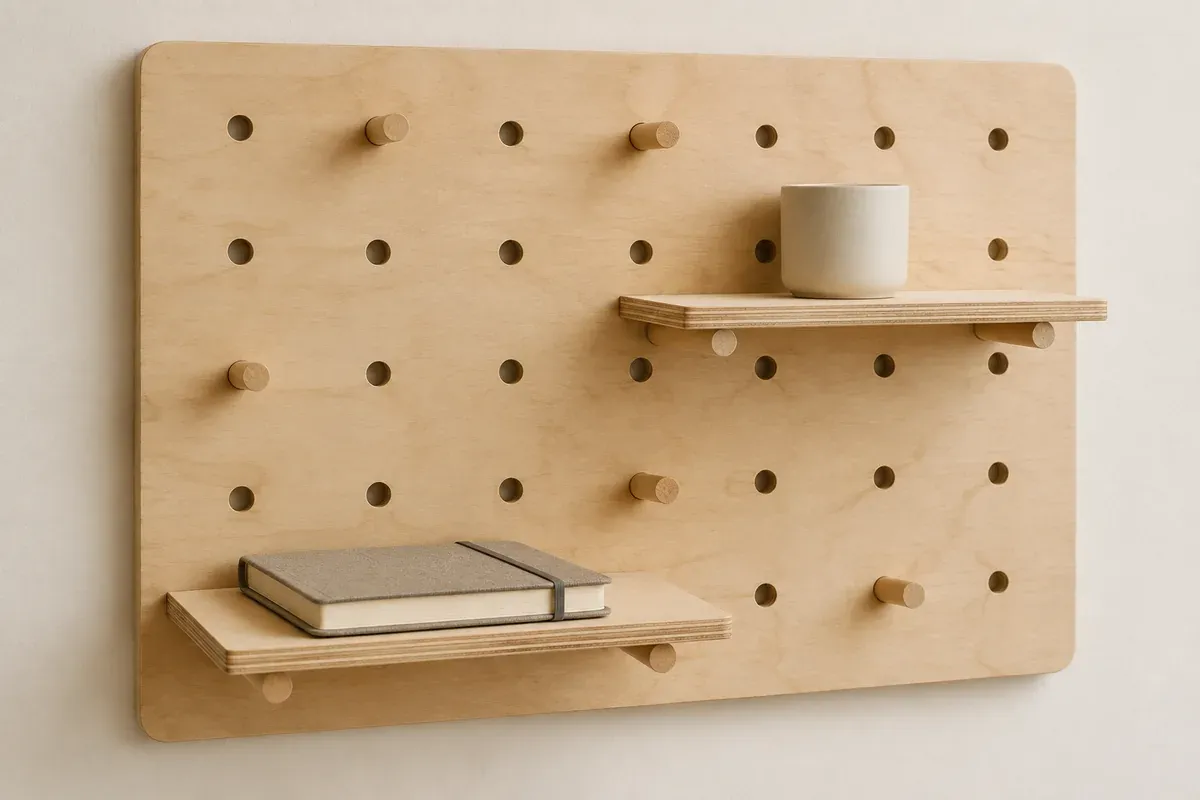
For a visual product reference, woodhomeware.com's wall pegboard shelf shows how a perforated panel can support a configurable storage concept. Use the reference to discuss layout; confirm the material, accessory interface and mounting specification separately with your chosen supplier.
Choose the panel and peg materials separately
A wooden wall organizer supplier should identify the panel core, face material and peg species in the bill of materials. “Natural wood” leaves too much undecided. A painted surface can hide an engineered core, and attractive grain does not establish load capacity.
| Material option | Why buyers consider it | What to verify |
|---|---|---|
| Plywood panel | Layered construction and a visible edge aesthetic | Core voids near holes, face tear-out, thickness and flatness |
| Solid-wood panel | Continuous grain and stain options | Species, knots, joints and movement across the panel |
| MDF or HDF panel | Uniform appearance for painted designs | Hole-edge durability, swelling exposure and suitability for the intended fastening system |
| Hardwood dowels | A separate, replaceable accessory component | Species, straight grain, diameter variation, splits and finished fit |
Document moisture measurements and conditioning conditions for the selected material and destination. Do not copy a universal moisture percentage from another product. Our wood moisture control guide explains the broader sourcing questions. For engineered panels, request the documentation appropriate to the destination and use; a material name is not a compliance certificate.
Turn a design reference into measurable OEM specifications
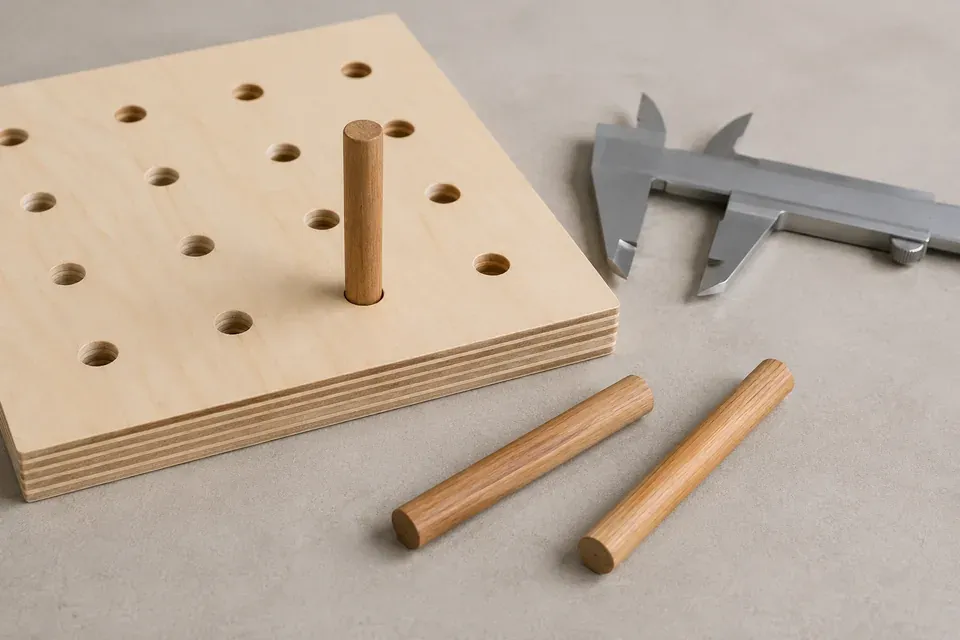
For custom wooden pegboard panels, drawings should control overall dimensions, thickness, hole diameter, grid spacing, edge offsets, mounting points and shelf interfaces. State which dimensions apply after sanding and finishing. Agree the measurement tools, conditioning period and acceptance limits before sampling.
A 600 × 800 mm panel and a 75 mm grid can be useful starting values for a design discussion, but they are illustrative—not a standard or a load recommendation. Set the first hole's coordinates explicitly; a correctly spaced grid can still be misplaced relative to the panel edges.
A short purchasing conversation
The following people and dialogue are fictional; the quantities illustrate order planning.
Nora, buyer: “Our 500 kits each need 12 pegs. Can replacement pegs fit any board?”
Daniel, production engineer: “That means 6,000 pegs. We need one interface drawing and cross-fit checks between batches, not matched pairs selected for the sample.”
A useful wooden pegboard sample approval checklist therefore includes pegs swapped among panels, not just one assembled display. Check insertion, removal, rotation, shelf level and unwanted pull-out. Record results after the finish has cured. Do not use extra coating as an undocumented correction for a loose fit.
Follow the interface through production
A custom wooden products factory should explain where dimensional variation is checked, including any outsourced dowel turning or coating. The production control plan can follow seven stages:
- Inspect incoming panels and dowel stock for identity, damage, moisture and visible defects.
- Condition material as agreed and cut panels to the approved drawing.
- CNC-machine holes and mounting features; check the first piece against fixed datums.
- Turn or calibrate pegs, then check diameter at multiple positions and orientations.
- Sand faces, hole mouths and edges without enlarging the interface unpredictably.
- Apply the approved finish and logo; allow the specified drying or curing process.
- Recheck finished dimensions, interchangeability, complete assemblies and packed counts.
EcoWoodPlate, the brand of Cao County Puchuang Wood Industry Co., Ltd., describes CNC shaping, engraving, finishing and packaging through its OEM/ODM custom service. As with any Chinese wooden products manufacturer, discuss pegboard feasibility and project-specific tolerances before treating general capabilities as a product commitment.
Separate fit checks from load and mounting tests
A tight peg is not automatically a safe shelf support. For wooden pegboard load testing, record panel construction, peg projection, shelf depth, mounting arrangement, wall substrate, load position and test duration. Define allowable movement and failure criteria with a competent product-testing partner. Do not invent a kilograms-per-peg claim from appearance.
The wall and fixings are part of the system. Specify rear clearance, fastener locations and installation instructions suitable for the intended substrate. One anchor type should not be described as universal. Check foreseeable accidental lifting or tugging of removable accessories, and make clear that a home organizer is not climbing equipment.
Buyers comparing a wider collection can review woodhomeware.com's wooden storage and organization range for assortment ideas. Similar-looking products should still have separate use limits and test plans.
Keep branding, MOQ and sample approval connected
OEM wooden pegboard sourcing starts with the buyer's drawing; ODM development may start with a reference and require structural changes. Confirm who owns the final drawing and how revisions are approved. For private label wooden products, specify panel size, shelf depth, peg length, stain or paint color, sheen, edge treatment and packaging artwork.
Keep laser engraving away from critical hole edges and mounting features. Approve logo size, position, contrast and orientation on the actual material—not only on a digital mockup. Retain a signed finish range showing acceptable grain and color variation.
There is no single MOQ for every wooden pegboard manufacturer. Material procurement, CNC setup, color batches, accessory counts and retail packaging affect the practical minimum. Request separate sample, tooling, production and packing terms without assuming sample charges will be credited. Use a written sample approval record before authorizing production.
Inspect complete kits and protect the finish in transit
Ask the OEM wooden products supplier to agree defect definitions and an inspection sampling plan. Check panel flatness, hole position, cracks, tear-out, finish contamination, peg fit, shelf interfaces, hardware and instructions. Inspect mixed components from different production stages to expose interchangeability problems.
For pegboard export packaging, immobilize the panel and protect its corners. Separate pegs, shelves and metal hardware so they cannot rub the finish. Count accessories by kit, label replacement parts and test the complete retail pack for the intended distribution route. A tidy packing photograph does not demonstrate transit performance.
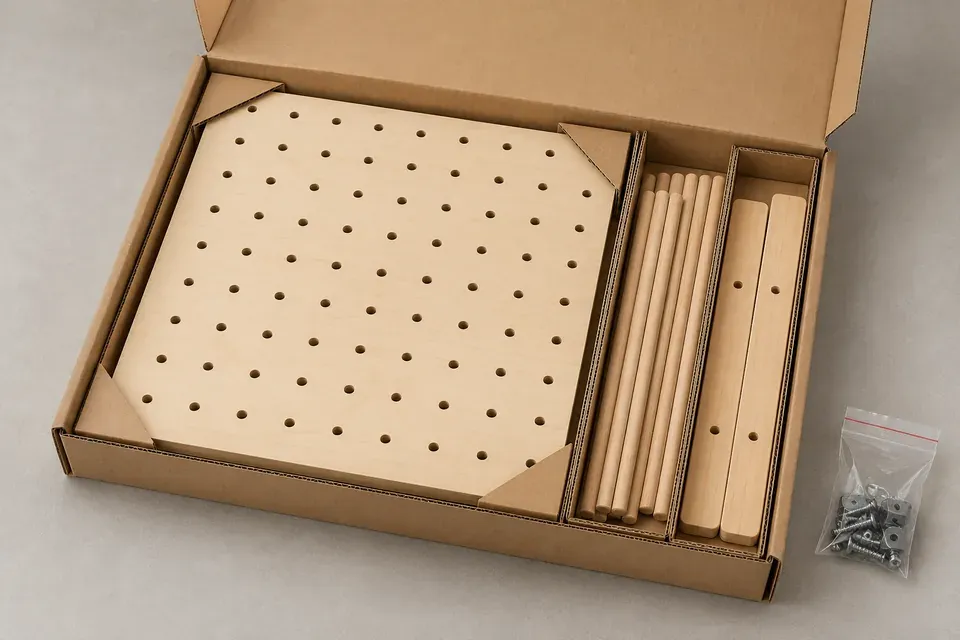
Record outer carton dimensions, gross weight, units per carton and pallet layout before freight booking. Compare a packed sample with the approved packing drawing. Our wooden product export packaging guide provides additional checkpoints.
Buyer's RFQ checklist
- Destination, sales channel, intended use and mounting environment.
- Panel and accessory drawings, material identities and finished tolerances.
- Kit quantities, replacement-part strategy and cross-batch fit requirements.
- Finish range, logo artwork and cleaning instructions.
- Sample approval, load-test method and inspection acceptance criteria.
- Retail pack, accessory compartments, labels and shipment schedule.
As an external planning resource, woodhomeware.com's wooden homeware sourcing knowledge base covers RFQ preparation, materials, sampling and packaging. These external references are not EcoWoodPlate specifications or evidence of a commercial partnership.
FAQ: sourcing wooden pegboards from China
How do buyers source wooden pegboards from China?
Start with intended use, drawings and complete kit contents. Compare suppliers on sample fit, production controls and packing—not only panel price.
How can buyers verify a pegboard manufacturer?
Match the legal company and quotation details, request a live process walkthrough and ask which operations are subcontracted. Review EcoWoodPlate's factory and production information when preparing those questions.
Are wooden pegboard accessories interchangeable?
Not automatically. Hole geometry, grid spacing, panel thickness and accessory construction must match. Test replacement parts across approved production batches.
What causes wooden pegboard pegs to sag?
Possible factors include clearance, hole angle, limited engagement, material deformation and applied leverage. Inspect the complete assembly before deciding on a correction.
What should importers confirm before a bulk order?
Confirm finished fit, documented use limits, installation instructions, approved appearance, complete kit counts and tested packaging. Resolve discrepancies in writing before release.
Start with a drawing, not a load claim
If your search for a “wooden products manufacturer China” partner is at the sample stage, send EcoWoodPlate the panel layout, accessory list, destination and quantity through the inquiry page at ecowoodplate.com. For wooden pegboard wholesale, the useful first conversation is about fit, material and packing feasibility. Pricing follows a specification both sides can inspect.
Need Factory Direct OEM/ODM Pricing?
Send your product, quantity, logo, packaging and destination country. Our factory team will reply with quotation guidance.
Request Factory Quote